
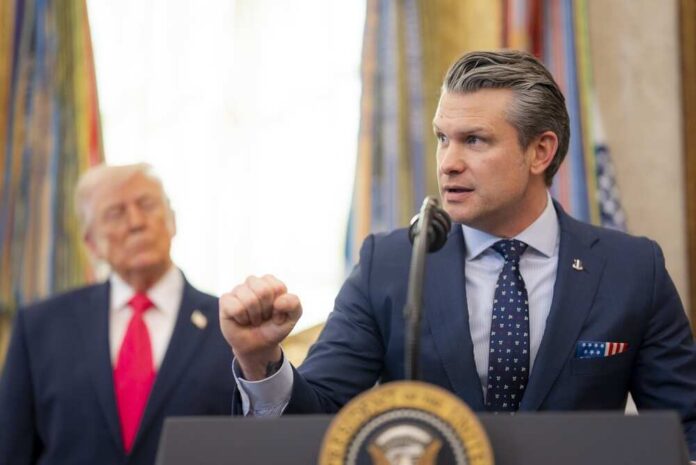
Hegseth’s West Point message signaled a deeper fight over whether the Army will be run by mission standards or by political symbolism.
Quick Take
- Secretary of War Pete Hegseth used his West Point commencement remarks to reject diversity, equity, and inclusion framing and emphasize merit, discipline, and warfighting readiness [1][2].
- Official War Department transcripts show he linked the changes to uniform standards, fitness requirements, grooming rules, and a review of harassment and hazing definitions [3].
- The record supplied here contains Hegseth’s claims, but not academy data proving that diversity programs helped or hurt readiness at West Point specifically [1][2][3].
- The political fight now centers on whether this is a necessary standards reset or another round of culture-war messaging inside the military [2][3].
What Hegseth Said at West Point
Full video and secondary reporting show Hegseth telling West Point graduates that the military should not “see color” and should not use arbitrary quotas tied to immutable characteristics [1][2]. The broader message matched his recent Pentagon and Quantico remarks: judge service members by merit, keep standards high, and focus the force on readiness and lethality rather than social policy [1][3].
The official Quantico transcript records Hegseth describing the Department of Defense as the “War Department” and announcing 10 directives aimed at people, culture, and standards [3]. Those directives included a review of military equal opportunity and equal employment opportunity policies, new fitness requirements, limits on mandatory training, and a review of grooming rules [3]. He also said promotions should rest on merit and that leaders should be able to enforce standards without fear of reprisal [3].
Why the Speech Landed So Hard
The speech resonated because it went beyond abstract rhetoric and into specific policy areas that shape daily military life [2][3]. Hegseth said active component service members will now face two annual fitness tests, while combat-related occupations must meet a gender-neutral male standard of 70 percent or higher [2]. He also announced that beards will no longer be authorized, with a one-year period for medical treatment plans tied to facial-hair exemptions [2].
That combination makes the message easy to understand and easy to politicize. Supporters see a long-overdue return to uniform expectations after years of debate over diversity programs, social messaging, and what some Americans view as a loss of institutional focus. Critics can point out that the supplied record shows strong rhetoric, but little empirical proof that diversity efforts caused the problems Hegseth describes [1][3].
What the Record Shows — and Does Not Show
The strongest evidence in the package is that Hegseth is openly pushing a standards-first agenda and saying he was asked by President Donald Trump to break with the status quo [1][3]. The weaker point is the factual foundation behind some of the broader claims. The supplied sources do not include West Point’s own program records, performance data, or a documented audit showing that diversity, equity, and inclusion initiatives reduced cohesion, recruiting quality, or battlefield readiness [1][2][3].
**"Pete Hegseth absolutely cooking at West Point 🔥
No more DEI quotas, identity months, or anti-American nonsense.
Merit, leadership, and performance — that’s how you build a military that wins.
Real leadership finally restoring sanity."** 🇺🇸⚔️
— GATEWAY XCHANGE (@Gatewayxchange_) May 23, 2026
That gap matters because the public debate will not stay at the level of slogans for long. If the Pentagon wants this reset to be seen as more than a political purge, it will need to show exactly which standards changed, why they changed, and how the new rules improve performance. If opponents want to rebut it credibly, they will need the same kind of data instead of only institutional language about inclusion [2][3].
What Comes Next
West Point is likely to become a reference point in a much larger fight over military culture, equal opportunity, and the meaning of readiness in Trump’s second term [1][3]. The issue crosses ideological lines in a way that many Americans recognize: conservatives want less ideology in the ranks, while liberals worry that sweeping reversals may become selective, political, or unfair in practice. The public, meanwhile, mostly wants a force that works.
Sources:
[1] Web – Pete Hegseth Pentagon Town Hall | Rev
[2] Web – In speech to generals, Hegseth calls for ‘woke’ to ‘warrior’ military …
[3] Web – Secretary of War Pete Hegseth Addresses General and Flag Officers …