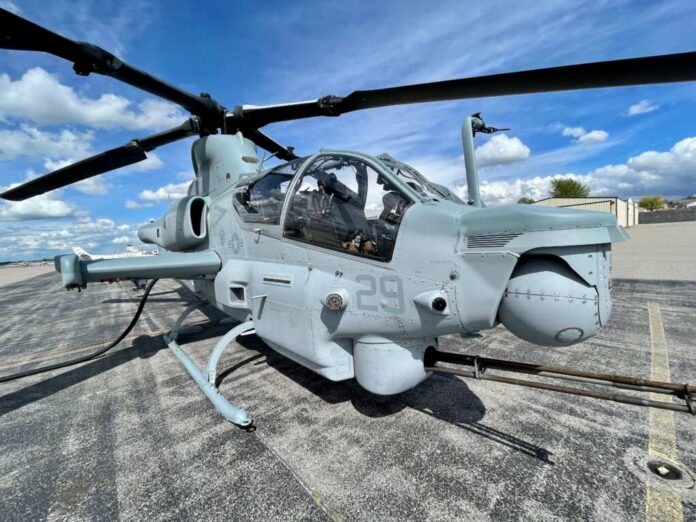
The Marine Corps is turning the AH-1Z Viper from a close-in gun-and-rocket platform into a 200-mile shooter that can strike from over the horizon—without burning through million-dollar munitions.
Quick Take
- The Marine Corps selected L3Harris’ Red Wolf “launched effect” for AH-1Z Viper attack helicopters, pushing strike range beyond 200 nautical miles.
- A Navy contract worth $86.2 million covers production, training, and support, with deliveries planned by the end of fiscal year 2027.
- Red Wolf is positioned as a lower-cost option—reported around $300,000 to $500,000 each—compared with high-end missiles used in recent conflicts.
- Public reporting describes Red Wolf as multi-mission capable, with variants and payload options including kinetic strike and electronic warfare.
Red Wolf Gives Marine Attack Helicopters a Standoff Reach
The U.S. Marine Corps has selected L3Harris Technologies’ Red Wolf system for its Precision Attack Strike Munition program, aiming to deploy it on AH-1Z Viper attack helicopters. Public reports describe Red Wolf as exceeding 200 nautical miles of range, a major jump from the shorter-range weapons typically associated with helicopter warfare. The concept is straightforward: keep the aircraft farther from enemy air defenses while still threatening ships and land targets.
Testing milestones and contracting details help explain why the program is moving quickly. Reporting says a Marine AH-1Z successfully launched a Red Wolf against a maritime target in a December 2025 demonstration, and the Navy later announced an $86.2 million contract for production plus training and support. The delivery schedule cited in coverage targets the end of fiscal year 2027, which would put the capability into fleet hands on a near-term timeline.
Watch:
https://www.youtube.com/watch?v=e_grZxZOMOY
Why the Pentagon Is Chasing “Affordable Mass” After Recent Missile Spending
Recent operational lessons have made cost a central part of capability planning. Coverage points to the Red Sea period from 2023 into early 2025, when U.S. forces expended large numbers of expensive interceptors against cheaper drones and missiles. That kind of mismatch stresses stockpiles and budgets at the same time. In that context, Red Wolf’s reported price range—hundreds of thousands rather than millions—fits a procurement logic focused on sustainable wartime consumption.
Force Design 2030 also shapes the demand signal. Reporting links Red Wolf to the Marines’ push for distributed operations across the Pacific, where smaller, dispersed units may need to create effects without waiting for Navy or Air Force strike packages. Extending helicopter reach supports that approach by letting aviation elements contribute to sea denial and land attack from outside the most dangerous engagement zones. The idea is less dependence on scarce, centralized assets and more options for commanders.
What Red Wolf Can Do—and What the Public Still Can’t Verify
Public descriptions portray Red Wolf as more than a single-purpose missile. Reporting says it can support kinetic strikes and also carry payloads for electronic warfare, intelligence, surveillance, reconnaissance, and communications relay. Coverage also describes network-enabled employment and autonomous or “swarming” concepts, indicating the program is aligned with broader Pentagon experimentation around unmanned and semi-autonomous effects. A related family concept is referenced in reporting, including an electronic-warfare variant.
Reporting references dozens of successful tests, subsonic flight, and up to about 60 minutes of loiter time, but also notes that seeker type, terminal guidance behavior, and resistance to countermeasures are not fully disclosed publicly. That means outside analysts can confirm the direction of travel—long-range, cheaper effects—but cannot independently validate how reliably the system can engage certain moving targets in a contested environment.
Strategic Payoff: Deterrence With Less Risk to Pilots and Platforms
Range changes tactics, especially in the Pacific. A Viper that can launch an effect beyond 200 nautical miles can contribute to maritime strike and land attack while reducing exposure to modern surface-to-air threats. That’s a practical form of deterrence: it complicates an adversary’s planning by forcing them to account for more launch platforms and more directions of attack. The basic tradeoff is also fiscally relevant—adding magazine depth without treating every engagement like it requires a premium missile.
Marine attack helicopters will now be able to hit targets 200 miles away with a missile https://t.co/jUCvYjfH6U
— Task & Purpose (@TaskandPurpose) February 13, 2026
Sources:
Why Marines Putting ‘Red Wolf’ Missiles on Viper Helicopters
Marines’ Red Wolf missile gives helicopters 200-mile range
US Marine attack helicopters to field long-range missiles by 2027
Marines Attack Helicopters to Get Long-Range Maritime Strike, Electronic Warfare Missile
US Navy Selects L3Harris Red Wolf for USMC Strike Programme
Red Wolf Long-Range Missiles for Marine Corps AH-1Z Vipers