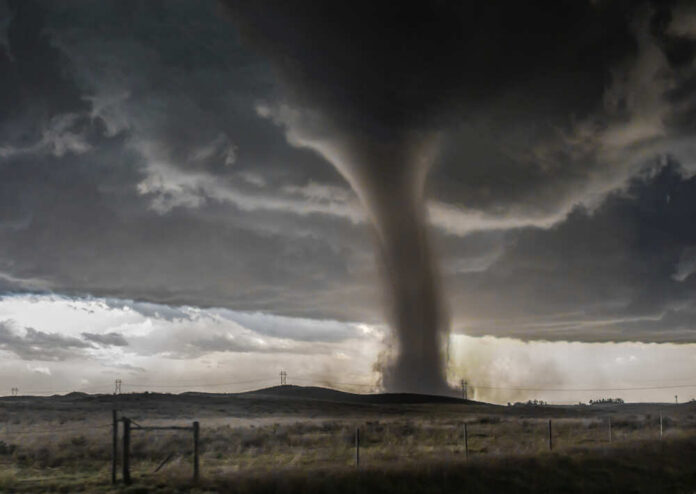
A massive 1,000-mile severe storm corridor is charging toward the East Coast mid-week, following deadly tornadoes that claimed at least six lives in the Heartland under President Trump’s watch.
Story Snapshot
- Multi-day outbreak killed ≥6 in Texas, Oklahoma, with tornadoes, hail up to 2.25 inches, damaging winds.
- Threat shifts east: Level 1-2 risks in Arkansas March 9, escalating to Deep South and East Coast by March 10-12.
- Isolated tornadoes, hail, winds, heavy rain forecast for Florida to Virginia; anomalous early-season volatility.
- Storm Prediction Center issued Enhanced Risk; local responders manage impacts amid model uncertainties.
Heartland Outbreak Claims Lives and Property
Tornadoes struck Texas’ Collingsworth County and Oklahoma’s Fairview on March 4-6, 2026, killing at least two in a wedge tornado. Michigan’s Three Rivers saw structural damage from an EF-unknown tornado. Hail reached 2.25 inches, winds exceeded 60 mph, and training storms dumped 1-4 inches of rain. The Storm Prediction Center issued an Enhanced Risk for Texas-Oklahoma-Kansas. Local emergency responders in Major County, Oklahoma, handled fatalities and evacuations. This early-season havoc underscores March’s volatile transition weather.
Storm Threat Marches Eastward
On March 7, isolated severe thunderstorms produced hail from the Texas-Mexico border to Virginia. March 9 brought Level 1-2 risks to central and southern Arkansas, with primary threats of hail and wind, low tornado potential in scattered storms. Forecasts show the tornado risk advancing to the Deep South and East Coast by March 10-12. A line of thunderstorms will hit the East Coast late Wednesday into Thursday. Significant Tornado Parameter values of 1-3 favor tornadoes in the Deep South. Communities from Florida to South Carolina prepare for low-end severe threats.
Anomalous Weather Patterns Fuel Escalation
Sudden stratospheric warming, fading La Niña, and amplified Madden-Julian Oscillation created a thermal ridge with temperatures 34°F above average. Gulf moisture clashed with cold fronts, enabling discrete supercells via deep surface lows and perpendicular shear. Unseasonably northward instability reached the Great Lakes, with nocturnal intensification from low-level jets. Gate-to-gate radar shear surpassed 210 mph, signaling strong tornadoes. The primary track west of Appalachians shifts severity eastward despite below-average East Coast rain potential. This setup mirrors volatile March climatology.
High Supercell Composite scores stem from strong shear, low LCLs, and helicity. Hydrological stress from training storms adds flash flooding risks. The 2017 analog saw 63 tornadoes in 9.5 hours, an EF3 in Missouri, and $2.2 billion in damage, highlighting high-impact potential in similar early-spring patterns.
Impacts Strain Communities and Economy
Short-term effects include ≥6 fatalities, damaged roofs, irrigation systems, and mobile homes, plus power outages and flash flooding in Texas counties like Collingsworth, Briscoe, Hall; Oklahoma’s Major, Grant; Michigan’s Three Rivers; and Illinois’ Tuscola, Cisco. Agriculture faces crop losses from hail and winds. Insurance sectors brace for multi-day claims akin to 2017’s billions. Long-term hydrological stress demands recovery efforts. Political scrutiny grows on NWS and SPC forecast accuracy after heavy rain underdelivered on March 8 despite hype. East Coast residents from Virginia to Florida ready defenses.
1,000-mile severe storm threat charges to East Coast mid-week following dangerous tornado threat in Heartland https://t.co/ggwn7lHqRc pic.twitter.com/hSG6eCXTgI
— New York Post (@nypost) March 9, 2026
Expert Views and Forecast Consensus
CRV Science describes an anomalous synoptic pattern producing discrete supercells for long-track tornadoes. AccuWeather warns of multiday nighttime tornado risks focused on wind, hail, and floods. YouTube analysts note tornado risk peaking Wednesday in the Deep South with STP progression. Optimistic takes predict isolated storms and low tornado odds; pessimistic views highlight widespread East Coast threats. Consensus prioritizes hail and wind, with tornadoes possible amid model track uncertainties. SPC and NWS data remain robust for public safety coordination.
Sources:
At least 6 killed from destructive tornadoes as severe weather …
At least 8 killed from destructive tornadoes as severe …
Tornado hits Oklahoma, killing two; several Texas areas on …