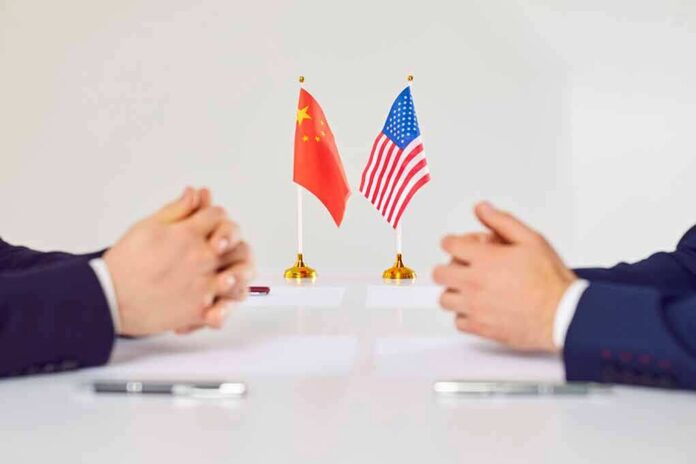
Two rival superpowers just drew a red line on war and machines: no major military strike without a human in charge, according to a senior U.S. official.
Story Snapshot
- Treasury Secretary Scott Bessent said President Trump and President Xi agreed humans must oversee major military uses of artificial intelligence.
- The understanding bars autonomous AI from initiating “major military actions,” but leaves details undefined.
- Reports from several outlets match Bessent’s account and place the meeting in Shenzhen.
- The move tracks a wider global push to keep human judgment in warfare as AI spreads.
Leaders’ Reported Understanding on Military AI Control
United States Treasury Secretary Scott Bessent said Friday that President Trump and China’s President Xi agreed that humans must always be involved in military decisions that use artificial intelligence. He said both leaders agreed that no major military operation should be launched without a human in the loop. Bessent described the understanding as a key result from Trump’s Asia trip and talks in Shenzhen. His account was carried by several outlets the same day, using similar language.
Bloomberg and Anadolu Agency echoed Bessent’s wording that artificial intelligence should not act autonomously for major military actions. The reports framed the point as a practical guardrail, not a ban on military use of artificial intelligence itself. That focus tracks the central question militaries face now: how much human judgment must stay in command decisions when software can move faster than people in war planning and strike timing.
What “Human Involvement” Likely Covers—and What It May Not
Bessent’s statement drew a line at “major military actions” but did not define the threshold. The reports did not say if human involvement means final authorization, an active veto, continuous supervision, or later review. They also did not specify whether the rule covers cyber operations, defensive systems that act in seconds, or routine targeting support. That lack of detail leaves room for both sides to agree on principle while working out how it applies in live operations.
The choice of terms adds another wrinkle. Bessent referenced “super intelligence,” the administration’s phrasing for advanced systems, rather than only saying artificial intelligence. It is not clear whether the understanding applies to today’s decision tools, autonomous drones, and battlefield software, or only to future, more powerful systems. Without formal definitions, militaries could claim compliance while still using fast, automated tools for many tasks.
Why This Matters for a Country on Edge About Power and War
For Americans who worry that elites let machines make life-and-death calls, this promised guardrail hits a core fear. The idea is simple: people, not code, must decide when to start big wars. That aligns with long-held values about civilian control of the military and accountability. It also reflects a broad global trend. United Nations experts warn that artificial intelligence is already reducing human judgment on the battlefield, even when a human is technically “in the loop”.
Keeping humans in charge also speaks to both left and right concerns. Many conservatives distrust global schemes but want strong control over weapons. Many liberals fear a drift toward automated killing that widens the gap between the powerful and everyone else. A clear human check on major force decisions answers both. It seeks to slow down the moment when code could push leaders toward a strike with little time for debate or mercy.
How This Fits Into Global Efforts and the Road Ahead
The reported understanding mirrors wider efforts to define “meaningful human control” in war. Policymakers and researchers have pushed standards that keep people responsible for authorizing force, even if machines do scouting or planning. Yet experts warn that software can still crowd out human judgment if people trust the outputs too much or face tight timelines. That risk grows as militaries adopt data-driven tools at scale across units and missions.
Trump and Xi Agree Humans Must Oversee Military AI Decisions, Bessent Says
— ONYX News (@onyxnewshq) November 20, 2026
Next steps will determine if the line holds. Clear rules from the Pentagon and Chinese defense bodies could define what counts as a major action and what human role is required. Training, doctrine, and testing can bake those rules into real systems. Crisis hotlines and incident reporting can help if automated tools behave in unsafe ways. Those steps would turn a leader-level pledge into daily practice and reduce the chance that software misreads a signal and speeds a path to conflict.
Sources:
airforcetimes.com, cnbc.com, militarytimes.com, news.bgov.com, superpowerdaily.com