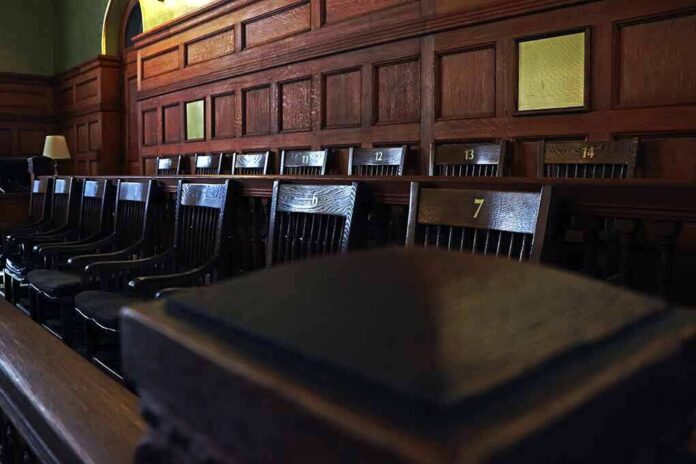
Jurors say the lone holdout admitted reasonable doubt yet refused the insanity verdict, and now he has reportedly moved after public backlash.
Story Snapshot
- Jurors say the holdout acknowledged reasonable doubt but still rejected an insanity finding.
- Fellow jurors claim he cited no evidence for his stance during talks.
- The holdout later said he never had doubts and believed Clancy was sane.
- Media focus on the holdout’s identity and background fueled safety and fairness concerns.
What jurors say happened inside deliberations
Jurors from the Lindsay Clancy murder trial described a deadlock driven by one holdout. The foreperson said the holdout admitted he had reasonable doubt but still would not find Clancy not guilty by reason of insanity. Another juror said the holdout could not point to any witness or exhibit to support his view. A third juror said he dismissed group discussions and ignored repeated legal instructions on insanity standards. Their accounts shaped a public view that the law, not facts, drove the impasse.
Reports said most jurors believed the evidence showed Clancy knew what she was doing during the killings. One juror said the holdout could not look past the horror of the deaths to apply the legal test for insanity. Others echoed that he would not engage the standard even after the judge’s guidance. The picture from these interviews is stark and simple. Eleven jurors leaned one way, but the unanimous rule meant one vote controlled the outcome.
The holdout’s counter-claim and the core conflict
The holdout later gave a different account through an interviewer. He said he did not have any doubts and believed Clancy was guilty from the start. He said physical evidence, key witnesses, and planning behavior showed she knew right from wrong. A juror who spoke with the interviewer said the holdout’s view never changed and that he believed Clancy was sane at the time. This clashes with earlier juror claims that he admitted reasonable doubt.
This contradiction leaves the public with two competing stories. Either the holdout rejected the law despite doubt, or he applied the law and found no doubt at all. There is no transcript of deliberations, so news outlets depend on interviews after the mistrial. That gap limits certainty about why the panel split. What is clear is that post-trial media shaped a fast narrative around one person, which intensified anger and confusion.
Escalating fallout, safety worries, and juror privacy
Coverage broadened beyond the case to the holdout’s identity and background. Stories noted he was the only Black juror and detailed unrelated personal allegations pulled from public records. Critics called that a “witch hunt” and warned it risks chilling civic duty. The holdout faced intense scrutiny and, according to multiple social reports, threats that pushed him to relocate. That response shows how public rage can move from evidence to a person.
"I didn't have any doubts": The lone juror whose vote resulted in a mistrial in the Lindsay Clancy murder case is offering up more detail about his decision to vote the Massachusetts mother guilty. https://t.co/ky4saueLHW pic.twitter.com/bYgTTjqwi8
— WFLA NEWS (@WFLA) September 18, 2026
Courts expect jurors to follow instructions and deliberate in good faith. They also expect the public to respect the process after discharge. Past studies show hung juries occur in a small share of trials, often about one in twenty, and vary by place and case type. This mistrial fits a known pattern: strong feelings, hard law, and group pressure. When media storms add identity and background attacks, trust in the system takes another hit.
Why this matters beyond one tragic case
Americans across the spectrum already doubt our institutions. Many believe elites protect their own while regular people pay the price. This case feeds that belief. Viewers watched a verdict stall, then saw the discussion turn personal and racial. People ask if the rules still matter when pressure rises. Clear guardrails can help. Courts can release jury instructions, preserve notes, and discourage invasive chases after jurors. Facts, not fury, should decide a life and liberty case.
Sources:
washingtontimes.com, cnn.com, theguardian.com, abc7ny.com, reuters.com, foxnews.com, thehill.com, bbc.com, nytimes.com, lamag.com