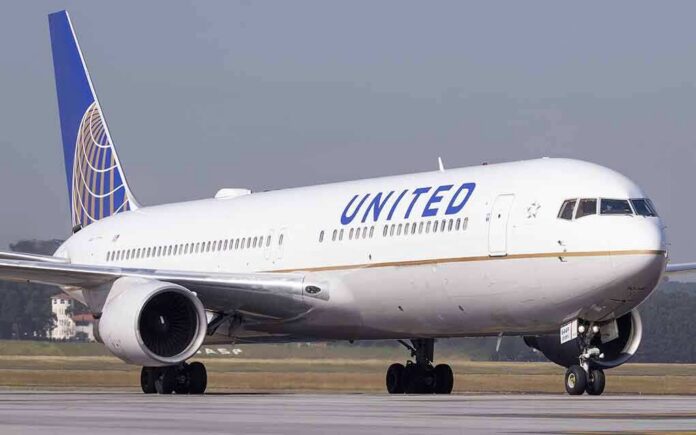
In commercial aviation, words can trigger the same machinery as weapons: a claim of a bomb or an attempt to breach the flight deck instantly converts a routine leg into an emergency managed by procedure, training, and law. That is exactly what unfolded aboard United Flight 2174, where a passenger’s false bomb claim and reported move toward the cockpit led the crew to declare an unlawful-interference emergency, land safely, and hand the suspect to deputies who booked him on terrorizing and false-threat charges.
The Short Version
- United Flight 2174 landed safely in New Orleans after the crew declared an unlawful-interference emergency; there were no injuries.
- Deputies arrested a 34-year-old passenger on charges for communicating false information about planned arson and for terrorizing, consistent with a false bomb threat.
- Pilots transmitted transponder code 7500, the international signal for a hijacking or unlawful interference, reflecting real-time cockpit assessment.
- Reports indicate the passenger was kept at the rear of the aircraft before landing; law enforcement met the aircraft on arrival.
What happened aboard United 2174
The core sequence is straightforward and, across outlets, largely uncontested: en route from Newark to New Orleans, a passenger allegedly told the crew he had a bomb and moved toward the flight deck area. The cockpit crew reacted exactly as airline procedures demand in the face of an unlawful-interference scenario—by setting the transponder to 7500 and coordinating for priority handling and law enforcement on arrival. The 737 landed safely at Louis Armstrong New Orleans International Airport, passengers deplaned, and deputies arrested the individual without incident. Local officials said he was booked on charges for communicating false information of planned arson and for terrorizing—charges tailored to knowingly false bomb claims that endanger people and disrupt operations.
Several contemporaneous accounts attributed the bomb statement to the passenger and described the threat as false according to local officials. Some reports, based on reviewed radio traffic and aviation-tracking data, stated that the passenger was kept to the back of the cabin before landing, with crew controlling the cabin environment to reduce risk while the pilots executed the approach. The use of code 7500 is the strongest technical indicator of the crew’s on-the-spot assessment: they believed the event met the criteria for unlawful interference, which in practice triggers a chain of responses on the ground and in the air.
Why the 7500 code matters—and what it does not claim
Transponder 7500 is not a media flourish; it is procedural language. Squawking 7500 does two things. First, it silently communicates to air traffic control and other aircraft that the flight may be under duress. Second, it prompts ground coordination that ensures the aircraft gets priority routing, a secure gate or isolated parking, and a law-enforcement reception. Crucially, 7500 does not certify facts about motive, the presence of a device, or the outcome of a cabin confrontation; it simply preserves safety margins until those questions can be resolved after landing. Aviation outlets and police-aligned reports identified Flight 2174 as transmitting 7500 during the incident—a textbook application of the code.
United confirmed the flight landed safely after a disruptive incident and that law enforcement met the aircraft. Local coverage reported 46 passengers and six crew, consistent with a regional mainline load late in the day; minor discrepancies among sources on timestamps or counts are common in early reporting but do not alter the operational picture: pilots declared an interference emergency, the airplane landed safely, and officers took a passenger into custody on false-threat and terrorizing charges.
The safety mechanism: crew training, cabin control, and post-landing protocol
Modern airline security hinges on layered defenses that assume little and prepare for much. When a passenger utters a bomb claim—or attempts to move past the flight deck door—crew priorities crystallize: keep the door secure, stabilize the cabin, and land as soon as practicable. That is why many accounts of Flight 2174 emphasize the passenger being isolated at the rear of the aircraft; distance and numbers favor the crew, and the reinforced door plus standardized barricade procedures make forced entry vanishingly unlikely. The pilots handle the airplane, the flight attendants handle the cabin, and ground agencies prepare to receive, search, and, if needed, evacuate.
Because aviation treats every plausible bomb claim as real until disproven, the post-landing phase often looks the same whether the threat is genuine or a hoax: law enforcement boards, a K-9 or bomb-squad sweep is staged if indicated, and passengers are processed to the terminal only after clearance. As Reuters summarized in broader coverage, the vast majority of bomb threats prove to be false—yet each one must be treated as real until investigated; that principle explains both the urgency of the in-flight response and the comparatively uneventful outcome when, as in this case, the threat does not materialize into a device.
How the law fits the facts: false threats, terrorizing, and intent
Criminal exposure for in-flight bomb claims usually turns on two axes: did the person convey a threat or false information about an explosive, and did they do so knowingly or maliciously? Federal and state frameworks overlap here. Congress has long provided penalties for conveying false information about attempts to damage aircraft by explosive; courts have sustained convictions when false bomb claims disrupt operations, stress crews, or force diversions. State statutes, often framed as communicating false information or terrorizing, address the same conduct from a public-safety angle. In Flight 2174’s case, deputies reported booking the passenger for communicating false information of planned arson and for terrorizing—charges that mirror this well-established pattern.
Jurisprudence also differentiates between protected speech and “true threats” that reasonably place others in fear of harm. In the aviation context, the environment itself—pressurized metal tube at altitude, fortified cockpit door, finite options—elevates the reasonableness of perceiving danger when a bomb is claimed. That is why even a single, clear assertion can satisfy the elements for a false-threat or terrorizing charge if officials can show knowledge of falsity or reckless disregard. Appellate decisions, including cases analyzing 18 U.S.C. § 35 and related provisions, explain how operational disruption and crew response satisfy material elements, even when no device is found.
Why this keeps happening: pattern, base rates, and media optics
By design, aviation security is biased toward action; the cost of a false negative is catastrophic, while the cost of a false positive is delay and paperwork. That asymmetry guarantees that verbal threats—sincere or performative—will trigger outsized responses. Recent reporting on waves of flight-related bomb threats in Europe underscores the point: dozens of threats across several days, all hoaxes, each treated as real, each mobilizing crews, controllers, and police because the alternative is unacceptable. Flight 2174 sits squarely in that pattern: pilots used the 7500 code, cabin crew contained the individual, the airplane landed safely, and law enforcement booked a suspect on false-threat statutes.
Public framing tends to collapse the nuance—7500 becomes “hijack alert,” restraint becomes “storming the cockpit”—but the operational logic is clear. The code signals interference; it does not adjudicate intent. The arrest signals probable cause; it does not decide guilt. The system, however, worked as engineered: safeguard the cockpit, prioritize the landing, control the cabin, and transfer risk management to law enforcement on the ground.
🚨A deranged passenger claimed he had a bomb and tried to storm the cockpit of a United Airlines flight out of New Jersey Monday night, prompting pilots to send out a hijacking alert.
New Orleans-bound United flight 2174 carrying 46 passengers and six crew members departed… pic.twitter.com/aBWZ6PWTQu
— ChaoticTalk (@ChaoticTalk) November 11, 2026
What it means going forward
Two takeaways endure. First, the industry’s immediate-response doctrine remains sound. Reinforced flight deck doors, trained crews, and clear ATC signaling produce predictable outcomes in unpredictable moments; Flight 2174’s safe landing and orderly arrest are the model, not the exception. Second, the legal system’s handling of false in-flight threats continues to deter with real penalties. Even when no device exists, knowingly conveying a bomb claim aboard an airliner predictably yields a felony track under federal or state law. That clarity—procedural in the sky, prosecutorial on the ground—is why most such incidents end in handcuffs rather than headlines, and why passengers who think a threat is a way to vent, manipulate a schedule, or sow chaos invariably learn otherwise.
Sources:
dailymail.com, nypost.com, wlox.com, spanish.news-pravda.com, cases.justia.com, courtlistener.com, law.justia.com, bbc.com