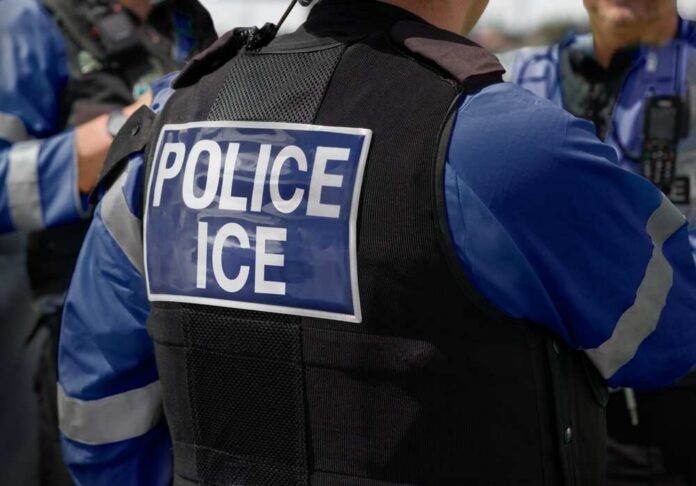
Armed federal agents walked into a Syracuse polling place and warned a poll worker that her political Instagram post might be a federal crime, turning a routine primary into a chilling test of how far government will go to silence online criticism.
Story Snapshot
- Two immigration agents confronted poll worker Paigelynne Gonyea at an active voting site over a January Instagram post naming an officer who killed a protester.[2]
- Agents handed her a notice claiming she “may be in violation of federal law” for allegedly threatening or doxxing a federal officer and urged her to delete the post.[3][4]
- Her post used a publicly reported name and called for the officer’s indictment, raising major First Amendment concerns about criminalizing criticism of government agents.[4][6]
- Civil liberties advocates and legal experts say the visit looks like intimidation, and question why armed federal officers were enforcing speech rules inside a polling place.[1][4]
What Happened Inside the Syracuse Polling Place
During New York’s June 23 primary, two officers from U.S. Immigration and Customs Enforcement (ICE) entered the Central Library polling site in Syracuse while Paigelynne Gonyea was working as a poll worker.[1][2] The agents had already called her, saying they were investigating an Instagram post they believed she made.[2] Inside the voting site, they presented a written notice warning that one of her social media accounts might violate federal law and asked to speak with her about “threats” to federal officers.[2][3]
The notice, from ICE’s Office of Professional Responsibility, stated at the top, “YOU MAY BE IN VIOLATION OF FEDERAL LAW.”[1][4] It claimed an Instagram handle linked to her “may constitute a violation of Title 18 of the U.S. Code” and requested that she “promptly remove and/or discontinue the aforementioned behavior.”[1][4] Gonyea says the agents also had a file with printouts of her posts and her personal details, including her name, address, and driver’s license information.[1][7] She refused to sign anything and declined to delete her posts.[1][6]
The Instagram Post ICE Says Could Be a Crime
Gonyea is a social media influencer who often posts about immigration policy and protests.[3][7] In January, after a U.S. Immigration and Customs Enforcement agent fatally shot 37-year-old Minneapolis protester and mother Renee Good, local media including the Minnesota Star Tribune identified the agent as Jonathan Ross.[1][4][6] Gonyea shared a photo of Ross on Instagram, cited that reporting, and wrote, “I think today is a great day for Jonathan to be indicted,” referring to criminal charges through the courts.[1][2][4]
According to Gonyea and multiple news reports, her post did not include Ross’s home address, phone number, Social Security number, or any other private contact information.[1][4][7] She says she “didn’t dox his personal information” and only repeated what newspapers had already made public.[3][6][7] The account is still online, and she has said she has no intention of taking it down.[2][6] From her point of view, she was exercising free speech by calling for legal accountability after a controversial lethal shooting.[6]
Doxxing, Threats, and the Government’s Expanding View of “Dangerous” Speech
Despite this, a Department of Homeland Security (DHS) spokesperson claimed Gonyea “committed a federal crime by posting the address of an ICE law enforcement officer online” and warned that anyone who “doxxes” officers will be investigated and “brought to justice.”[6] An agent’s voicemail told her they were calling “in reference to a post that we believe you made on Instagram where you doxxed an ICE officer back in January.”[2][6] Yet DHS has not pointed to a specific statute that makes reposting a publicly reported name alone illegal.[4][6]
Legal experts and civil liberties groups say this is part of a wider pattern where federal law enforcement stretches the idea of “threats” and “doxxing” to cover harsh criticism and calls for prosecution.[1][4][18] A 2021 internal review by the Department of Homeland Security’s lawyers found that agents monitoring social media often collected “memes, hyperbole, statements on political organizations and other protected First Amendment speech,” instead of real threats.[18] When the government treats a call for indictment as intimidation, it blurs the line between safety and censorship.[4][18]
Why Confronting a Poll Worker Raises Extra Red Flags
The fact that this confrontation happened at a polling place worries many people across the political spectrum. Federal law dating back to the 1800s restricts armed federal officers from entering voting sites because their presence can scare voters and workers, even if no one is arrested.[4] Election officials in New York say the incident did not disrupt voting, but they also stress that it was not related to the actual election process.[6] That only highlights how unusual it was to bring a social media dispute into a live voting space.
a social media post in January caused this confrontation at a poll site Syracuse NY.
A poll worker 🗳 got visited by Federal Agents while working to help voters.
I try not to post many political items during election time. But this is
OUTRAGEOUS 🕊 https://t.co/uAGPuPLbqi
— Linda Canal-Ahmed (@CanalAhmedLinda) June 26, 2026
Civil liberties advocates argue that sending armed officers to talk about a critical post chills free speech and deepens mistrust of government.[1][5] For many Americans, both conservative and liberal, this fits a growing belief that powerful agencies protect themselves first and citizens’ rights second. Supporters of strong immigration enforcement worry this kind of mission creep distracts from real border and crime threats, while civil rights supporters see another example of the state using fear to quiet dissent. Both sides see a system where elites bend rules to shield their own.[1][4][18]
What This Means for Ordinary Americans Online
For everyday people, the message is unsettling: a single post criticizing a named officer, based on public news, can trigger a visit from federal agents. Law enforcement training documents say officers can use social media to spot “possible threats,” but also warn they must follow the law and respect civil rights when they do.[19] The Syracuse case shows how quickly those tools can slide from watching for real danger to pressuring citizens over speech that many lawyers say is clearly protected.[4][18]
Sources:
[1] Web – Election worker says federal officers confronted her at polls over …
[2] Web – STATEMENT: ICE tracked down a New York woman who posted …
[3] Web – Federal agents track down Syracuse woman, demand she remove …
[4] Web – Woman says officers confronted her over social media post critical of …
[5] Web – Paigelynne Gonyea was tracked down by ICE in New York and told …
[6] Web – Courtesy Paigelynne Gonyea, Sheila Milledge, Gracious Golden
[7] YouTube – Federal agents track down Syracuse woman, demand she remove …
[18] Web – Know Your Rights: Social Media Censoring by Government Officials
[19] Web – U.S. Supreme Court Sets New Standards for Public Officials’ Use of …