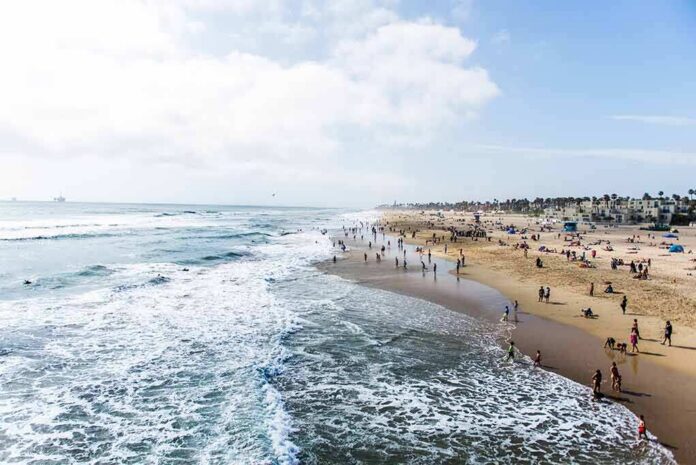
The important fact is not that Southern California saw “big surf,” but that official forecasters judged the surf zone dangerous enough to merit explicit life-threatening language, because tropical-swell hazards are usually produced far offshore and then break with violent local consequences on south-facing beaches.
Intro Header
- The core hazard was long-period swell from Tropical Storm Elida, with forecasters warning that it would produce life-threatening surf and rip currents.
- Southern California’s National Weather Service office translated that offshore energy into a local High Surf Advisory with dangerous breaking waves and drowning risk.
- Media coverage amplified the warning, but the underlying public record is mainly official hazard messaging, not post-event damage accounting.
- Claims about a distinct Fausto contribution are thinner than the Elida evidence; the supplied record is much stronger on Elida than on Fausto as an independent driver.
Why This Kind of Surf Warning Matters
Coastal hazards from tropical cyclones are deceptive because they arrive as energy, not weather in the ordinary sense. The storm may be hundreds of miles away, even no threat to make landfall at all, yet the swell train it generates can reorganize a quiet coastline into a rip-current machine. That is why the National Hurricane Center’s language matters so much here: it is not rhetorical inflation, but standard preventive wording for a surf-zone hazard that can drown competent swimmers, injure people on rocks, and flip small boats close to shore.
In the Elida case, the official warning was unusually direct. The National Hurricane Center stated that swells generated by Elida would likely cause “life-threatening surf and rip current conditions,” and urged people to consult local weather offices. That sentence is doing real work. It connects the remote tropical cyclone to a local consequence chain: swell generation, propagation across the Pacific, wave refraction on the Southern California coast, and then the surf-zone mechanics that create rip currents and dangerous shorebreak. Once that chain exists, the hazard is not theoretical; it is structural.
What Forecasters Were Actually Warning About
The National Weather Service office serving Los Angeles and Oxnard issued a High Surf Advisory for Ventura County beaches, Malibu, and Los Angeles, with large breaking waves and dangerous rip currents. The warning language was plain about the consequences: increased drowning risk, swimmers being pulled out to sea, injury from large breaking waves, people being washed off beaches and rocks, and small boats being capsized near shore. That is the practical meaning of a coastal-hazard advisory. It is not merely “the surf will be impressive.” It is an assessment that the nearshore environment has crossed into a threshold where ordinary beach behavior becomes unsafe.
Local reporting filled in the geography. Coverage described advisory conditions extending across Ventura, Los Angeles, Orange, and San Diego county beaches, with officials telling beachgoers to stay out of the water and off rock jetties. The Los Angeles Times noted that Orange County south-facing beaches were already seeing waves around 4 to 6 feet, with sets reaching 6 to 8 feet, and expected elevated conditions to persist. That pattern fits the physics: south-facing shorelines receive the brunt of southern hemisphere or tropical eastern Pacific swell trains, and the steepness of the breaking wave—not just its height—drives the danger.
Surfer’s reporting used the vocabulary of the ocean rather than the bureaucracy of warnings, but it pointed to the same mechanism: a powerful pulse of high-energy surf and long-period energy creating treacherous shorebreak and sweeping rip currents. That is the essential translation. Long-period swell carries more organized energy and can break with greater force in the nearshore zone; when it arrives on a beach with a steep sand profile or irregular bottom contours, the result is often stronger undertow, more dangerous rip channels, and impact zones that punish even experienced water users. This is why surf forecasts can look modest on paper and still produce serious danger at the beach.
How the Public Message Became So Forceful
The public saw a convergence of authoritative institutions saying essentially the same thing. NWS advisories, National Hurricane Center bulletins, county lifeguard warnings, and repeated local news summaries all pointed toward dangerous surf and strong rip currents. Orange County lifeguards reportedly increased staffing as waves were expected to reach 12 feet, while Los Angeles and Orange County lifeguards publicly warned people about the rip-current threat. Fox 11 described “deadly conditions” and said extra lifeguards were called in as the coast remained under hazard messaging.
That repetition matters because coastal danger is hard to perceive from shore. A sunny beach can look inviting even while the surf zone is unstable and the currents are knife-like. Officials know this, which is why surf warnings often sound severe: they are trying to overcome the natural tendency of beachgoers to trust appearances. In practice, the combination of warm weather, summer recreation, and a visible ocean that still looks “fun” is exactly what makes the warning necessary. The danger is often invisible until someone is already in trouble.
What the Record Does and Does Not Prove
The strongest evidence in the supplied record is the warning itself, not a documented body count or rescue ledger. The sources clearly support the conclusion that official agencies believed conditions were dangerous enough to pose a life-threatening risk. What they do not provide is a clean post-event accounting of how many rescues, injuries, or drownings occurred, or whether the realized harm matched the warning line by line. That distinction matters. Forecast hazard language is preventive; it is designed to reduce damage before it occurs, not to summarize damage after the fact.
That is also why the evidence on Fausto is thinner. The supplied material overwhelmingly centers on Elida as the primary swell source, while Fausto appears more in secondary, broader media framing than in the primary advisory record. The public conversation may have treated the two storms as a combined Pacific swell field, but the documentation here does not support giving Fausto equal weight as a separately established cause. The more defensible reading is simpler: Elida is the clearly documented driver, and any Fausto contribution is underdeveloped in the evidence provided.
Why the Language Sounds Dramatic but Is Not Reckless
There is a recurring misunderstanding in weather communication: people hear “life-threatening” and assume exaggeration, when in fact the word is often doing disciplined work. In surf-zone forecasting, the threat is probabilistic and localized. A hazardous swell does not mean every beachgoer will be in immediate peril; it means the coast has entered a state where the odds of drowning, injury, or rescue rise materially, especially for children, weaker swimmers, and anyone entering the water without respecting the rip current structure. The warning is broad because the ocean is broad. The danger, however, is real.
That is why the most responsible reading of the event is not sensationalism on one side or skepticism on the other. The evidence supports an ordinary but serious conclusion: tropical-storm swell can produce genuinely dangerous Southern California surf, and official agencies were justified in using strong public language to keep people out of the water. The open question is not whether the hazard existed; it did. The open question is whether later observers will remember that such warnings are meant to prevent casualties, not merely describe scenic chaos.
The National Weather Service has issued a safety alert for people heading to Southern California beaches to escape the heat.
Officials at Newport Beach say lifeguards made roughly 100 rescues Monday amid dangerous surf and rip current conditions. pic.twitter.com/tzfmSVJGZH
— SoCal Daily Pulse (@socaldailypulse) July 21, 2026
Sources:
nypost.com, surfer.com, latimes.com, usatoday.com, sanluisobispo.com, nhc.noaa.gov, cbsnews.com, laist.com, youtube.com