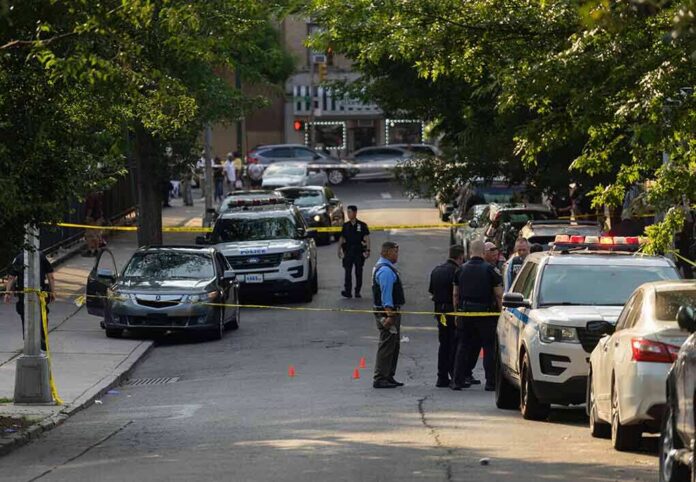
A routine death investigation at a Boston rental has sparked big questions about political power, housing, and who really pays the price when things go wrong.
Story Snapshot
- Boston police are probing a death at a Mattapan rental home owned by Rep. Ayanna Pressley’s husband.
- Homicide detectives responded, but police say there is no sign of foul play and no link to the owners so far.
- The property is an investment rental, not the couple’s residence, and has been on the market for about a month.
- The case highlights how tragedies at politically connected properties collide with rising housing stress for ordinary renters.
What Happened At The Malta Street Rental
Boston police say officers were called to 25 Malta Street in the Mattapan neighborhood around 1:52 p.m. Saturday for a report to “investigate a person.” When officers arrived, they found an individual who was pronounced dead at the scene. The Boston Police Department’s Homicide Unit responded and is now handling the investigation, which is standard practice for unexplained deaths. Police have not released the victim’s name, cause of death, or detailed circumstances and say the probe remains active.
City property records list the multi‑family house as owned by Conan Harris, the husband of Massachusetts Congresswoman Ayanna Pressley. The home is a large, seven‑bedroom, two‑unit building valued at roughly $920,000 and used as a rental rather than the couple’s primary residence. The realtor for the property told local media that tenants have lived there “for a while,” underscoring that this is a long‑term rental, not a short‑term political venture. The house was listed for sale about a month before the incident.
How Police And The Pressley Family Have Responded
Boston police upgraded the initial “investigate person” call to a full death investigation once the individual was found deceased, and homicide detectives were brought in to review the facts, as they do with many unattended deaths. Officials have stressed there is currently no indication of foul play, even though the homicide unit is leading the case. A spokesperson for Congresswoman Pressley’s office said neither Pressley nor her family were involved in the incident and offered “deepest condolences” to the victim’s family. Police sources also emphasize that the owners are not linked to the circumstances of the death at this time.
Coverage of the case has varied in tone, from straight local reporting to more charged national headlines pointing to Pressley’s membership in the progressive “Squad.” Some outlets have highlighted that Harris previously used the Malta Street address for business purposes, suggesting his financial ties to the property go beyond simple ownership. Even so, published reports agree on one key point: there is no evidence, at least so far, tying Pressley or Harris to whatever caused this person’s death. The unanswered questions are about the victim and the conditions that led to their death, not about direct action by the landlords.
Death, Rentals, And Public Anger Over Elites
This case taps into a deeper frustration many Americans feel across party lines: one set of rules for political insiders and another for everyone else. A body at a rental owned by a member of Congress’s family will always get attention that a similar tragedy at an ordinary landlord’s property would not. That contrast fuels suspicion among both conservatives and liberals who already believe elites live comfortably off assets like rental homes while renters struggle to hang on to the American Dream.
Body Found at Property Owned by Rep. Ayanna Pressley’s Husband
Police are investigating a death discovered Saturday at a rental home in Mattapan, Massachusetts, owned by Conan Harris, husband of Rep. Ayanna Pressley (D-MA).
Harris previously served 10 years in federal prison… pic.twitter.com/prwsSEYvg9
— Paul A. Szypula 🇺🇸 (@Bubblebathgirl) July 19, 2026
Research shows that high housing costs and eviction are more than financial headaches; they can be matters of life and death. One long‑term study found that people paying half or more of their income toward rent were about nine percent more likely to die over the next twenty years than those paying a third. Another national analysis linked eviction filings to sharply higher mortality risk, especially for lower‑income renters. These findings suggest that the stress and instability tied to housing can quietly push many families toward health crises and early death, even when no crime is involved.
Why Politically Connected Properties Draw Extra Scrutiny
When a death occurs on property owned by a politically connected person, it tends to be viewed through a different lens. Academic work on “political connections” has found that companies tied to powerful figures can have worker death rates two to three times higher than unconnected firms, in part because oversight often breaks down when elites are involved. That history has made people on both the right and the left more skeptical when they hear “no foul play” and “no link to the owners” in cases like Malta Street. They worry the system protects those at the top faster than it protects people at the bottom.
At the same time, public health research warns against seeing every housing‑related death as a conspiracy. Studies across developed countries show that when housing costs rise faster than income, preventable deaths and even suicides go up. Counties with high eviction rates also see more overdose deaths and other “deaths of despair,” especially among people already living on the edge. Put together, the data paints a grim picture: the housing squeeze is deadly, and renters in properties owned by politicians and regular landlords alike face similar risks from stress, poor conditions, and lack of options.
The Bigger Story Behind The Malta Street Case
For now, the Malta Street case remains a mystery in key ways: we do not know who died, how they died, or whether housing stress played any role. What we do know is that the death happened at a rental tied to a national lawmaker in a country where many feel the government has failed to keep housing safe and affordable. Conservatives see progressive politicians who talk about justice but profit from high‑value rentals. Liberals see a system that lets wealth and property pile up while renters face deadly pressure.
This tragedy does not yet tell us everything about those bigger fights, and it does not prove misconduct by the property owners. But it does show how easily a single death can become a symbol of wider anger. A person died in a house that is an investment for a political family. Police say there is no foul play. At the same time, millions of renters live with risks that rarely make headlines. As the investigation continues, the key question is whether leaders will only protect their own reputations or finally face the deadly cost of America’s broken housing system.
Sources:
pjmedia.com, cbsnews.com, nypost.com, facebook.com, tmz.com, boston25news.com, evictionlab.org, pmc.ncbi.nlm.nih.gov, euronews.com, pure.uva.nl