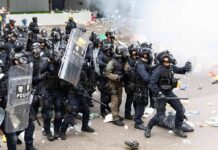
Police say anti-immigrant unrest in Northern Ireland now cuts across old sectarian lines, and some paramilitary members showed up as tensions spiked.
Story Snapshot
- Police reported cross-community involvement and anti-immigrant themes in recent disorder.
- The Police Service of Northern Ireland said loyalist paramilitary members were present at riots.
- Officials found social media coordination, but no proof of organized paramilitary leadership.
- Race hate incidents in Northern Ireland recently hit record highs, heightening fear.
Police Findings: Who Showed Up and Why It Matters
Police Service of Northern Ireland leaders told oversight bodies that members of loyalist paramilitaries were present during racist rioting in Belfast. The chief constable also said some figures helped direct violence at several locations, which raised alarms about escalation and control of crowds. Senior officers described “clear anti-immigration and extreme right-wing” themes in online calls that preceded street disorder. Officers also said minority families were left in fear after homes were attacked and children needed rescue.
Police leaders later stressed a careful line between individual presence and formal command. A senior assistant chief constable said investigators saw significant coordination on social media, including posts from outside Northern Ireland, but had no evidence that loyalist paramilitary leadership planned or coordinated the unrest. That distinction shaped arrests and charges and guided how authorities framed the threat to the public and to migrants living in affected neighborhoods.
Claims of Wider Plots Versus What Authorities Can Prove
Tabloids and online videos pushed claims that republican militants planned a campaign to drive migrants out within days. Intelligence officials cited in one outlet alleged a New Irish Republican Army plan to force migrants to leave. These sensational reports drew heavy traffic, but police and independent monitors emphasized what they could actually verify in court: individual involvement by some loyalists, not organized, top-down orchestration across groups.
Independent reviewers echoed the police line. The Independent Reporting Commission wrote that there was evidence of paramilitary involvement in racist incidents, but not proof that recognized leaderships authorized or ran a coordinated campaign. The report warned that the link between paramilitaries and racist violence is a serious and growing problem, even without formal orders. That framing urges quick action against hate crime while avoiding claims that cannot be proven.
Why Northern Ireland’s Target Has Shifted to Race
Police data show a clear trend: race hate incidents and crimes have climbed to the highest levels since records began in 2004 to 2005. In the 2024 to 2025 year, race hate incidents reached 1,807 and race hate crimes hit 1,188. Those totals exceeded prior peaks and tracked with repeated summers of tension near migrant housing. Officials say this wave reflects a wider shift from old sectarian flashpoints to racialized targets.
Northern Ireland is one of the most obvious arguments against migration if you were willing to admit it. Generations of division between the native and migrant populations, huge violence and unrest on both sides, leaving a region that lags behind its neighbours in many metrics.
— conalmcintyre (@conalmcintyre4) August 18, 2026
Journalists reported that some loyalists now link immigration to fears about housing, jobs, and community status. That message has drawn new faces to protests and made strange alliances online and on the streets. Cross-community anger can grow faster than police can prepare. When rumor and rage meet weak trust in government, the result is sudden crowd action that endangers families who did nothing wrong but move to a new country.
What This Means for Ordinary People
For migrants, the risk is direct: threats, smashed windows, and fear of going outside. For long-time residents, the costs stack up too: burned cars, shuttered shops, and neighborhoods marked as unsafe. Police now race to stop flash mobs organized in hours. Politicians argue over blame. Many people on both the left and right see the same pattern: leaders talk, communities suffer, and the loudest voices online set the agenda while trust keeps falling.
Authorities say they will charge those who attack homes and hotels, and they urge calm. But the math is hard. Social media networks move faster than official warnings. Paramilitary legacies give a few actors outsized sway on tense nights. Real fixes need steady work: better protection for targets, faster rebuttals to viral lies, and practical help in areas that feel left behind. Without that, the cycle of fear and fury will return.
Sources:
youtube.com, dailymail.com, bbc.com, nytimes.com, wsws.org, itv.com