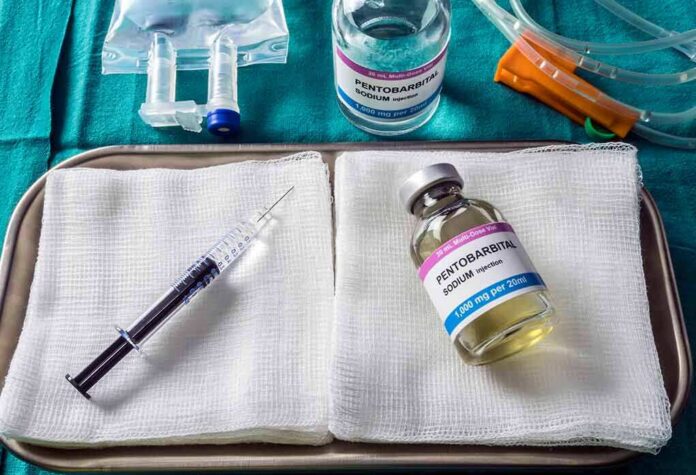
Two doses of Tennessee’s lethal-injection drug failed to kill Christa Pike, forcing the state to halt executions and admit its own protocol had reached its limits.
Story Snapshot
- Witnesses reported Pike was still breathing after two pentobarbital doses, and she was taken to a hospital.
- The Tennessee Department of Correction said staff followed every step of the approved protocol and could do no more.
- Governor Bill Lee paused all remaining 2026 executions and ordered an independent review.
- The episode highlights long-running failures in lethal-injection systems and fuels distrust in government competence.
What Happened In The Chamber
Media witnesses said Tennessee officials administered two rounds of the lethal drug pentobarbital to Christa Pike on Wednesday evening. Reporters described ongoing breathing and even snoring more than forty minutes after the second dose. Officials later transported Pike by ambulance from Riverbend Maximum Security Institution to an outside hospital. These observations came as courts weighed last-minute legal motions, adding hours of delay and confusion to the timeline.
The Associated Press summarized that two doses were given, yet Pike appeared to remain alive when the viewing blinds closed. A Yahoo repost of the Associated Press video noted she was taken away by ambulance soon after. NBC News reported that Pike’s lawyers told courts she had not lost consciousness and still had a heartbeat after the injections. Those filings helped shape the public record of what happened inside the chamber before witnesses were escorted out.
State Response And Protocol Limits
The Tennessee Department of Correction released a formal advisory stating staff followed every step of the state’s lawful, established execution protocol, which had been approved by the Attorney General’s Office. The department also said the protocol does not allow any additional procedures beyond what staff carried out that evening. The statement emphasized that the chemical used has “consistently been effective” in past executions, underscoring the agency’s view that this outcome was both rare and unexpected.
Governor Bill Lee responded within hours. He paused the state’s remaining 2026 executions and ordered a comprehensive, third-party review to determine what went wrong. He also delayed the only other execution scheduled for this year. The governor’s action echoed earlier pauses Tennessee has taken after execution problems. His message stressed the need for facts and accountability before the state proceeds again with lethal injection.
Why This Failure Resonates Nationally
This event lands in a larger pattern of lethal-injection breakdowns that have raised medical and legal alarms. National reporting has chronicled repeated problems with intravenous lines and drug effects in several states. Public health research has questioned whether lethal injection is as peaceful and painless as promised, even when protocols are followed. Those concerns span ideology: people who want the state to be both firm and competent, and people who reject capital punishment, see a system not working as advertised.
Experts have also noted the difference between a “botched” execution and a “failed” one. Botched cases involve painful delays or protocol deviations that still end in death. Failed cases, like Pike’s, end without a death despite the attempt. Analysts say true failures are rare. That rarity does not calm the worry. Instead, it raises a harder question: if the state cannot deliver reliable results under its own rules, what else inside the system is running on autopilot and failing quietly?
Accountability, Transparency, And Public Trust
Tennessee now faces two tests. First, the independent review must explain why pentobarbital did not work as intended, and whether drug quality, dosing, intravenous access, or training played a role. Second, state leaders must decide if protocol changes, staff retraining, new oversight, or even a different method are needed. The Department of Correction’s statement that staff could do “no more” under current rules may be legally correct. It also highlights a policy gap that shook public trust.
🚨 CHRISTA PIKE IS STILL ALIVE AFTER TWO EXECUTION ATTEMPTS 🚨
Tennessee tried twice.
Both times the procedure failed.
She’s still breathing.The image circulating was built from witness descriptions. It is not a live photo.
Colleen Slemmer is still dead.
The sentence is… https://t.co/jbC9VqYX5q— Unmask The SYS (@UnmaskTheSys) October 1, 2026
For many Americans, right and left, this is the kind of government failure that feels both basic and unacceptable. Conservatives see another agency that cannot carry out a solemn duty it claims to master. Liberals see a punishment system that risks needless suffering and error. Both see institutions that close ranks when things go wrong. Real transparency, precise timelines, and clear medical findings will matter more now than press lines. The facts must lead, and the fixes must be real.
Sources:
pjmedia.com, yahoo.com, wsbradio.com, wsoctv.com, nbcnews.com, cbsnews.com