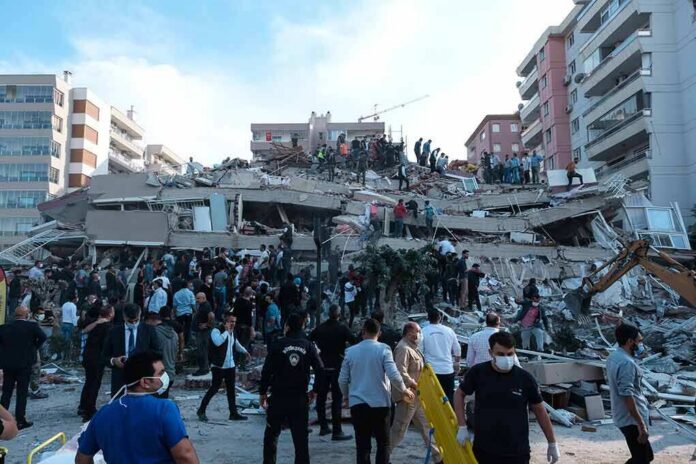
At least nine people, including five children, were killed when an airstrike hit a house in Yemen’s Saada province, triggering a frantic search for survivors under the rubble.
Story Snapshot
- Airstrike in Saada province killed at least nine people, including five children and two women.
- Search-and-rescue teams combed the rubble for survivors after the strike.
- Houthi-run Health Ministry named a house in Sahar district as the site and cited 19 wounded.
- Reports differ on the number of injured, but agree on at least nine dead.
Confirmed Strike And Immediate Aftermath
Associated Press reported that an airstrike struck Yemen’s Saada province on October 18, killing at least nine people. The report said the dead included five children and two women. Video from the scene showed search and rescue teams working through rubble to reach survivors. The strike occurred in territory held by Houthi forces, who have fought Saudi-backed forces for years. The minimum death toll was reported as nine while recovery efforts continued at the site.
A spokesperson for the Houthi-run Health Ministry, Anees al-Asbahi, said the strike hit a house in the Sahar district. He said nine people were killed and nineteen were wounded, including eleven children. His statement added detail on the target type and the injured, and it matched the Associated Press count on the minimum deaths. The description pointed to a family home as the impact site, aligning with images of collapsed walls and household debris.
Conflicting Injury Counts And What We Know For Sure
Other contemporaneous reports that cited Houthi media gave a different injury count, saying sixteen were wounded. That mismatch does not change the reported minimum of nine dead, but it shows how numbers can shift during rescue operations. Early casualty lists often change as hospitals register patients and as families locate missing relatives. For this incident, the common ground across reports is the location, the strike on a house, and at least nine people killed.
The Associated Press account did not name who carried out the strike. Some outlets, relying on Houthi-linked channels, attributed the strike to Saudi Arabia. That claim remains sourced to parties to the conflict, not to an independent investigator. The event still fits a wider pattern in Yemen, where air-launched explosives have been a major cause of civilian deaths and injuries documented by international bodies in recent reporting cycles.
Why This Matters To Americans Watching A Costly, Endless War
Yemen’s war has dragged on for years, with civilians paying the highest price. Many Americans, right and left, see stories like this and feel that powerful actors make choices far from public view, while families suffer. People who worry about endless foreign entanglements see more risk and little oversight. People who focus on human rights see children and parents pulled from rubble. Both groups want facts, accountability, and a foreign policy that serves the public interest at home.
A reported UDI airstrike struck a civilian residence in Yemen, leaving a woman and children trapped under the debris. Emergency crews urgently combed through the wreckage in search of survivors following the strike in Saada, in northwestern Yemen. According to the most recent… pic.twitter.com/BxwpgnKZrB
— SNN Finland (@snnfinalnd) October 18, 2026
This strike also highlights a recurring problem with information from active war zones. Immediate numbers often come from warring parties or local officials under their control. That does not erase the human loss shown on the ground, but it can cloud details like who launched the attack and the final casualty figures. Responsible reporting fixes on what is established, marks what is still being counted, and avoids turning unknowns into claims. Here, the established fact is at least nine dead in a hit on a home.
What To Watch Next
Watch for hospital and civil records from Sahar district that firm up the list of victims. Look for satellite images and on-site photos that confirm the exact location and blast pattern. Monitor any statement from Saudi officials or allied forces addressing operations over Saada on that date. Independent investigators often review munition fragments and crater sizes to identify likely attackers. Any official admission, or a detailed incident review, would help settle key questions about responsibility and intent.
Sources:
youtube.com, apnews.com, english.ahram.org.eg