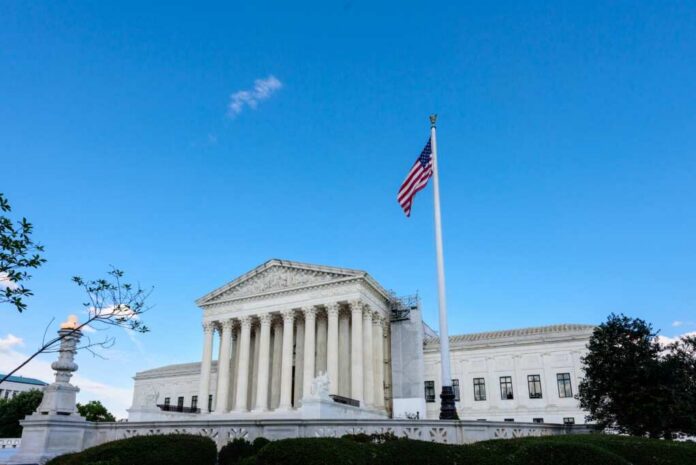
The Supreme Court is poised to restore the meaning of “Election Day” by striking down state laws that allow mail-in ballots to trickle in days after everyone else has voted.
Story Snapshot
- Supreme Court heard arguments in Watson v. Republican National Committee challenging Mississippi’s five-day grace period for mail-in ballots postmarked by Election Day
- Conservative justices appeared ready to rule the state law conflicts with federal statutes establishing a single Election Day for congressional elections
- A decision could invalidate similar grace period laws in 14 states before the 2026 midterm elections
- The case centers on whether “Election Day” means ballots must be received by that date, not just postmarked
When Election Day Stopped Being a Day
Mississippi allows mail-in ballots postmarked by Election Day to arrive up to five business days later and still be counted. The Republican National Committee, along with Mississippi’s Republican and Libertarian parties, sued to stop this practice. They argue federal law is crystal clear: Congress designated the Tuesday after the first Monday in November as “Election Day” for federal elections, not “Election Week.” The 5th Circuit Court of Appeals agreed with challengers in a three-judge panel decision, though five judges dissented when the full court declined to rehear the case.
The Arguments That Swayed the Justices
During over two hours of oral arguments on March 23, 2026, conservative justices hammered Mississippi’s position. Justice Neil Gorsuch posed a hypothetical scenario where a scandal breaks after Election Day, prompting voters to revoke their mailed ballots if given the chance. Justice Samuel Alito expressed dissatisfaction with Mississippi’s argument that states get first crack at setting ballot rules. Paul Clement, arguing for the RNC, emphasized that early voting is perfectly acceptable under federal law, but accepting ballots after Election Day opens the door to fraud and undermines election finality.
The States’ Rights Counterargument Falls Flat
Mississippi’s attorney Caroline Stewart defended the grace period as a reasonable state accommodation for voters who mail ballots on time but face postal delays beyond their control. Liberal justices backed this position. Justice Ketanji Brown Jackson focused on whether Congress explicitly preempted state ballot receipt deadlines. Justice Elena Kagan cited the Electoral Count Reform Act of 2022, which references a “period of voting” rather than a single day, suggesting Congress tolerates some flexibility. The problem with this argument is that federal law has designated a specific Election Day since 1845, a standard created to prevent the very chaos and fraud potential that grace periods invite.
What Happens to Fourteen States
If the Court rules as expected by June 2026, election officials in 14 states will need to eliminate their grace periods before the midterm elections. Justice Brett Kavanaugh confirmed during arguments that implementation before November 2026 is feasible since ballots typically mail 45 days before elections. This timeline gives states sufficient notice to adjust procedures. Rural and remote voters who rely heavily on mail delivery may face tighter deadlines, but the solution is simple: mail your ballot earlier. Military and overseas voters remain protected by separate federal exceptions.
Election Integrity Versus Ballot Harvesting Convenience
The conservative majority’s skepticism reflects common sense concerns about election integrity. When ballots arrive days after Election Day, the door opens for mischief. Voters could theoretically attempt to change or revoke votes after seeing results or learning new information. Vote counters face pressure to “find” additional ballots in close races. The 2020 election amplified these concerns when mail-in voting expanded dramatically and numerous states extended deadlines, creating confusion and eroding public confidence. A Supreme Court decision enforcing a firm Election Day deadline would restore clarity and trust to federal elections, regardless of how loudly opponents cry voter suppression.
The case represents more than technical statutory interpretation; it embodies a fundamental question about whether “Election Day” retains any meaning or becomes an elastic concept bent to political convenience. The Trump-era push for election security found its way into this litigation, and rightly so. Americans deserve to know that when they wake up the Wednesday after Election Day, all the votes are in and counting can proceed without ballots mysteriously appearing from post office sorting facilities. The Court appears ready to deliver that certainty.
Sources:
Court appears ready to overturn state law allowing for late-arriving mail-in ballots – SCOTUSblog
Supreme Court hears arguments in case about mail-in ballots arriving after Election Day – ABC3340
SCOTUS GOP 2026 redistricting midterms – Politico
Supreme Court looks to make Election Day great again – Courthouse News