America’s air dominance in the Pacific hinges on a hard truth: the U.S. didn’t build one “perfect” stealth fighter—it built two, and allies are training to use them together near China and North Korea.
Quick Take
- U.S. Air Force F-22s and South Korean F-35As conducted rare simulated close-range dogfights over/near the Korean Peninsula in mid-May 2024.
- The exercise rotated jets through offensive and defensive roles, sharpening tactics without revealing a public “winner.”
- The F-22 remains optimized for air superiority and visual-range maneuvering, while the F-35 is built for sensor-driven, networked warfare and multirole missions.
- The training signals deterrence and interoperability in a strategic region, but limited official details leave outcomes scenario-dependent.
Rare Allied Dogfighting Drill Near a Strategic Hotspot
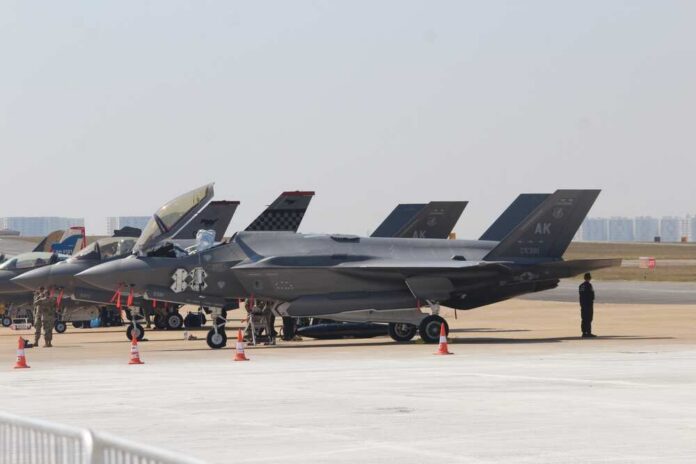
U.S. Air Force F-22 Raptors from the 19th and 199th Fighter Squadrons deployed to Gunsan Air Base, South Korea, arriving May 13, 2024, and soon flew a simulated dogfighting event with Republic of Korea Air Force F-35A Lightning IIs. The aircraft reportedly took turns in offensive and defensive roles during close-range air combat. Public reporting framed the event as a “rare” stealth-on-stealth training opportunity rather than a publicity contest.
South Korea’s F-35As are part of a broader allied push to build credible deterrence under real-world regional pressure. Training over and around the Korean Peninsula matters because it forces pilots to operate under the same geography, basing constraints, and threat calculations they would face in a crisis. Even when the event is labeled “simulation,” the value comes from practicing tactics, communications, and decision-making in the air with partner forces.
What Each Jet Is Actually Built to Do
The F-22 and the F-35 share stealth characteristics, but they were designed for different jobs. The F-22 entered service as a fifth-generation air superiority fighter, emphasizing speed beyond Mach 2, high agility, and thrust-vectoring for extreme maneuvering. The F-35 was designed as a multirole platform with deep sensor fusion, networking, and an ability to contribute to strike and electronic warfare missions. Comparing them as if they were interchangeable can mislead the public.
Analysts consistently describe the match-up as conditional: at close range, the F-22’s kinematics and maneuverability are widely credited as decisive advantages, while at longer ranges the F-35’s sensors, data fusion, and ability to operate as a “quarterback” in a larger kill chain become more influential. That difference is exactly why a controlled training environment is useful. It can validate tactics for when stealth, radar, missiles, and maneuver all interact in unpredictable ways.
Why No One Is Declaring a “Winner”
Public accounts of the mid-May 2024 exercise do not provide scoring, kill ratios, or a formal outcome, and that omission is not surprising. Modern air combat training is often designed to test specific tactics or decision loops, not to crown a single platform. When two stealth aircraft fight, outcomes can swing based on rules of engagement, missile assumptions, electronic warfare modeling, and even what each side is allowed to “see” through simulated sensors.
That uncertainty cuts against the online culture-war instinct to demand a simplistic verdict—especially when defense spending is a political target. The strongest confirmed takeaway from reporting is that both sides treated the training as skill-building: South Korea emphasized improving close-combat proficiency, and U.S. forces focused on interoperability. Without official data, any claim that one aircraft “proved” superiority in this specific event should be treated as unverified.
Deterrence, Procurement, and the Real-World Budget Question
The exercise also highlights a procurement reality many taxpayers care about: the F-22 is not exported, and its production ended years ago, while the F-35 is the widely fielded allied stealth fighter. That structure shapes coalition warfare. In a major conflict, the U.S. may rely on F-22s to help secure air dominance while allied F-35 fleets provide scale, sensing, and strike capacity. The reported cost gap often cited in comparisons reinforces why the U.S. and partners leaned into the F-35 program.
F-22 vs. F-35: When America’s Two Best Stealth Fighters Faced Each Other in Simulated Combathttps://t.co/LRkREG4KD2
— 19FortyFive (@19_forty_five) March 19, 2026
For a conservative audience wary of waste and bureaucracy, the key point is that capability must match mission. The reporting around this event supports a complementary model: one jet optimized to win air superiority engagements, another optimized to connect sensors, share targeting, and execute multirole operations. Limited public detail prevents firm conclusions about performance in this specific drill, but the strategic intent—credible allied readiness in a dangerous region—comes through clearly.
Sources:
F-22 Raptors and F-35 Fighters Battled in the Sky (In a Simulation)
F-22 Raptor vs F-35 Lightning II
F-35 vs F-22: Rare dogfight near China unveils next-gen tactics
The Striking Differences Between The F-22 Raptor & The F-35 Lightning II