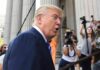


When a sitting president stands beneath Mount Rushmore and declares communism “the greatest threat to our country” before cracking a joke that “my wife hates it when I do that,” he is doing more than riffing; he is weaponizing history, ideology, and humor in a single performance to frame how Americans should see their present moment.
Key Points
- Trump’s Mount Rushmore address fused patriotic ceremony with a stark warning that communism is a “mortal threat” surpassing even world wars and 9/11.
- His language—“with communism everything turns to sh*t”—and the aside about his wife disliking that phrasing, illustrate how he mixes coarse rhetoric and domestic humor to sharpen political messaging.
- The speech sits in a long American tradition of anti‑communist alarm, but updates it by tying “communism” to contemporary culture wars and monument debates.
- Media accounts agree on the core content of the speech but diverge sharply on its meaning, with some seeing principled warning and others seeing divisive, almost McCarthy‑era demagoguery.
- Understanding this speech requires seeing it both as campaign‑style theater and as a signal of how Trump and his allies intend to frame ideological conflict in the years ahead.
Mount Rushmore as Stage: Why This Speech Was Designed to Echo
Mount Rushmore is not a neutral backdrop. Its four presidential faces and contested history have made it a recurring stage for arguments about American identity, patriotism, and land rights. When Trump chose this site to mark the run‑up to the nation’s 250th anniversary, he deliberately wrapped his message in granite symbolism: the founding, the canon of “great presidents,” and the permanence of a particular vision of America.
Accounts from outlets across the spectrum highlight how the event was choreographed. Trump’s appearance came amidst fireworks, military imagery, and a crowd of supporters, while Native American protesters were removed from a blocked road by National Guard troops in riot gear before the speech. The visual contrast—president framed by presidents, protesters dispersed, monuments lit—amplified his central claim: that American heritage is under siege, and that he stands between it and the forces he labels “communist” or “radical.”
“Communism Is a Mortal Threat”: The Core Claim
At the heart of the speech is a blunt assertion: “Communism is a mortal threat to American liberty… It is the greatest threat to our country, including World War I, World War II, Pearl Harbor or even 9/11.” This is not a standard campaign line; it is a hierarchy of danger that consciously elevates ideological conflict above some of the bloodiest and most traumatic episodes in U.S. history. In a few sentences, Trump reorders the American story so that the enemy is not a foreign power in conventional war, but an ideological current he says is already “in our land.”
His formulation draws on familiar Cold War tropes—communism as existential menace—but recodes them for contemporary battles. Where mid‑20th‑century anti‑communism focused on Soviet power and nuclear arsenals, Trump targets what he calls “radicals” who remove monuments, question traditional narratives, or press claims of systemic racism. Communism, in this telling, is not primarily a foreign state; it is an umbrella label for internal movements he believes seek to remake American culture and history.
“Everything Turns to Sh*t”: Rhetoric, Humor, and the Melania Aside
Trump’s reported line—“with communism everything turns to sh*t”—captures how he uses coarse, memorable phrasing to translate abstract ideology into a visceral image. Unlike a policy speech that might parse Marxist economics or state planning, this is a gut‑level, sweeping indictment: communism does not merely fail; it ruins. The vulgarity is not incidental; it is a device to make the warning sticky.
Just as telling is the self‑conscious aside: “My wife hates it when I do that.” In a few words he pulls Melania Trump into the frame as the imagined domestic critic, someone who supposedly prefers polish to profanity. The effect is threefold. First, it softens the harshness by presenting the line as a bit of marital mischief rather than pure rage. Second, it signals that he knows he is violating decorum and is doing so on purpose. Third, it humanizes the moment, inviting supporters to laugh along at the idea of a spouse rolling her eyes at his language, even as he drives home the underlying claim that communism destroys societies.
This blend—ideological alarm, barnyard phrasing, and family humor—is characteristic of Trump’s broader rhetorical style. It allows him to escalate threats (“mortal,” greater than world wars) while keeping the tone conversational, almost stand‑up. For a segment of his audience, the refusal to sanitize the language reads as authenticity; for critics, it underscores the crudeness with which he flattens complex histories into slogans.
From Cancel Culture to Communism: How Trump Connects the Dots
Trump did not deliver his warning in an abstract vacuum. He explicitly linked the supposed communist menace to debates over statues, monuments, and what he and conservative allies describe as “cancel culture.” In prior Mount Rushmore remarks, he condemned “a relentless campaign” to remove monuments as an attempt to “erase history,” casting protesters against Confederate and colonial statues as part of a broader ideological revolution.
By the time of this speech, that thread had evolved. Communism, in his formulation, is the intellectual engine behind efforts to tear down monuments, rewrite school curricula, and question the American founding. Media coverage notes that he painted his opponents as “radicals” and “extremists” attacking American history itself. For his supporters, this narrative frames monument takedowns not as localized debates over specific figures but as evidence of a systemic ideological project animated by a foreign‑sounding “ism.”
The choice of Mount Rushmore reinforces this linkage. The site has been a flashpoint for Native American activists who argue the land should be returned, and whose protests were physically removed before his speech. In Trump’s frame, resistance to the monument—and to the presidents it represents—becomes an example of the same destructive ideology he calls communism, even when the actual protesters’ language centers on Indigenous sovereignty rather than Marxist doctrine.
Media Interpretations: Principled Warning or Dark Political Turn?
Major outlets agree on the key factual elements of the speech: Trump warned that communism is America’s greatest threat, tied that warning to culture‑war battles, and delivered the message in a highly charged Mount Rushmore setting. Where they diverge is on how to read it. Some regional and conservative accounts emphasize the patriotic tone and the seriousness of the warning, framing the address as a clear‑eyed response to what Trump described as a resurgence of communism “in our land.”
NPR’s contemporaneous reporting, by contrast, described the speech as veering from “soaring rhetoric about American exceptionalism” into “darkly political” territory, explicitly noting that his warnings evoked “one of the country’s ugliest chapters” of anti‑communist hysteria. This is a reference to episodes like McCarthyism, when charges of communist sympathies were used to justify blacklists, investigations, and broad assaults on dissent. From this vantage point, Trump’s framing looks less like sober threat assessment and more like an attempt to wrap present‑day critics in the stigma of past enemies.
CBS coverage similarly highlighted that he aimed at “radicals” and “extremists” who attack American history, underscoring how the speech operated as a campaign against political opponents under the banner of anti‑communism. The key point is not that his factual claims about communism’s record are contested—there is broad historical evidence that communist regimes have produced severe oppression and economic failure—but that his application of the label to a wide range of domestic adversaries is politically expansive.
The Long Shadow of American Anti‑Communism
Trump’s Mount Rushmore rhetoric sits squarely in a century‑long American pattern in which communism functions both as a real geopolitical rival and as a catch‑all marker for domestic threats. During the early and mid‑20th century, fears of Soviet expansion, nuclear war, and ideological subversion made anti‑communism a dominant theme in both foreign and domestic policy. That period saw everything from genuine espionage cases to witch hunts against artists, academics, and activists.
In the post‑Cold War era, the Soviet Union is gone, but the rhetorical device remains. Politicians deploy “socialism” and “communism” as foils, sometimes loosely, to capture a range of policies or movements they oppose. Trump’s claim that communism is a greater threat than Pearl Harbor or 9/11 accelerates this trend, recentering ideological struggle as the main drama of American history and downplaying discrete military shocks.
The stakes of such framing are not purely symbolic. When communism is cast as an omnipresent internal menace, it can justify policies that treat opponents as enemies rather than as participants in democratic disagreement. The line “everything turns to sh*t” is a rhetorical flourish, but embedded in it is a policy argument: that any movement or reform he can successfully tag as “communist” is unfit for compromise and must be defeated, not accommodated.
President Donald Trump is visiting metro Atlanta on Wednesday to pitch a new nationwide investment initiative for children during a Wednesday afternoon speech at Wheeler High School in Cobb County. https://t.co/M5umqY7u8y
— FOX 5 Atlanta (@FOX5Atlanta) July 23, 2026
Why the Speech Still Matters
For many listeners, Trump’s Mount Rushmore comments were one more campaign‑style broadside in a crowded media cycle. Yet as an artifact of political rhetoric, they are unusually revealing. They show how he and his allies intend to define the stakes of contemporary conflict: not as marginal tax debates or regulatory tweaks, but as a civilizational battle between capitalism and communism, heritage and erasure, patriotism and betrayal.
They also demonstrate a language pattern that has proven durable: mixing blunt, sometimes coarse judgments with jokes and personal asides to keep the audience engaged while normalizing the more extreme claims. “My wife hates it when I do that” is funny, but it also tacitly asks listeners to accept the idea that some threats are so grave they justify breaking decorum. Over time, that argument can be extended to justify breaking other norms as well.
For a reader trying to understand where American politics may be headed, the Mount Rushmore speech is a useful bellwether. It crystallizes a worldview in which ideological labels carry enormous weight, domestic protests are interpreted through the lens of foreign “isms,” and history itself is framed as a battleground. Whether one agrees with Trump’s assessment of communism or not, grappling with the mechanics of this rhetoric is essential to understanding the climate in which future policy, protest, and political conflict will unfold.
Sources:
youtube.com, ajc.com, axios.com, fox5atlanta.com, cbsnews.com, usatoday.com