

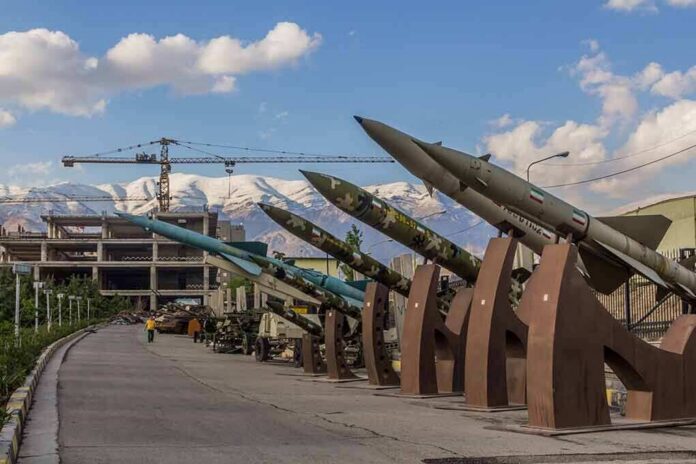
Iran’s “missile cities” are not a mystery tactic unveiled overnight but the logical end-state of a decades-long engineering strategy: put what matters underground, build it redundantly, and make it hard to finish off. The open-source record now supports two things at once—rapid reconstruction of key nodes after heavy strikes and the existence of hardened subterranean infrastructure—while stopping short of proving sustained, large-scale underground manufacturing during wartime.
At a Glance
- Commercial satellite imagery shows Iran repairing and rebuilding multiple missile sites within months of major strikes.
- Hardened underground facilities and tunnel networks are real; the question is function and capacity, not existence.
- U.S. assessments acknowledge focused Iranian efforts to restore infrastructure and source foreign systems and materials.
- The decisive bottleneck is industrial: solid-fuel mixers and production lines remain the limiting factor for scale.
What the evidence actually shows: reconstruction, resilience, and a capacity to recover
Across several independently analyzed sites, Iran moved quickly after the 2025 strikes to clear debris, repave access, and restart construction. Imagery-driven reporting identified activity at Khojir, Parchin, and Shahroud—facilities tied to solid-fuel missile work—consistent with a system that retained both the plans and the manpower to put buildings and surface infrastructure back into service at speed. A subsequent analysis that surveyed roughly two dozen struck locations concluded that some facilities, notably the Shahroud test complex, appeared to be rebuilt unusually fast—potentially returning to functional status within months rather than years. Separate scene-by-scene reviews documented damaged tunnel portals near Kangavar, reopened excavation near Dezful, and fresh roadwork and reconstruction north of Kermanshah, all signatures of a network designed for underground operations as much as for above-ground convenience.
These observations align with U.S. government analysis available in public summary: after the strikes, Iran concentrated on repairing military infrastructure and looked outward for systems and materials, particularly from Russia and China. The picture that emerges is not of a program stunned into paralysis, but of an industrial ecosystem that knew exactly what to fix first and where to find replacement inputs when sanctioned supply chains pinched.
How Iran’s “missile cities” work: design choices that trade productivity for survivability
Underground missile complexes are built to solve specific problems: keep launchers and munitions alive under attack, protect critical tooling, and preserve command-and-control. That requires geology and geometry—deep galleries driven into competent rock, multiple adits for redundancy, robust ventilation for propellant work, segregated bays for explosives safety, and electrical and fire-protection systems that can operate if entrances are cratered. The open record shows these fingerprints: tunnel mouths with blast walls, serpentine access roads, and excavation campaigns that reopen choked portals after bombardment. The logic is straightforward. You can rebuild a road and a portal mouth in weeks; you cannot reconstitute an entire dispersed tunnel complex from scratch in a war. Iran spent years creating depth and dispersion precisely so the network could be recoverable in stages and still matter operationally even when mauled.
But survivability engineering is not the same as mass manufacturing. Underground workshops that can handle storage, mating, limited component fabrication, or final checks do not automatically constitute a full-rate factory with casting pits, planetary mixers, and quality-assurance instrumentation scaled for hundreds of solid motors. In short: the architecture is there to persist; whether it sustains high-throughput production is the core dispute.
The bottleneck that decides scale: solid propellant tooling
The most consequential constraint flagged in open sources is the status of large industrial mixers required to produce modern composite solid propellant at volume. Commercial imagery confirms reconstruction at multiple solid-fuel facilities; it does not show the return of the heavy mixers themselves, and analysts caution that repaired shells do not equal restored throughput. That distinction matters. Solid motors demand controlled mixing, degassing, casting, and cure cycles—processes that hinge on a handful of capital assets and trained crews. Without those mixers and associated casting pits, an underground shop can service stocks, assemble units, and perhaps complete small-batch work, but it will struggle to regenerate a wartime depletion curve. This is why even analyses highlighting fast physical repairs still avoid claims of verified production rates; the machines that convert chemicals into motors are the rate setters.
U.S. government summaries mirror this split picture: a drive to rebuild and to source foreign-origin equipment alongside reported difficulty reconstituting full production capacity. That is not a contradiction; it is exactly how industrial recovery often unfolds—first restore access and utilities, then tooling, then throughput.
What the unveiling videos do—and do not—prove
Tehran’s tours of a newly presented “missile city” are designed to over-communicate depth, volume, and resolve. The publicly released material so far shows stored missiles, launchers, and a command walk-through—powerful signals of survivability, but not a camera pan across a live propellant line or a metrology cell calibrating guidance packages. Claims that production “moved underground” are assertions by a party to the conflict; they carry propaganda value but, standing alone, they do not settle questions of pace, yield, or quality control. Independent, imagery-based reporting remains the higher-confidence spine for what we can say in public: multiple complexes are active construction sites; entrances are repaired; new galleries are driven; and the network’s access is being restored.
To the extent there is a quantitative claim to weigh, the strongest lies in the time constants visible from space—roads cleared and repaved in weeks, portals reopened across a season, buildings framed and re-roofed within a campaign cycle. Those kinetics indicate a recovery capacity that should inform any assessment of deterrence and strike planning, even absent a verified count of newly manufactured units.
🚨🇮🇷 IRAN UNVEILS NEW UNDERGROUND MISSILE CITY, SHOWS MASSIVE WEAPONS STORAGE COMPLEX
Iran’s Islamic Revolutionary Guard Corps (IRGC) has released footage and photographs of a newly unveiled underground missile facility, showcasing rows of ballistic and cruise missiles, mobile… pic.twitter.com/7SQqA5dYOH
— Nova Intel (@intel_nova) November 10, 2026
Where the arguments genuinely meet: function, not existence
The debate worth having is narrow and technical. Both sides implicitly accept that Iran possesses an extensive underground missile infrastructure and that numerous nodes have been rebuilt or are being expanded. The unresolved questions are functional. First, which tasks are being performed underground right now—storage, final assembly, limited subcomponent production, or full-cycle propellant manufacturing? Second, how much of the prewar capacity survived in place versus being regenerated with new equipment? Third, how much output, if any, is attributable to wartime manufacturing rather than prewar stockpiles? On these points, reputable open sources are cautious: some analysts describe solid-propellant areas at major sites as inactive post-strike, emphasize the difficulty of assessing mixer status, and project timelines measured in months to a year for partial resumption at a focused site.
Against that caution stands evidence of rapid physical recovery and official U.S. assessments acknowledging an Iranian push to replace lost equipment and import enabling systems, sometimes leveraging external suppliers. Put together, the record supports a sober synthesis: Iran is restoring the missile enterprise faster than many expected, and the underground complex is central to that resilience, but independently verified proof of sustained, high-volume underground production has not surfaced in open sources.
Implications for strategy and intelligence collection
This synthesis has concrete consequences. For strike planners, the lesson is that damaging buildings is necessary but insufficient; the scarce, high-value tooling and the logistics flows that feed it—oxidizers, binders, metal powders, inhibitors—are the real choke points. For policymakers, it underscores why sanctions and export controls focused on precision mixers, vacuum systems, cure ovens, and metrology equipment are leverage multipliers. For intelligence, the collection priorities are unambiguous: persistent surveillance of freight into and out of named portals; thermal and power-signature analysis for continuous-process operations; and time-series tracking of vehicle patterns consistent with serialized output. Each would convert a debate about entrances and roads into a quantifiable picture of throughput.
Finally, for readers trying to reconcile confident official videos with cautious satellite analysis, the rule of thumb is simple. Treat survivability signals—depth, redundancy, restored access—as real and strategically important. Treat production claims—rates, volumes, quality—as unproven until the bottleneck equipment reappears in the chain. That is not skepticism for its own sake; it is how industrial capability is measured when factories move into rock.
Sources:
zerohedge.com, apnews.com, iranwire.com, nationalsecurityjournal.org, business-standard.com, newscord.org, congress.gov, reuters.com, lranintl.com