

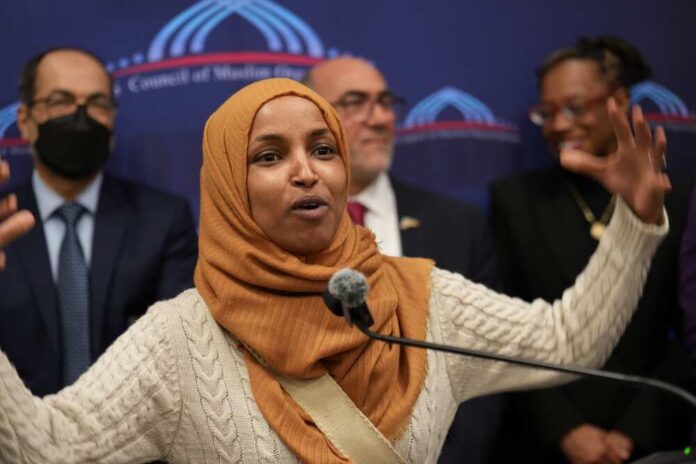
A sitting vice president’s immigration-fraud allegation against a member of Congress is now colliding with foreign-policy symbolism—and it’s exposing how shaky Washington’s rules feel to ordinary Americans.
Story Snapshot
- Vice President JD Vance alleged Rep. Ilhan Omar committed immigration fraud in a podcast interview and discussed legal options with White House adviser Stephen Miller.
- Somaliland, a self-declared state that split from Somalia in 1991, replied on X with a taunt-like offer: “Extradition? Say the word …”
- No U.S. extradition process is underway, and the underlying fraud allegation has not been proven in court; Omar has previously denied similar claims.
- The episode is amplifying conservative frustration over unequal enforcement—at a time many voters are also weary of foreign entanglements and rising costs.
What Vance Alleged—and What’s Actually Verified
Vice President JD Vance said in an interview with podcaster Benny Johnson that the administration believes Rep. Ilhan Omar “definitely” committed immigration fraud, including a long-circulated claim that she married her brother to gain entry or legal status. Vance also described discussing potential legal remedies with Stephen Miller. The reporting confirms the statements were made and widely amplified, but no court finding or DOJ filing is cited in the available sources.
That distinction matters for constitutional conservatives who want equal application of the law without turning politics into prosecution-by-headline. The sources also note Omar has denied similar accusations in the past, calling them “bigoted lies.” Based on the provided reporting, the public record in this snapshot phase is mostly rhetoric: a high-level allegation, an expressed intent to explore a case, and a political firestorm still waiting on evidentiary testing.
Somaliland’s “Extradition” Offer Is Real—but Largely Symbolic
Somaliland’s government account responded on X with a message framed as an invitation for the U.S. to send Omar there—shifting from “deportation” talk to “extradition.” The post is real per multiple outlets, yet extradition is a legal process built on treaties and recognized jurisdictions. Somaliland has operated autonomously since 1991 with its own governing institutions, but it lacks broad international recognition, creating a major practical hurdle to any formal extradition demand.
The reporting also places Somaliland’s jab inside a deeper political quarrel. Omar has opposed Somaliland’s push for recognition and sided with Somalia’s territorial claims, which has fueled resentment from Somaliland figures. Somaliland is simultaneously pitching itself to Washington as a stable partner in a rough neighborhood, offering basing access, port logistics, and minerals in exchange for recognition. In that sense, the Omar controversy becomes a messaging tool in a much larger bargaining effort.
Immigration Enforcement Meets Political Trust—And Voters Want Proof
Conservative audiences have spent years watching immigration rules enforced unevenly, from porous borders to selective scrutiny of paperwork violations. That’s why Vance’s allegation lands: it speaks to an accountability instinct—either the law applies to everyone, or it becomes a weapon used only against regular citizens. At the same time, the sources available here do not independently verify the fraud claim, meaning the only responsible posture is to demand evidence, due process, and transparency.
Why This Flashpoint Is Different in 2026: War Fatigue and Foreign Leverage
In 2026, the national mood is defined by stressors that make people skeptical of elite narratives—high energy costs, inflation hangovers, and a new war with Iran that has divided the MAGA coalition. That context colors how conservatives read stories like this one. When foreign actors jump into U.S. domestic disputes, it triggers two instincts at once: enforce sovereignty and the rule of law, but also avoid being steered into new geopolitical commitments through emotional political drama.
What Happens Next—and the Limits of What We Know
The near-term reality is simple: there is no sign in the provided sources of an active extradition proceeding, and Somaliland’s status complicates any formal legal channel. The most concrete development is Vance’s statement that the administration is exploring how to build a case, paired with Somaliland’s public offer. If investigators move forward, the key tests will be documentary evidence and courtroom standards—not viral clips, not partisan commentary, and not foreign government posts.
For conservatives who feel burned by years of propaganda, the best demand is straightforward: publish verifiable facts, follow lawful procedure, and avoid letting international symbolism become a back door into bigger commitments. If the allegation is true, enforcing immigration law strengthens fairness and public trust. If it is not proven, the country cannot afford another round of “guilty because politics,” especially when Americans are already questioning whether leaders can resist the pull of endless conflict abroad.
Sources:
African nation calls Ilhan Omar extradited after Vance’s fraud claim
Republic of Somaliland asks US to extradite Ilhan Omar there ‘to face justice’
Instapundit: Somaliland asks U.S. to extradite Ilhan Omar