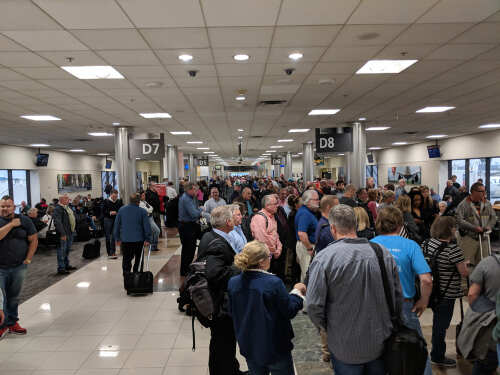
Democrats are warning that ICE agents at America’s airports could “kill” travelers—yet, days into the deployment, there are still no reported incidents, leaving the public stuck between shutdown-driven chaos and election-year panic politics.
Quick Take
- President Trump deployed ICE agents to 14 major airports to support TSA operations during a prolonged DHS shutdown and staffing shortages.
- Top Democrats publicly warned the plan could lead to brutality, family separations, shootings, or even deaths—claims not supported by any reported airport incidents as of March 27, 2026.
- Border Czar Tom Homan said ICE is handling non-screening tasks like crowd control to free TSA officers to run checkpoints.
- TSA absences spiked amid missed paychecks, with reports of thousands of callouts nationwide and extreme wait times at major hubs.
ICE Steps In as Shutdown Strains TSA and Travelers
Federal airport security became the latest pressure point in the partial DHS shutdown after more than 40 days of disrupted funding left TSA employees missing paychecks and airports facing record-long lines. Reports cited roughly 3,250 TSA callouts nationwide, with some major airports experiencing absence rates as high as 30–40%. Travelers at hubs such as JFK and Atlanta described multi-hour waits, turning routine travel into an all-day ordeal.
The Trump administration’s response was a targeted deployment of ICE agents to 14 major airports beginning March 23, 2026. According to Tom Homan, the agents are not running screening equipment or replacing TSA’s security function. Homan said the goal is to move people through bottlenecks by assigning ICE to tasks like managing exits, crowd flow, and other non-screening duties that keep TSA officers tied up.
Democrats Escalate Rhetoric: “Brutalize or… Kill”
House Minority Leader Hakeem Jeffries went public on national television with a stark warning, arguing that “untrained ICE agents” could “brutalize or… kill” travelers in airports. Sen. Richard Blumenthal echoed the concerns online, invoking scenarios that included shootings and deaths. Senate Minority Leader Chuck Schumer took to the Senate floor to denounce the plan as “asking for trouble,” linking the deployment to broader fears about immigration enforcement.
The sources provided do not include evidence that ICE agents have engaged in violence at airports since the deployment began, and they note no reports of brutality or deaths as of March 27, 2026. That gap matters because the public argument from Democrats is not merely that the plan is undesirable, but that it poses immediate danger to ordinary Americans trying to travel. So far, the available reporting supports the existence of intense political rhetoric, not the predicted outcomes.
What ICE Is Doing—and What It Isn’t
The practical dispute centers on mission scope. Homan described ICE as supporting TSA by handling non-screening functions so trained TSA screeners can stay on screening lines. That distinction is central to whether the deployment represents routine interagency support during a crisis or a backdoor expansion of ICE authority in civilian spaces. The provided research does not list written DHS directives or operational memos, limiting what can be verified beyond public statements.
Still, a conservative audience should watch the boundaries closely. Sending any federal agency into a new public-facing role raises legitimate questions about rules of engagement, training requirements, and accountability. Those concerns can be addressed without resorting to claims of imminent killings. If lawmakers believe the deployment exceeds statutory authority or violates civil liberties, the proper test is oversight hearings, document requests, and clear standards—rather than public panic that could worsen tensions in crowded terminals.
The Real Root Cause: Shutdown Politics and Funding Leverage
The shutdown fight is the underlying driver. Democrats have pushed for TSA funding to be separated from broader DHS and immigration enforcement disputes, while Republicans have tied DHS funding to the wider package, including ICE-related issues. That stalemate kept TSA employees in a financial squeeze and created the very conditions—high callouts and long lines—that triggered emergency measures. The situation mirrors the 2018–2019 shutdown, when TSA absences also spiked and airports buckled.
For voters who are already exhausted by years of dysfunction, the lesson is straightforward: when Washington plays budget chicken, regular Americans pay first. Travelers lose time and money. Federal workers get squeezed. Meanwhile, political leaders compete for the most inflammatory soundbite. With the country already strained by higher costs and broader national-security pressures, airport stability should be treated as basic governance, not a stage for doomsday predictions.
Sources:
Top Dems assert there’s risk ICE agents could kill travelers under Trump airport plan
Democrat leader says ICE agents in airports could brutalize or kill travelers