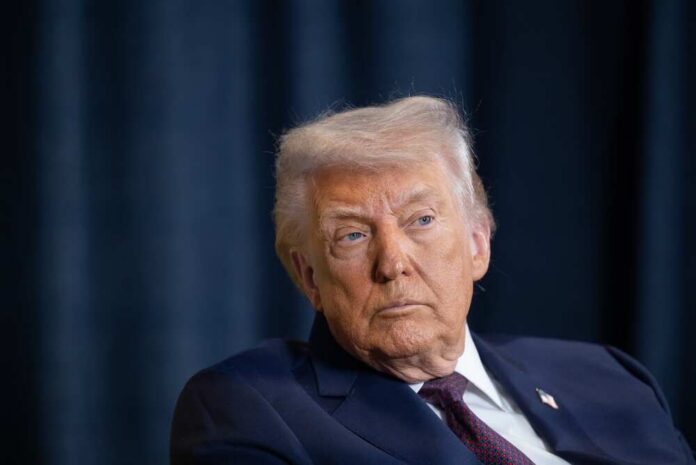
President Trump’s “No more Mr Nice Guy” Iran post shows how modern wars can be shaped as much by viral imagery as by ships and sanctions.
Story Snapshot
- President Donald Trump posted an illustration of himself holding a firearm with explosions in the background, warning Iran to “get smart soon” and sign a “non-nuclear deal.”
- The post landed as the U.S. prepared for an extended naval blockade rather than an immediate bombing campaign or a full pullback.
- Iran answered with its own propaganda, airing an assassination-taunt image tied to the 2024 Butler, Pennsylvania rally shooting.
- With nuclear talks stalled and the Strait of Hormuz still central, the biggest near-term risk is miscalculation that jolts oil markets and widens conflict.
Trump’s post, and why the imagery matters
President Trump used Truth Social to publish a stylized image of himself in a black suit and sunglasses holding a firearm, with explosions over an Iranian landscape and the caption “No more Mr Nice Guy.” In the accompanying message, Trump argued Iran “can’t get their act together” and urged Tehran to sign a “non-nuclear deal.” The timing was deliberate: it arrived as the administration intensified pressure while diplomatic off-ramps looked stalled.
For supporters, the image reinforces a familiar Trump approach: project strength publicly, then demand concessions privately. For critics, the same theatrical framing looks like escalation. The available reporting supports the core fact that the post was real and intentionally provocative, but it does not establish what operational steps, if any, were triggered by the message itself. That distinction matters, because adversaries often react to perceived intent as much as to actual military movement.
Blockade strategy: pressure without immediate bombing
Reporting on the administration’s internal posture indicates Trump instructed aides to prepare for an extended blockade of Iran, choosing that option over immediate bombing or a rapid withdrawal. In parallel, Trump rejected an Iranian proposal connected to reopening the Strait of Hormuz while nuclear issues remained unresolved. A blockade is not a cost-free “middle path,” but it can be framed as coercion short of strikes—especially if Washington believes time and economic pressure work in its favor.
For Americans watching costs at home, the Strait of Hormuz angle is not abstract. Energy markets respond quickly to perceived risk in key shipping lanes, and prolonged uncertainty can filter into gasoline and broader inflation pressures. The research provided does not include price data, but it does identify the channel through which economic pain could arrive: disruptions, delays, or panic surrounding shipping through Hormuz. That reality helps explain why the administration may prioritize control and deterrence in that corridor.
Iran’s counter-message: propaganda and assassination taunts
Iranian state media responded by circulating a threat-laced image referencing the 2024 assassination attempt against Trump at the Butler, Pennsylvania rally, paired with language implying the next shot would not miss. The exchange shows two governments communicating not only through diplomatic channels but also through mass messaging designed to harden domestic audiences. When propaganda replaces precision, the risk is that each side starts treating online theater as an indicator of imminent action.
The record here is clearer on rhetoric than on intent. The citations describe what was posted and broadcast, but they do not provide verified evidence of an operational plot tied to the Iranian messaging. That gap is important when assessing public fear versus confirmed threat streams. Still, the choice to invoke political violence imagery can raise tensions, complicate negotiations, and narrow the political room leaders have to de-escalate without appearing weak.
Questions inside the U.S. government: munitions and transparency
One underappreciated part of the story is the internal U.S. debate about readiness and information flow. A cited report relayed concerns that Vice President JD Vance raised alarms about munitions supplies, while intelligence assessments suggested the Pentagon may have been giving Trump an incomplete picture of the war. The research characterizes this as sourcing-driven and not officially confirmed, but it spotlights a real governance issue: decisions are only as sound as the information reaching elected leaders.
Trump Vows 'No More Mr. Nice Guy' in 4 AM Iran Threat Featuring Image of Himself With Gun https://t.co/XHWPIm2QMx
— Mediaite (@Mediaite) April 29, 2026
Politically, Democrats are positioned to attack the administration’s tone and approach, while Republicans will argue deterrence prevents wider war. For voters who already feel the federal government is failing—whether due to endless conflicts, opaque bureaucracy, or elite incentives—this episode lands as another reminder that accountability is hard during crisis. The immediate test will be whether messaging, naval posture, and negotiations can be aligned tightly enough to avoid a spiral no one can easily control.
Sources:
Trump shares image of himself brandishing a gun in fresh threat to Iran