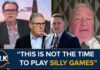
An MSNBC panel treated a direct quote from the Declaration of Independence as a controversy — and House Speaker Mike Johnson responded by reading it back to them word for word.
Quick Take
- Speaker Johnson told an MSNBC panel that Americans’ rights come from God, not government — quoting the Declaration of Independence directly.
- MSNBC framed the remarks as part of a church-state controversy, linking them to a White House-sponsored prayer festival on the National Mall.
- Johnson grounded his argument in founding texts, citing the Declaration of Independence and Abraham Lincoln’s Gettysburg Address.
- The exchange highlights a deeper American debate about whether rights are pre-political and natural or legal entitlements created by government institutions.
Johnson Quotes the Founding Documents on Live Television
Following the House passage of President Trump’s budget bill, Speaker Mike Johnson appeared on MSNBC and made a statement that sent the panel into a tailspin. Johnson declared: “We boldly proclaim the self-evident truth that our rights do not come from the government. They come from God himself.” He then cited the Declaration of Independence directly, calling it the nation’s “birth certificate” and quoting its most famous line: “We hold these truths to be self-evident.” [1]
Johnson did not stop there. He invoked Abraham Lincoln’s Gettysburg Address, quoting that America is “dedicated to this proposition — one nation under God, a government of the people, by the people, for the people, shall not perish from the earth.” Johnson framed the principle not as a partisan talking point but as a civic creed that must be “fought for” and “taught to the next generation so that they will have the same liberty, opportunity, and security.” [1]
Why MSNBC Pushed Back
The MSNBC panel framed Johnson’s remarks within a broader segment titled around the question of separation of church and state, connecting his comments to a White House-sponsored, nine-hour prayer festival planned for the National Mall. Panelist Matthew Taylor characterized the prayer event as unprecedented direct government sponsorship of religion, and commentators argued that Johnson’s rhetoric reflected a Christian nationalist agenda in conflict with the Constitution’s Establishment Clause. [2]
The panel’s constitutional counterargument centered on the distinction between the Declaration of Independence and the Constitution. The Constitution prohibits religious tests for public office and protects free religious exercise — it does not cite a Creator as the source of rights. Critics argued that treating the Declaration’s philosophical language as operative legal authority conflates two very different founding documents and what each one actually does. That is a legitimate distinction, even if it sidesteps the broader natural-rights tradition Johnson was invoking. [2]
A Debate as Old as the Republic
This dispute is not new. The tension between natural-rights philosophy — the idea that rights exist before and above government — and legal positivism — the idea that rights are only enforceable when codified in law — has run through American civic life since the founding era. Johnson’s formulation, that rights are “endowed by our Creator,” is lifted almost verbatim from the Declaration of Independence itself, a document written by Thomas Jefferson and signed by the founders in 1776. [3]
What makes the exchange notable is not the argument itself but the setting. When an MSNBC panel treats a direct quotation from one of America’s founding documents as a culture-war provocation, it tells you something about how far the national conversation has drifted from shared civic literacy. Americans across the political spectrum — conservative or liberal — might reasonably ask why quoting Jefferson on a news panel in 2026 is treated as a radical act rather than a civics lesson. [3]
What Both Sides Get Right — and Miss
Johnson is on solid historical ground when he argues that the Declaration’s authors believed rights preceded government. That is what natural-rights theory means, and it is plainly stated in the text. Where critics raise a fair point is in noting that the Declaration is a philosophical and political statement, not an enforceable legal instrument. The Constitution is what courts apply, and it does not resolve the theological question of where rights originate. Both documents matter; they just do different things. [1]
MSNBC is beyond parody: “What about this passage from Mike Johnson declaring that our rights do not derive from government and they come from our creator and heavenly father… Is this him putting God above the Declaration of Independence?” pic.twitter.com/VoS2FVsTJO
— TheBlaze (@theblaze) May 19, 2026
For Americans frustrated with a political class that seems more interested in scoring points than governing, this episode cuts both ways. Johnson used founding texts to make a principled argument about human liberty and limited government — that is exactly the kind of civic grounding many voters say they want from leaders. But the media environment turned it into a fight about Christian nationalism before the sentence was finished. Neither side served the public particularly well, and the actual substance — what the founders believed about the source of human rights — got lost in the noise.
Sources:
[1] YouTube – House Speaker Mike Johnson speaks after Trump budget bill’s final …
[2] Web – Mike Johnson says our rights come from God, ‘not government’
[3] YouTube – Speaker of the House Mike Johnson gives remarks after ‘One Big …