

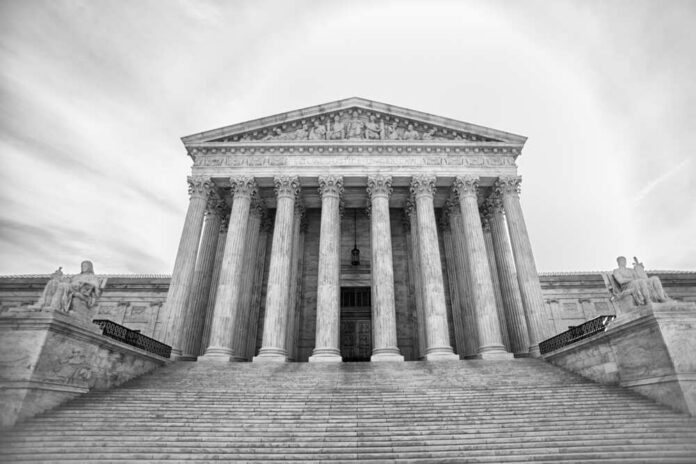
The Supreme Court just gave the Trump administration another major immigration win, and the left’s favorite parole pipeline is now on life support.
Quick Take
- The Supreme Court let the administration move ahead with ending the CHNV parole program.
- DHS says the program was abused and used to admit more than 500,000 poorly vetted migrants.
- Federal judges in Massachusetts and New York had tried to slow or block the move.
- The First Circuit Court of Appeals later said the termination was likely legal.
What the Court Allowed
On May 30, 2025, the Supreme Court stayed a lower court order and allowed the Trump administration to keep ending the CHNV humanitarian parole program. The move cleared the way for the Department of Homeland Security to revoke parole and related work authorization while the case keeps moving through the courts [1][9]. The order came without a written opinion, which left the public with no detailed explanation from the justices.
That silence matters because the case affects a huge group of migrants from Cuba, Haiti, Nicaragua, and Venezuela. The program had given temporary legal status to more than 500,000 people, and the court’s action let the administration treat that status as over for now [3]. For Trump supporters who want a harder line on immigration, the ruling looks like a rare example of the system finally backing enforcement instead of delay.
Why DHS Says the Program Had to End
DHS announced on March 25, 2025, that it was ending the CHNV program and sending termination notices. The department said the Biden-era program was abused and that it had allowed hundreds of thousands of poorly vetted illegal aliens into the country [4]. DHS also said parole-based work authorization was being revoked, and it urged affected migrants to leave or self-deport if they had no other lawful status.
That argument fits a broader Trump immigration message: the federal government should not keep open-ended programs that invite fraud, strain public services, or weaken border control. The administration has framed CHNV as a policy mistake that rewarded lawbreaking and undercut American workers [4]. Critics dispute that claim, but the administration has kept the same message throughout the fight: categorical parole can be withdrawn when the executive branch says the program no longer serves the national interest.
How the Lower Courts Responded
The fight did not end with the Supreme Court’s stay. A federal judge in Massachusetts had ruled that DHS could not end parole in a blanket way without individual review, and the court said the government lacked a rational basis for the move [2]. Another federal judge also blocked a separate parole-related termination tied to migrants who entered through a government appointment app [8]. Those rulings show why the case became such a fight over executive power and immigration discretion.
Still, the Supreme Court’s stay changed the immediate legal picture, and the First Circuit Court of Appeals later said the administration’s termination was likely legal [1][7]. That does not make the fight over. It does mean the administration got a major procedural win while the case keeps winding through appeals. For many conservatives, that is the core point: the government can finally act first and argue later instead of letting policy stay frozen for years.
Why This Case Matters Beyond CHNV
The CHNV dispute is about more than one parole program. It is about whether a president can unwind a large-scale immigration policy from a prior administration without being blocked at every step. The administration says the program was harmful and poorly run. Opponents say the government ignored reliance interests and cut off lawful status too broadly [2][3]. The outcome will shape future fights over parole, temporary status, and executive control of the border.
The case also signals how the current court may handle emergency immigration disputes. The justices did not issue a full opinion, but they still let the administration proceed [1]. That has real-world impact right away. It affects work permits, lawful presence, and removal risk for a large group of migrants who entered under the Biden-era program. For readers tired of soft immigration policy and endless legal roadblocks, this is one of the clearest examples yet of the Trump administration trying to restore order.
Sources:
[1] Web – Trump Administration Sweeps All of the (Other) Immigration Cases at …
[2] Web – Supreme Court Allows for Termination of Humanitarian Parole …
[3] Web – CHNV Parole Terminations Paused by District Court
[4] Web – Trump Administration Terminates CHNV Program, Impacting More …
[7] Web – Featured Issue: Parole Programs under the Trump Administration
[8] Web – Explainer on Termination of Parole – Refugees International
[9] Web – A federal judge ruled that the termination of parole status … – …