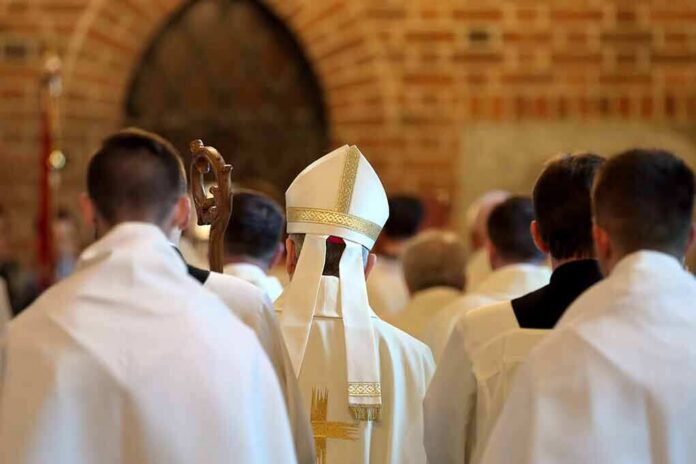
When a Catholic cardinal says defending marriage and family may demand martyrdom, it signals how deep the cultural and spiritual cracks in our society have become.
Story Snapshot
- Cardinal Raymond Burke is urging Catholics to defend traditional marriage and family even to the point of martyrdom.
- He warns that marriage, as the Church understands it, is under “diabolical” attack from modern culture and even from inside the Church.
- His call fits a wider clash over divorce, same-sex unions, and the meaning of family in Western societies.
- The debate echoes broader American fears that powerful elites are reshaping core values while ordinary families pay the price.
Cardinal Burke’s Call to Defend Marriage “To the Point of Martyrdom”
Cardinal Raymond Burke recently told Catholics they must be ready to defend marriage and family even at the cost of martyrdom. He spoke during a homily at a shrine in Wisconsin, using the Apostle James as an example of loyalty to the point of death. Burke said believers should be prepared for “red martyrdom” of blood or “white martyrdom” of daily witness in the face of mockery and persecution. This is not soft language; it is a clear warning about coming conflict.
Burke has used the word “martyrdom” for years when talking about marriage and family. In a major essay on faith today, he explained that martyrdom means giving the highest witness to the truth, even unto death. He cited older Catholic teaching that every true follower of Christ must expect some form of martyrdom in defending core beliefs. For him, that includes resisting pressure to accept new ideas about sex, divorce, and family that clash with long-standing doctrine.
Why He Says Marriage Is Under “Diabolical Attack”
Burke argues that the basic truth of marriage is under a “ferocious and indeed diabolical attack” in today’s world. He points to campaigns to redefine marriage, the spread of same-sex unions, and a culture that treats sexual behavior as a matter of preference, not moral law. In one speech, he called Western society a “disordered moral state” and said secular forces are pushing “unnatural sexual activity” as normal. In plain terms, he sees a direct hit on the family as God created it.
For Burke, defending life, marriage, and the family is not a side issue; it is the foundation of any “viable human culture.” He links the breakdown of family life, attacks on unborn children, and confusion over gender to a deeper spiritual crisis. He warns that the “call to the martyrdom of witness is even more urgent” because of these trends. He also stresses that Catholics must be willing to suffer socially and politically when they stand against laws or norms that weaken lifelong, faithful marriage.
Clash Inside the Church: Indissoluble Marriage and Pastoral Change
This debate is not only about the wider culture; it is also about fights inside the Church hierarchy. Burke strongly opposed proposals to let some divorced and civilly remarried Catholics receive Communion while still living as husband and wife with a new partner. He said that allowing this would be a “fundamental break” with Catholic teaching on the indissolubility of marriage. In another interview, he insisted it is “impossible” for the Church to change this teaching.
Burke helped write a book defending traditional marriage and later joined other cardinals in issuing formal questions, called “dubia,” about Pope Francis’s document on family life, Amoris Laetitia. He believes Church leaders cannot separate doctrine from pastoral practice. If marriage is indissoluble in teaching, then practice must reflect that, even when people suffer after divorce. Supporters say he is guarding clear rules; critics say he is blocking efforts to show mercy and flexibility in complex family situations.
Deep Echoes in a Distrustful, Divided Society
Burke’s warning lands in a world where many Americans, left and right, feel their leaders no longer protect ordinary families. Conservatives see past “woke” and globalist policies as driving moral confusion and high costs that make raising a family harder. Liberals see growing gaps between rich and poor and fear minorities and migrants are treated as disposable. Both sides worry that a distant “elite” makes rules while regular people absorb the fallout.
Cardinal Raymond Burke has called on Catholics to remain steadfast in defending the sanctity of marriage and family, even if it requires personal sacrifice or martyrdom. Speaking during the Feast of St. James at the Shrine of Our Lady of Guadalupe in Wisconsin, he urged the… pic.twitter.com/S1dMhQOgjK
— SG News (@SGNews123) August 5, 2026
When Burke talks about secular powers attacking marriage and calls for heroic witness, many hear more than a church debate; they hear another sign that core institutions are drifting away from everyday values. For some Catholics, his martyrdom language is a rallying cry to resist cultural pressure on sex, gender, and family. For others, it feels like another front in a culture war that ignores real struggles of broken homes and economic stress. Either way, his words underline how high the stakes now seem for the future of marriage, family, and faith.
Sources:
lifesitenews.com, thecatholicherald.com, sspx.org, ncronline.org, christianpost.com, youtube.com, sspx.ca, religionnews.com