
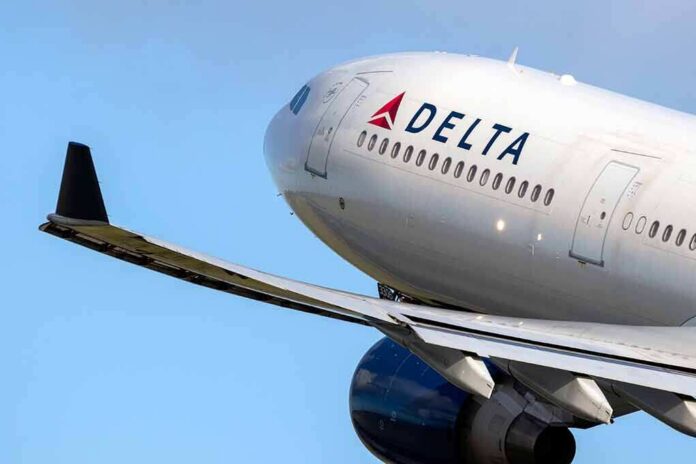
Delta’s automated weight-and-balance system failed at the world’s busiest airport, forcing manual workarounds and triggering hours of delays at the heart of Thanksgiving travel.
Story Highlights
- Delta confirmed an automation failure tied to weight-and-balance calculations and used manual workarounds.
- The Federal Aviation Administration (FAA) shifted a Delta-only ground stop to a ground delay averaging under an hour.
- Reports counted hundreds of Atlanta delays on Sunday morning as the disruption spread through schedules.
- Holiday travelers faced backups while flights continued operating under airline and FAA procedures.
What Triggered the Delays at Atlanta
Delta Air Lines reported a failure in its automated system that helps calculate aircraft weight and balance on Sunday at Hartsfield-Jackson Atlanta International Airport. The airline said teams were using manual workarounds to keep flights moving while work continued to restore automation. The problem hit during peak holiday travel. That timing increased congestion and made the effects more visible to travelers across many routes that connect through Atlanta.
The Federal Aviation Administration issued a Delta-only ground stop early, then downgraded it to a ground delay program. The agency’s advisory said the shift meant flights could move but with expected waits averaging just under an hour, and the program was set to continue into the early afternoon. The FAA described the action as carrier-specific, not an airport shutdown. That detail matters because other airlines were not directly halted under the advisory.
How Weight-and-Balance Automation Affects Flights
Airlines use software to speed weight-and-balance math and center-of-gravity checks before pushback. That automation makes dispatch faster and helps crews avoid errors. When the system fails, crews can shift to approved manual steps, but those steps take more time and labor. Delta said it used manual workarounds to keep departures safe while restoring its tools. That process slowed gate turns and ramp work, which then rippled into longer lines and missed connections across the network.
Federal guidance explains that airlines must follow an approved weight-and-balance control program. Automation can be the primary tool, but operators must still meet limits for weight and center of gravity when systems fail. This framework aims to protect safety first, even if on-time performance suffers. It also explains why the FAA could allow flights to continue under a ground delay, since the airline had alternate procedures within its approved program.
Scope and Scale of the Thanksgiving Disruption
Local outlets reported large and rising delay counts at Atlanta through the morning. One report cited 364 delays at the airport, while another placed the total near 500 shortly before 10 a.m.. Those differences likely reflect changing conditions as flights stacked up and cleared. The FAA advisory tied average waits to just under an hour and noted the program could last until about 1 p.m. Eastern time. Such averages can mask longer waits on some routes and shorter ones on others.
Delta asked for the initial FAA action that became the ground delay, underscoring that the problem was specific to the carrier’s operations that morning. Crowds formed at gates as agents reprinted paperwork, updated load sheets, and resequenced departures. Even when the system outage eased, schedules remained out of alignment. That prompted rolling delays into midday as crews and aircraft returned to planned rotations.
Why This Matters Beyond One Bad Morning
Air travel today runs on complex software. When one key tool fails, the impact can spread fast, especially at a mega-hub like Atlanta. The episode shows how a single point of failure can slow thousands of people and strain airport staff. It also shows the value of backup procedures that keep planes within safety limits, even when computers go dark. The tradeoff is time. Manual steps protect standards, but they reduce throughput and raise traveler frustration.
An issue with Delta Air Lines’ weight and balance automation system was causing flight delays Sunday at its hub in Atlanta and nationwide. https://t.co/HO1EdtiG7s
— ABC7 News (@abc7newsbayarea) November 22, 2026
Travelers of every viewpoint see the same pattern: systems grow more complex, yet basic services still break at the worst time. People pay more for tickets, wait longer in lines, and still get stuck when software fails. That fuels a wider worry that large institutions talk about resilience but deliver fragility. When operators are transparent and regulators act quickly, trust can hold. Clear updates, rapid root-cause work, and proof the fix will stick are the next tests for Delta and the FAA.
Sources:
facebook.com, wctv.tv, wsbtv.com, reddit.com, faa.gov