

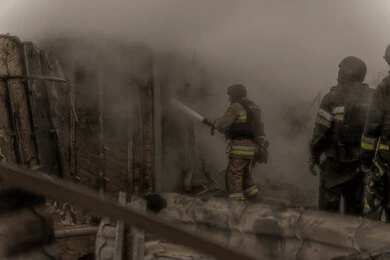
A single set of sparks from an older man’s car has now become the symbol of how fragile our modern industrial life is when basic safety, planning, and accountability break down.
Story Snapshot
- Overnight wildfire near Thessaloniki spread into an industrial zone, destroying factories and a recycling plant.
- Authorities arrested a 76-year-old man, accused of starting the blaze when his vehicle threw sparks into roadside vegetation.
- Hundreds of firefighters battled toxic smoke and explosions from burning industrial materials as evacuations were ordered.
- The case highlights how human negligence, weak prevention, and climate-stressed landscapes combine to turn small mistakes into major disasters.
Wildfire tears through factory belt outside Thessaloniki
Late Saturday evening, a fast-moving wildfire broke out in ravines and brush near the Oraiokastro suburb of Thessaloniki, Greece’s second-largest city. Strong winds pushed the flames downhill into a mixed area of forest, homes, and factories, including a large recycling plant filled with flammable materials. Two factories were reported completely destroyed as the fire swept through the industrial zone overnight, sending explosions and thick smoke into nearby neighborhoods. Residents watched from a distance as orange flames lit the sky and black smoke covered western Thessaloniki.
Greek authorities ordered evacuations for three nearby suburbs and a special-needs facility housing 157 people, moving most residents to a gym and some to a psychiatric hospital for safety. Fire officials urged people in parts of Thessaloniki to stay indoors, close windows, and seal doors as toxic smoke from the burning recycling plant drift over the city. About 160 firefighters, dozens of engines, and water-dropping aircraft worked through the night to keep the blaze from reaching dense residential districts. By Sunday, the fire had damaged several businesses and homes, though most main city neighborhoods were spared.
Police focus on a 76-year-old driver accused of sparking the blaze
Overnight, the Hellenic Fire Service announced the arrest of a 76-year-old man on suspicion of starting the wildfire through negligence. Officials say the man’s vehicle produced sparks that ignited dry vegetation along a roadside near Oraiokastro, just as winds and high heat made the area extremely fire-prone. Fire authorities also said the man “appeared not to be sober” when detained, suggesting alcohol may have played a role in his behavior and reaction time. He is expected to appear before a prosecutor, who will decide formal charges and possible pre-trial conditions.
Greek media reports say investigators are still working to confirm exactly how and where the ignition occurred, but the official line points squarely at human negligence, not faulty infrastructure or corporate behavior. A post from Greek Reporter described the man’s driving as “reckless” and tied his alleged sparks directly to the wildfire that later engulfed factories and sent smoke over Thessaloniki. Other outlets echoed the fire service narrative that a single careless act on a dry, windy night set off a chain of events that emergency crews struggled all night to contain. So far, there is no public evidence of wider criminal intent, organized arson, or sabotage.
Human error meets weak prevention and climate-stressed landscapes
This case fits a broader pattern inside Greece’s fire seasons, where officials quickly blame individual negligence, often tied to vehicles, barbecues, or machinery, when major wildfires erupt near towns. Fire experts have long warned that Greece’s forests and peri-urban areas hold huge amounts of dry “fuel” because of poor land management, abandoned fields, and weak prevention planning. That means a single spark on the wrong day can race through brush and industrial zones before ground crews have time to act. In 2021 and earlier seasons, investigators found that planes were often used instead of strong early ground attacks, leaving fires to grow too large.
🔥 Wildfire spreads to factories near Greek city of Thessaloniki
🚒 Firefighters focus on recycling plant and textile factory as thick smoke blankets much of Thessaloniki pic.twitter.com/vbQW6XmPKM
— Anadolu English (@anadoluagency) July 5, 2026
Greek officials say most wildfires are avoidable and caused by people, not lightning or freak accidents. A fire service spokesman recently estimated that roughly 85% of Greek wildfires start with negligence, from tossed cigarettes to outdoor cooking and farm equipment. At the same time, climate research shows hotter, drier summers and stronger winds make every mistake more dangerous, since plants and soils are already dry and ready to burn. For many citizens, that mix of human error, underfunded prevention, and climate stress looks like a system built to fail, where ordinary people and workers pay the price when the state and big business cut corners on safety.
Sources:
youtube.com, cbc.ca, ground.news, abcnews.com, facebook.com, apnews.com, seymourtelegraph.com.au, cnn.com