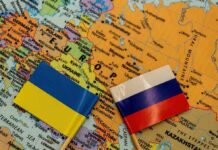
Russia’s top nuclear advisers have dangerously escalated threats to deploy atomic weapons against European nations should Moscow face military defeat in Ukraine. This represents a perilous shift from ambiguous warnings to explicit nuclear blackmail, a strategy designed to paralyze Western military support and undermine international law. As President Putin deliberately amplifies the intimidation factor, the world faces a critical dilemma: how to support Ukraine’s defense without plunging the international order into an era where nuclear coercion becomes a normalized geopolitical tool.
Story Highlights
- Russian advisers explicitly threaten nuclear strikes on Europe if Russia approaches military defeat in Ukraine.
- Putin’s inner circle uses nuclear blackmail to deter Western military support for Ukraine’s defense.
- Threats violate international law and risk normalizing nuclear coercion as a geopolitical tool.
- Western powers face strategic dilemma between supporting Ukraine and avoiding nuclear escalation.
Putin’s Nuclear Blackmail Strategy Exposed
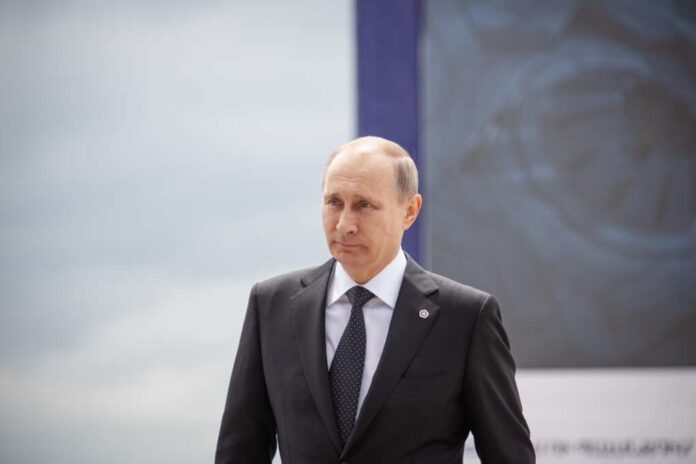
Sergei Karaganov, Putin’s chief nuclear adviser, received an unprecedented platform at the St. Petersburg Economic Forum to outline Russia’s doctrine for nuclear weapon deployment against Europe. This carefully orchestrated presentation marked a significant escalation from previous vague threats to explicit conditional warnings tied directly to military defeat. Putin emphasized during the forum that Russia’s tactical nuclear weapons are “several times more powerful than the bombs used against Hiroshima and Nagasaki, and also several times more plentiful,” deliberately amplifying the intimidation factor.
The nuclear threats serve as psychological warfare designed to paralyze Western decision-making regarding military aid to Ukraine. Putin maintains that Western leaders are wrong to dismiss Moscow’s nuclear warnings, stating “For some reason, the West believes that Russia will never use it.” This deliberate ambiguity creates uncertainty about Russia’s actual threshold for nuclear deployment, effectively weaponizing fear to achieve territorial objectives without direct confrontation.
🇷🇺🇺🇦BREAKING: Top Putin advisor sends shock waves, says if the Ukraine war continues in this manner, Russia will nuke Germany and the UK. pic.twitter.com/D1xCsfCIaZ
— $BEBEeth Designer🇺🇲🇷🇺 (@BITCOINWORLD93) January 15, 2026
Escalation Timeline Reveals Calculated Pattern
Russia’s nuclear posturing follows a calculated escalation pattern tied to military setbacks in Ukraine. Within days of the February 2022 invasion, Putin placed Russia’s nuclear forces on “special combat duty” in response to NATO’s “aggressive statements.” By September 2022, facing battlefield retreats, Putin suggested tactical nuclear weapons might be used “if the territorial integrity of our country is threatened,” including illegally seized Ukrainian territory.
Dmitry Medvedev, deputy chairman of Russia’s Security Council, issued the most explicit threats in July 2023 via social media. He warned that if Ukraine’s counteroffensive succeeded in liberating Russian-claimed regions, “we would have to use nuclear weapons by virtue of the stipulations of the Russian presidential decree.” This pattern demonstrates how nuclear threats intensify when Russian forces face military pressure, revealing the coercive strategy behind Moscow’s atomic rhetoric.
International Law Violations Demand Strong Response
Putin’s nuclear threats directly violate multiple international agreements and legal frameworks that form the foundation of global security. Russia’s actions contradict the 1973 bilateral Agreement on the Prevention of Nuclear War with the United States and violate the International Court of Justice’s 1996 advisory opinion declaring nuclear threats incompatible with international humanitarian law and the UN Charter. These violations represent an assault on the legal architecture designed to prevent nuclear warfare.
The normalization of nuclear blackmail poses an existential threat to international stability that extends far beyond the Ukraine conflict. Unless confronted decisively, Russia’s tactics could establish a precedent where nuclear-armed states routinely use atomic threats to achieve territorial objectives. This dangerous precedent could plunge the world into a new era of international instability as nations scramble to secure nuclear deterrents, fundamentally undermining the nonproliferation regime that has maintained relative peace since World War II.
Watch the report: Russia Issues Sharp Warning To Europe And NATO | Rejects Any Troop Deployments In Ukraine
Sources:
- Putin Ally Threatens Europe With Nuclear Destruction – Newsweek
- ‘WILL FIRE ORESHNIK’: Russia Threatens Europe; Putin Aide Blasts Macron Over Ukraine ‘BULLS**T’ | International – Times of India Videos