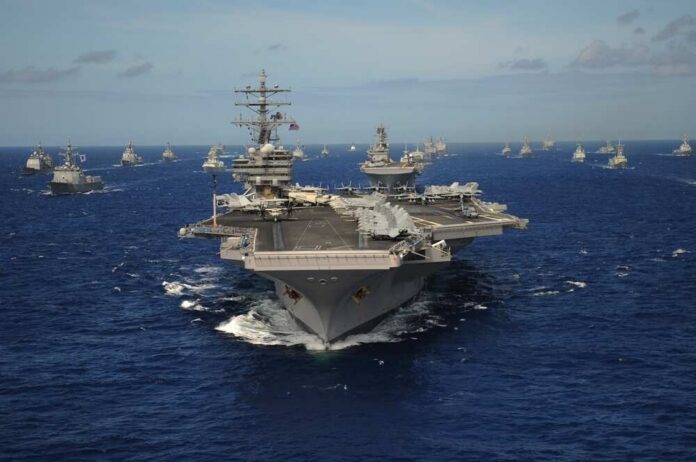
The Navy’s newest and most expensive aircraft carrier endured a grueling 11-month deployment to the Middle East for operations against Iran, suffering a devastating shipboard fire that treated over 200 sailors for smoke inhalation while equipment failures mounted and families back home waited months beyond promised return dates.
Story Highlights
- USS Gerald R. Ford’s deployment extended from 7 to 11 months for Iran operations, approaching Vietnam-era records
- Shipboard fire in laundry area required 24+ hours of damage control, treating 200+ sailors for smoke inhalation
- Senator Tim Kaine raises alarms about sailor morale, retention, and mounting maintenance backlogs
- Deployment reveals consequences of shrinking fleet and endless Middle East commitments under current administration
Broken Promises and Extended Deployments
The USS Gerald R. Ford departed Naval Station Norfolk on June 24, 2025, for what sailors and families were told would be a standard 7-month deployment. Instead, the crew found themselves rerouted to the Middle East in February 2026 when the administration launched a campaign against Iran starting February 28. Vice Admiral Jim Kilby confirmed in early March 2026 that the deployment would stretch to 11 months, with sailors already having spent 253 days at sea by that point. This represents precisely the kind of endless Middle East entanglement that frustrated voters believed would end, yet here we are watching our servicemembers pay the price for another regime change operation.
Crisis at Sea: Fire and Failing Equipment
In March 2026, a fire erupted in the carrier’s laundry area requiring more than 24 hours of damage control efforts. Over 200 sailors received treatment for smoke inhalation as the Navy’s most technologically advanced vessel struggled with the emergency. The ship was forced to divert to Naval Support Activity Souda Bay in Crete, Greece, for repairs. This crisis came atop ongoing equipment failures as deferred maintenance issues compounded during the extended deployment. The $13 billion Ford-class carrier, commissioned in 2017 with advanced electromagnetic catapults and nuclear reactors, proved vulnerable to basic operational hazards while sailors improvised repairs with broken gear far from home.
Congressional Concerns About Sailor Welfare
Senator Tim Kaine of Virginia, representing the carrier’s homeport of Norfolk, pressed Navy Secretary John Phelan with serious concerns about crew morale, retention, and maintenance impacts. Kaine’s intervention highlights the human cost of extended deployments that the Navy brass publicly downplays. Approximately 5,000 sailors aboard the Ford and its carrier strike group missed family milestones, anniversaries, and births while operating in the Red Sea. The Norfolk community felt the economic and morale strain as deployment after deployment stretches beyond promised timelines. These extended absences create recruitment and retention nightmares that will haunt the Navy for years, yet Admiral Daryl Caudle offered only praise for crew resilience rather than accountability for the policies causing the strain.
Fleet Shortages Drive Unsustainable Operations
The Ford’s 11-month deployment, potentially reaching 334 days and rivaling the USS Midway’s Vietnam-era record of 332 days, exposes fundamental problems with America’s naval strategy. The shrinking carrier fleet cannot sustain current operational demands without breaking sailors and ships. Unlike the USS Nimitz’s 341-day COVID-era deployment driven by pandemic logistics, the Ford’s extension stems directly from Middle East combat operations against Iran that strain an already overtaxed force. Maintenance backlogs are mounting, with public shipyards scrambling to adjust schedules for whenever the battered carrier finally returns. This cycle accelerates Ford-class maintenance demands and disrupts carrier rotation navy-wide, undermining long-term readiness for the sake of short-term Middle East presence.
The situation aboard the USS Gerald R. Ford crystallizes the disconnect between campaign promises to avoid new wars and the reality of 2026. Sailors expected to be home by early 2026 instead find themselves firefighting in Iranian waters while leadership celebrates their endurance rather than questioning the mission itself. As Rear Admiral Paul Lanzilotta insists the crew remains “focused and capable,” families in Norfolk and MAGA voters nationwide ask when capability stops being an excuse for endless deployments. The constitutional mandate to provide for the common defense does not require sacrificing our sailors’ wellbeing and family stability for operations that were supposed to end, not expand, under this administration.
Sources:
Navy’s Kilby signals USS Ford could see 11-month deployment, approaching record length
Kaine Presses Navy on Extended Deployment of USS Gerald R. Ford
USS Gerald R. Ford Crew Demonstrates Resilience, Readiness During Extended Deploy
USS Gerald R. Ford Now in the Red Sea, USS George H.W. Bush Wraps Pre-Deployment Exercises