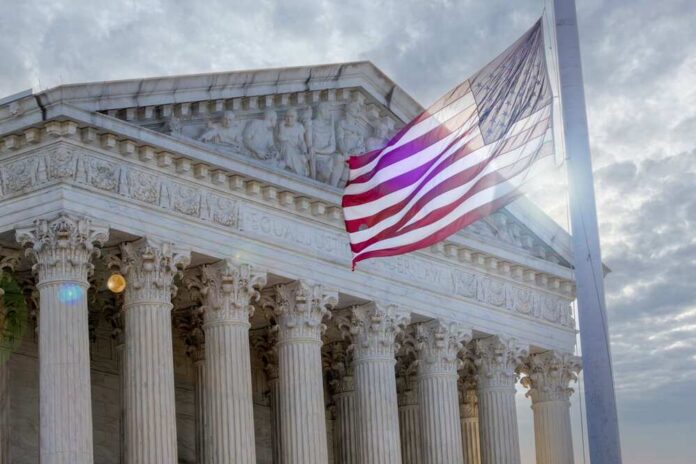
The Supreme Court has agreed to hear a case that could determine whether states can exclude religious preschools from taxpayer-funded programs while simultaneously allowing secular schools to maintain selective admissions policies based on race, gender identity, and economic status.
Story Snapshot
- Supreme Court will review Colorado’s exclusion of Catholic preschools from a $349 million universal preschool program
- Two Catholic schools were denied participation for refusing to admit children from LGBTQ+ families, while secular schools with selective admissions remain eligible
- The case challenges whether Colorado violated religious liberty protections established in recent Supreme Court precedents
- U.S. Solicitor General filed a brief supporting the Catholic schools, arguing the state discriminates against religious institutions
Religious Liberty Clash Over Public Funding
St. Mary Catholic Virtue School in Littleton and Wellspring Catholic Academy in Lakewood applied to participate in Colorado’s Universal Preschool program in 2023 but were rejected by state officials. The Colorado Department of Early Childhood determined that the schools’ admissions policies violated the program’s nondiscrimination requirements on sexual orientation and gender identity. The Catholic institutions require families to support Catholic teachings on marriage and sexuality, creating an irreconcilable conflict with state mandates that forced their exclusion from the taxpayer-funded initiative.
Pattern of Lower Court Defeats
The Archdiocese of Denver and the two preschools filed suit in federal court in August 2023, arguing Colorado’s exclusion violated their constitutional rights to free exercise of religion. A federal district court sided with the state in January 2024, ruling that the program’s requirements were neutral and generally applicable. The 10th Circuit Court of Appeals upheld that decision in September 2025, going further by praising Colorado’s policy as a “model” for other states. The appellate court relied on the 1990 Supreme Court decision in Employment Division v. Smith, which permits restrictions on religious exercise if laws are neutral.
Alleged Double Standard in Admissions Policies
Legal representatives from the Becket Fund for Religious Liberty argue Colorado applies discriminatory standards by permitting secular schools with selective admissions to participate in the universal preschool program. The petition to the Supreme Court notes that while Catholic schools face exclusion, the state allows other participating schools to prioritize admission for “children of color” or “gender-nonconforming children.” Aaron Reaves of the Becket Fund stated there is “no evidence of discrimination” by the Catholic preschools and emphasized that government cannot enforce ideological orthodoxy on religious institutions seeking equal treatment under publicly funded programs.
Supreme Court Precedents Challenge State Position
The case arrives at the Supreme Court against a backdrop of recent decisions favoring religious liberty in public funding disputes. In Trinity Lutheran v. Comer (2017), the Court ruled states cannot exclude religious schools from playground resurfacing grants. Espinoza v. Montana Department of Revenue (2020) established that excluding religious schools from scholarship programs violates the Free Exercise Clause. Most recently, Carson v. Makin (2022) prevented Maine from barring religious schools from its tuition assistance program. These precedents suggest Colorado’s exclusionary policy faces significant constitutional obstacles, particularly given the state’s accommodation of secular selective admissions while rejecting religious criteria.
Federal Government Backs Religious Schools
The U.S. Solicitor General filed an amicus brief on January 30, 2026, urging the Supreme Court to reverse the 10th Circuit’s decision. The brief argues Colorado creates unequal exemptions that favor secular institutions while discriminating against religious ones. This federal support amplifies the national significance of the case, signaling potential implications for similar funding programs across the country. The involvement of the Solicitor General transforms what began as a state-level dispute into a broader examination of how government must treat religious institutions when distributing public benefits, particularly when selective admissions are permitted for secular purposes.
Stakes for Religious Education and Government Control
Colorado’s Universal Preschool program serves more than 40,000 children through a network exceeding 2,000 providers, with religious institutions comprising roughly two percent of participants. The program, funded by $349 million and approved by voters through Proposition EE in 2020, promises “universal access” to preschool for four-year-olds. Catholic families and preschools argue they face financial penalties for maintaining faith-based admissions standards while secular alternatives receive taxpayer support. A Supreme Court ruling in favor of the petitioners could force states nationwide to reconsider policies that exclude religious providers from public funding, potentially reshaping early childhood education and reigniting debates over voucher and charter school programs that intersect with religious liberty concerns.
Sources:
Colorado Catholic preschool discrimination case hits Supreme Court – Washington Examiner
Colorado Catholic parents and preschools ask Supreme Court for equal treatment – Denver Catholic
U.S. Solicitor General backs Catholic preschools in Colorado case – Magisterium
Catholic preschools appeal to Supreme Court in Colorado case – Colorado Public Radio
Supreme Court weighs Colorado pre-K religious liberty challenge – Law Week Colorado
St. Mary’s Catholic Parish v. Roy – ERLC