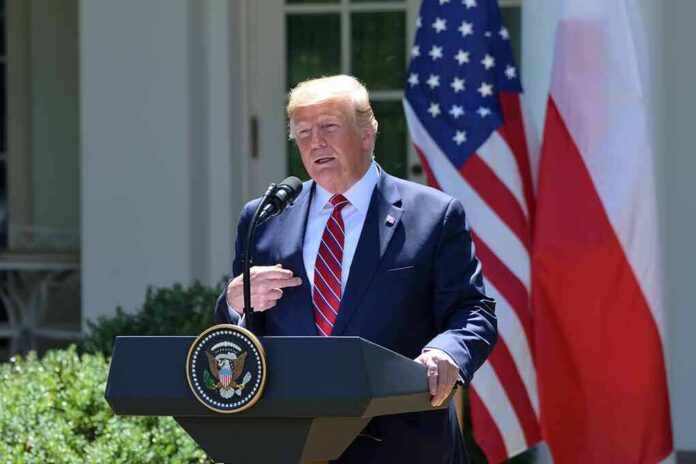
President Trump and China’s President Xi Jinping delivered tightly scripted remarks at the White House as a rare state visit moved from pageantry to pointed talks on trade, technology, and Taiwan.
Story Highlights
- Trump and First Lady Melania hosted Xi Jinping and Peng Liyuan for an official state visit.
- China confirmed Xi’s September 23–25 trip at Trump’s invitation.
- Both leaders planned public remarks at the White House and during the state dinner.
- The visit comes amid tensions over trade rules, advanced tech, and Taiwan.
What Happened at the White House Today
The White House said President Trump and First Lady Melania Trump welcomed President Xi Jinping and Peng Liyuan for an official state visit on Thursday, September 24, 2026. The announcement framed a day of ceremony, speeches, and a formal dinner. The schedule included morning remarks by both presidents and another round of remarks during the evening state dinner. The plan did not include a full news conference with open questions from reporters, according to an Associated Press live report.
China’s Foreign Ministry said Xi would be in the United States from September 23 to 25 at Trump’s invitation. The statement said the two leaders would hold in-depth talks. Beijing’s notice tracked with the White House timing and emphasized the strategic nature of the meeting. Newsrooms described the visit as the first state visit by a Chinese leader to Washington in more than a decade, underscoring its rarity and high stakes.
What the Leaders Aimed to Address
U.S. and Chinese officials signaled that trade rules, technology controls, and Taiwan would be front and center. Reuters and broadcast outlets previewed talks over export limits, artificial intelligence risks, and supply chains. They also noted military tensions in the Taiwan Strait and questions about Iran. The public program leaned on ceremony to project stability, while both sides kept tighter control on unscripted press time during the visit, a common feature of such summits.
The leaders’ remarks were designed to reassure their own public and to reduce friction. Earlier reporting noted that both sides wanted to “relax tension” and steady the relationship after months of sharp rhetoric. Analysts pointed to the long gap since the last comparable visit. That gap raised pressure on both teams to show progress, even if concrete deals take longer. The stagecraft signaled a reset effort, but lasting change depends on follow-up steps after the ceremonies end.
Why It Matters Beyond the Optics
Regular Americans are watching prices, jobs, and retirement accounts. Trade and tech rules between the two largest economies hit all three. Tariffs and export limits can change costs for farm goods, cars, and consumer electronics. Clear rules on chips and artificial intelligence can shape factory jobs and data security. When leaders speak from the White House podium, they send signals that move markets. That is why the tone of these remarks matters even if the tough details come later.
🇺🇸🇨🇳 THE SILENT DRILL
WATCH THE VIDEO
There was something visually striking about today’s ceremony at the White House.
President Trump, President Xi, Peng Liyuan and First Lady Melania Trump stood together on the BLUE ROOM BALCONY, watching the U.S. Marine Corps Silent Drill… pic.twitter.com/Dei8FMEa5e
— Christina71-1111 (@christinab9124) September 24, 2026
Many citizens across the political spectrum worry that Washington power players care more about image than results. A stage-managed visit can look like theater. But even careful ceremony can set guardrails. It can pause escalations and open doors for talks on fentanyl flows, cyber theft, and military hotlines. The measure will be whether promised working groups and timelines appear after the visit. If they do, the scripted words today could start real, trackable steps tomorrow.
Sources:
youtube.com, whitehouse.gov, apnews.com, cbsnews.com, abcnews.com, reuters.com, nytimes.com, nbcnews.com