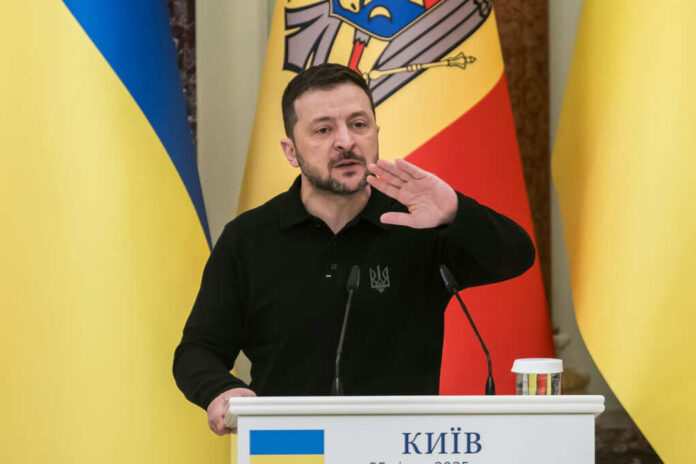
President Volodymyr Zelensky has moved fast to reshape Ukraine’s security team, and the biggest surprise is how quickly the changes sparked confusion and backlash.
Quick Take
- Zelensky appointed Yevhenii Khmara to act as head of the Security Service of Ukraine after Vasyl Malyuk stepped down.
- Some reports wrongly described Khmara as a defense minister, which mixed up two separate state jobs.
- The reshuffle came during a wider shake-up of Ukraine’s wartime leadership.
- Zelensky then urged unity as protests and political noise grew around the moves.
Zelensky’s Security Shake-Up
Ukrainian reporting and official decrees show that Zelensky appointed Major General Yevhenii Khmara as acting head of the Security Service of Ukraine, after Vasyl Malyuk resigned from that post. Khmara had led the agency’s Alpha Special Operations Centre before the appointment, and the change was part of a larger round of wartime personnel shifts in early January 2026. Several outlets covered the move as a leadership reset inside Ukraine’s security services.
The confusion matters because the Security Service of Ukraine is not the Ministry of Defense. The security service handles internal security and counterintelligence work, while the defense ministry runs military policy and administration. In this case, the public record points to Khmara taking over the security service, not the defense ministry. That mix-up can sound small, but in wartime it can distort who is actually in charge of what.
Why the Backlash Grew
The appointment landed inside a larger leadership overhaul that also touched military intelligence, border security, and the cabinet. Reporting said Zelensky was replacing several top officials as Ukraine faced pressure from Russia and growing demands for stronger wartime management. That broader shake-up gave critics more room to question timing, process, and trust, even though the core appointment itself is documented and not in dispute.
At the same time, the public reaction exposed a deeper problem: many Ukrainians and outside observers are now sorting real personnel changes from bad information. Research on Russia’s information war has shown that false or misleading stories often blur agency roles and leadership titles to create confusion. In this case, the mistaken defense-minister framing fits that pattern of role-conflation, where a real appointment gets wrapped in the wrong institution.
Unity Message Meets Political Strain
Zelensky’s call for unity was meant to steady the message, but it also showed how tense the moment had become. Ukraine has been under intense strain from the war, from internal reform demands, and from repeated leadership changes. When protesters and critics react to one reshuffle, it usually reflects larger fears about stability, competence, and whether top officials are making changes fast enough or simply creating more churn.
Ukrainian President Volodymyr Zelensky ousted the country’s popular defense minister, Mykhailo Fedorov, prompting protests in Kyiv over a fear that his removal will jeopardize the war effort just as Ukraine is scoring victories on the front line. https://t.co/fAMxI1lVAc
— The Washington Post (@washingtonpost) July 16, 2026
That tension reaches beyond Ukraine’s borders because the story also shows how quickly a factual personnel move can become information warfare. A real resignation, a real appointment, and a real public backlash can all be wrapped into a noisy narrative that hides basic structure. For readers, the key fact is simple: Khmara was appointed to lead the Security Service of Ukraine in an acting role, and the defense-minister label was the error.
Sources:
insiderpaper.com, meduza.io, euromaidanpress.com, youtube.com, eeas.europa.eu, chathamhouse.org