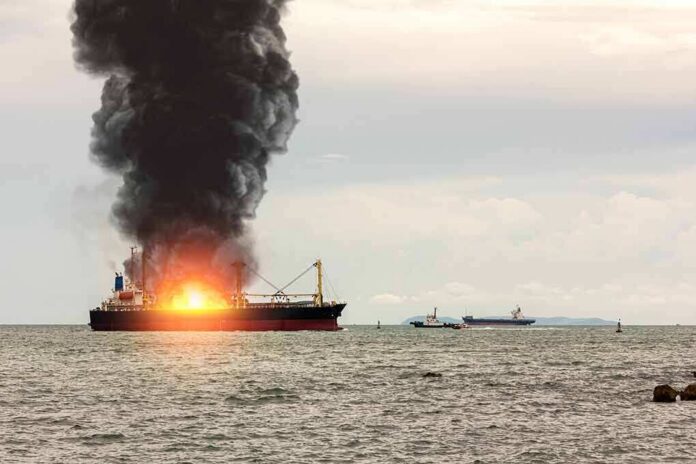
An Indian cargo ship sinking in a war-torn Red Sea after an attack is another warning that global conflict is now reaching ordinary workers just trying to earn a living.
Story Snapshot
- An Indian-flagged cargo vessel sank in the Red Sea off Yemen after coming under attack, but all crew members were rescued.
- India’s government says the ship was hit near Yemeni waters and has formally condemned the strike as an attack on a civilian vessel.
- The attack fits a growing pattern of ships targeted in the Red Sea, turning a major trade route into a danger zone.
- The incident highlights how distant conflicts and unaccountable armed groups can threaten basic trade and worker safety worldwide.
What Happened To The Indian Cargo Ship
On August 4, an Indian-flagged commercial vessel named MSV Faize Noore Oliya sank in the Red Sea off the coast of Yemen after it was hit during an attack. India’s Ministry of External Affairs said the ship was struck and then went down near Yemeni waters, and it publicly condemned the incident as an attack on a defenseless civilian vessel. Reports say the ship was sailing about 13 nautical miles south of the Yemeni port city of Hodeidah when the strike occurred, placing it squarely inside a known conflict zone.
India’s shipping minister Sarbananda Sonowal said the vessel was hit by a projectile near Yemeni waters, which caused it to capsize and sink. Other reporting, citing Yemeni sources, describes the strike as coming from an explosives-laden boat, showing that even basic details like the weapon used are not yet fully clear. Despite this confusion, both Indian officials and multiple news outlets agree on the core chain of events: the ship came under attack, was badly damaged, and ultimately sank in the Red Sea off Yemen.
Rescue Efforts And Confusion Over Crew Numbers
India’s Foreign Ministry said that all 13 Indian nationals on board were rescued after the sinking, and it thanked Yemeni authorities for their support in the operation. Other reports note that there were 14 people in total on the ship, including one Yemeni crew member, and that all 14 were brought to safety by Yemeni rescue forces and taken to the Port of Mokha on Yemen’s western coast. These small differences in the count mainly reflect whether the Yemeni sailor is included, but they show how numbers can shift in fast-moving emergencies.
Media coverage says survivors received medical checks or first aid after they were brought ashore, and there have been no reports of deaths or serious injuries among the crew. India’s Embassy in Riyadh is reported to be working with Yemeni authorities to support the rescued sailors and to gather more details on the incident. Even with all lives saved this time, the experience for those workers was likely terrifying: one moment they were doing their jobs, the next they were fighting to escape a sinking ship in a war zone.
Red Sea Attacks And A Growing Risk To Global Trade
This attack did not happen in isolation; it is part of a wider pattern of ships being targeted in the Red Sea as different armed groups try to use a vital trade route as leverage in regional wars. In recent months, Yemen’s Houthi movement and other forces have struck multiple cargo vessels with missiles, rockets, drones, and explosive boats, sometimes sinking ships and killing crew members. In one separate case, a Liberian-flagged ship named Eternity C was attacked repeatedly and later sank, with several sailors killed and many missing, showing how deadly these strikes can be.
For regular Americans watching from home, this may feel far away, but the impact comes back to us in higher prices, shipping delays, and more fragile supply chains. When a major sea lane like the Red Sea becomes a battlefield, insurance costs spike, companies reroute ships, and the price of basic goods can rise. Many citizens already believe global elites and distant bureaucrats play games with wars and trade while ordinary workers pay the price. Stories like this Indian ship attack reinforce that fear, because it is hard to see who, if anyone, is truly held accountable.
Unanswered Questions And The Deep State Feel
Key facts remain unclear, including exactly who carried out the attack and what weapon was used; some reports link the strike to forces opposed to the Yemeni government, while others simply say no group has claimed responsibility yet. There is also no public forensic report, no detailed ship owner statement, and no full release of rescue logs in the record provided so far, leaving important gaps about how the incident unfolded minute by minute. This kind of partial information is common in modern conflicts, where governments and armed groups shape the story long before independent experts can investigate.
Just in: Indian Shipping minister Sarbananda Sonowal statement on sinking of Indian commercial vessel in Red Sea
"Indian MSV Faize Noore Oliya has been hit by a projectile near Yemeni waters, causing the vessel to capsize and sink. India strongly condemns this unprovoked attack…
— Sidhant Sibal (@sidhant) August 4, 2026
For Americans who already feel that the “deep state” and global power players hide the truth, the pattern here looks familiar: regular people get fragments of information, while decisions about war, trade routes, and risk are made far above their heads. Both conservatives and liberals increasingly agree that the federal government is failing to protect basic economic security, even as overseas crises threaten energy supplies and shipping lanes. A civilian cargo ship sinking after an attack, with crew saved mainly by local forces rather than a strong international system, underlines that sense that no one is really in charge of safety for ordinary workers at sea.
Sources:
insiderpaper.com, tribuneindia.com, x.com, ndtv.com, newsx.com, facebook.com, mea.gov.in, youtube.com, themedialine.org, timesofisrael.com, moneycontrol.com, bbc.com, en.wikipedia.org, whalesbook.com