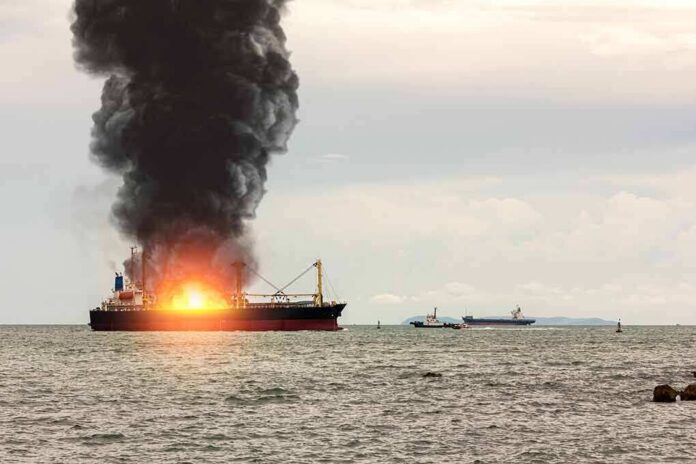
Three Iranian oil tankers burned or lay dead in the water after Iran fired ballistic missiles at two U.S. Navy warships—and that sequence matters.
Story Snapshot
- U.S. Central Command said Iran fired missiles at a U.S. carrier and a destroyer; both evaded.
- U.S. forces struck three Iranian-linked oil tankers tied to a “shadow” shipping network.
- Two tankers were disabled and one destroyed; crews on one ship abandoned before the hit.
- Iran claims the U.S. struck first and broke a ceasefire, setting up a sharp narrative clash.
What Triggered The Tanker Strikes
U.S. Central Command reported that Iranian forces launched ballistic missiles at a U.S. aircraft carrier and a guided-missile destroyer operating in international waters. Both ships evaded the attack, and no U.S. personnel were hurt. Soon after, U.S. forces hit three Iran-linked oil tankers. Command officials framed the action as a targeted response meant to impose costs for attacks on commercial shipping and U.S. forces, not as an unprovoked strike.
Major outlets carried the same broad sequence: missiles at U.S. warships, then U.S. strikes on three tankers. That alignment across reports suggests the U.S. version set the public baseline for what happened. The specific vessels named in coverage mapped to key Iranian export nodes and routes. The message was plain: if you shoot at U.S. ships or threaten maritime traffic, your oil lifelines are at risk. Washington chose targets that hit wallets, not cities.
Why These Ships, And Why Now
U.S. officials described the targets as part of a shadow shipping network that funds Iran’s Islamic Revolutionary Guard Corps and its proxy forces. The network uses old tankers, complex ownership webs, and tricks like turning off tracking signals and ship-to-ship transfers to hide origin and buyers. That playbook is well documented across sanctions advisories and maritime analyses, and it underpins why the U.S. treats some “commercial” tankers as dual-use assets when linked to hostile activity.
Central Command said two tankers were disabled and one destroyed, and that the crew had abandoned one unladen ship before the strike. That detail signals an effort to reduce the risk to civilian mariners, a point that tracks with long-standing rules about distinction and proportionality at sea. The practical effect aims to be leverage, not mass casualties: deny revenue streams that fuel missiles and drones, and do it without turning sailors into targets.
The Legal And Strategic Frame
Washington’s case hangs on self-defense under the United Nations Charter after an armed attack at sea. The law of the sea allows warships to transit and defend themselves in international waters. The difficult question is not the right to defend, but how far that right extends when the targets are civilian-flagged ships tied to a hostile state’s military finance network. The answer rests on necessity, proportionality, and solid intelligence that the vessels directly supported the attacks.
The US says it struck three Iran-linked oil tankers after ballistic missiles targeted two American warships, escalating tensions around the Strait of Hormuz. https://t.co/aoiuecL9QB
— Global Breaking News (@GNFBreaking) September 5, 2026
From a deterrence view, the strike picks a pressure point Iran cannot ignore: oil cash. A hit to export capacity and insured shipping raises costs quickly. That aligns with common-sense strategy and American conservative values: defend our sailors, keep sea lanes open, and punish the war-makers, not the workers. The risk sits in miscalculation. Sink too much capacity or hit the wrong ship, and you push fence-sitters to Iran’s side and spike global prices without ending the threat.
Iran’s Counter-Claim, And How It Stacks Up
Iran’s military says the U.S. struck an Iranian tanker first and broke a ceasefire, and that Iran then launched missiles, cruise missiles, and drones at U.S. ships, causing significant damage. That story clashes directly with the U.S. timeline. Iran presented its claim through state-linked channels, not independent evidence. Without radar tracks, imagery, or neutral verification, the counter-claim looks like a bid to flip the blame narrative more than a refutation of U.S. accounts.
Iran also says it hit two tankers for taking an unsafe southern route and ignoring warnings. That line seeks to cast Iran as a safety enforcer rather than an aggressor. But under transit passage norms, policing shipping lanes with missiles is not maritime safety; it is coercion. Lawful defense claims require a clear armed attack to justify force, not disputed warnings in a crowded chokepoint. That is a hard sell outside Tehran’s media space.
What To Watch Next
Two proof points will decide how this episode lands: the U.S. release of strike and battle-damage imagery, and any allied confirmation of the initial missile attack on the carrier group. If those show clean shots, minimal mariner harm, and tight links to the Revolutionary Guard’s finance chain, the deterrent story holds. If they do not, critics will call it economic warfare at sea. Markets, insurers, and shippers will vote with premiums before diplomats finish their talking points.
Sources:
bbc.com, centcom.mil, thehill.com, reuters.com