

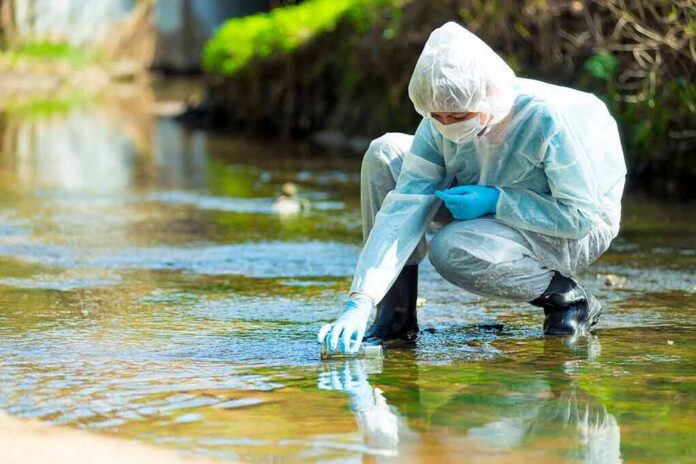
Michigan’s own environmental agency says three out of every four rivers and streams in the state likely have too much fecal contamination to meet safety rules.
Quick Take
- Michigan’s environmental agency estimates 75% of rivers and streams exceed state limits for fecal bacteria.
- The estimate comes from testing at 367 sites statewide, not a check of every waterway.
- More than half of tested spots are too dirty even for wading or paddling.
- The state says sewage overflows, farm runoff, and broken septic systems all share the blame.
- Michigan faces a $15 billion gap in unfunded water infrastructure repairs over 20 years.
State Testing Shows Widespread Contamination
Molly Rippke, who runs E. coli testing for Michigan’s Department of Environment, Great Lakes, and Energy (EGLE), told the Associated Press that results so far show about 75% of rivers and streams likely break state fecal-contamination limits. The finding comes from the agency’s own draft 2026 report, not from outside activists. That report pulled data from 367 testing sites across Michigan, including 257 chosen through a statistical sampling method.
The numbers matter because they affect how people use the water. Michigan’s swimming standard is broken when a single sample tops 300 E. coli per 100 milliliters, or when a 30-day average passes 130. The looser limit for paddling, wading, and fishing sits at 1,000 E. coli per 100 milliliters. The Associated Press reported that most tested waterways failed the swimming standard, and over half failed even the lower bar for simple water contact.
What the Numbers Don’t Prove
The 75% figure is an estimate, not a full count. Michigan has tested roughly half of its rivers and tributaries, so the number stretches results from tested spots to guess at the rest. Rippke herself noted that water quality changes constantly and most waterways aren’t checked regularly, so a high reading doesn’t mean a river stays polluted all the time.
E. coli bacteria also work only as a stand-in, or proxy, for fecal contamination. Finding high E. coli levels doesn’t by itself prove a specific virus or parasite caused someone to get sick. The state uses E. coli because it’s a cheap way to flag where other, harder-to-detect germs might also be present. That distinction matters for anyone reading the 75% number as a direct health verdict.
No Single Source, No Clear Culprit
EGLE describes the pollution problem as complex, pointing to sewage overflows, leaking septic systems, and runoff from farms, including large livestock operations. Bridge Michigan reported that Michigan communities face about $15 billion in unfunded stormwater and wastewater repair needs over the next two decades, with fixes to known problem rivers repeatedly delayed. A separate University of Michigan analysis put the statewide water infrastructure funding gap even higher, near $40 billion in one-time costs alone.
The available record doesn’t point to one decision by Governor Gretchen Whitmer that caused these conditions. Responsibility is spread across local governments, utilities, farmers, septic system owners, and state regulators going back through multiple administrations. Whitmer’s office announced an $89 million Reclaim the Rivers initiative in October 2026 aimed at cleaning up contamination in the Detroit and Kalamazoo rivers, though that effort targets industrial pollutants like PCBs rather than fecal bacteria specifically.
Pure Michigan has a poop problem: Dangerous fecal levels befoul 3 of 4 rivers
Rachel Cuschieri-Murray loves the Grand River, which she calls a “precious gift.” The state’s longest river flows 252 miles from Hillsdale County, past farm fields…https://t.co/yWk6a8Ttaq pic.twitter.com/2CDZPH47CP— Blue Community .net (@BlueCommunity_N) November 20, 2026
EGLE says it already works to fix the problem through a federally approved pollution-reduction plan, known as a Total Maximum Daily Load, first approved by the Environmental Protection Agency in 2019. The agency enforces discharge permits, orders corrective action against illegal polluters, and asks landowners and local health departments to volunteer fixes in farm-heavy areas. The state also built a public mapping tool so residents can check contamination risks near them.
Why This Resonates With Frustrated Voters
This story lands at a moment when people across the political spectrum already doubt whether government agencies fix the problems they’re paid to fix. Conservatives see confirmation that environmental promises outpace results. Liberals see proof that underfunded infrastructure and lax farm rules hurt public health. Both camps can point to the same $15 billion repair gap and ask why it took this long for lawmakers to act, regardless of who sits in the governor’s office.
What’s clear is that Michigan’s rivers carry real risk for swimmers, paddlers, and anglers, backed by the state’s own data. What’s not clear is who, specifically, let the problem grow this large, and whether any single administration could have stopped decades of sewer overflows, farm runoff, and septic failures on its own.
Sources:
the-independent.com, theoaklandpress.com, michigan.gov