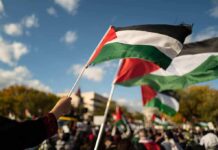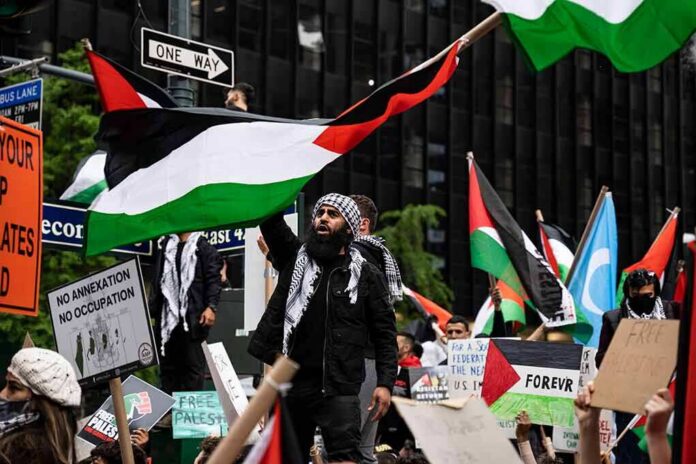
Across Europe’s recent unrest, Palestinian flags appeared not as proof of a single command center but as a portable frame that fused with local grievances—an instance of diffusion, not direction—where symbolism traveled faster and farther than any verifiable organizational control.
The Short Version
- Palestinian symbols visibly surfaced amid disruptive protests in multiple European countries; images showed overlap with far-left and anarchist iconography in places like Berlin and Hamburg.
- In France, Palestinian and Algerian flags were present alongside vandalism and clashes; some footage captured anti-Israel and anti-American acts.
- Large portions of the marches were peaceful and centered on domestic issues—education conditions, cost of living, and public services—before smaller groups engaged in violence.
- The strongest reading of the evidence: transnational symbolic diffusion layered onto primarily domestic protest agendas, without public proof of centralized pro-Palestinian direction of violence.
What the images show—and what they do not
Video and reporting from France and Germany established a consistent visual motif: Palestinian flags and keffiyehs were present in demonstrations that, at their violent fringes, featured arson, looting, and clashes with police. In Germany, Palestinian flags were reported alongside anarchist and Antifa insignia during demonstrations across roughly 30 cities; fires and looting were described in Hamburg and Frankfurt. In France, Palestinian and Algerian flags surfaced amid rioting in central Paris, while footage from Lyon showed the burning of U.S. and Israeli flags and anti-Israel chants. These facts substantiate overlap in street scenes between Gaza solidarity imagery and radical-left symbols. What they do not do is identify chain-of-command, financing streams, or operational direction by Palestinian-solidarity groups for the violent acts themselves. The imagery is unequivocal; responsibility is not.
Claims of large-scale coordination across borders likewise run ahead of hard documentation. Commentary describing flags “everywhere” and unrest spanning France, Germany, Italy, Belgium, Portugal, Albania, Spain, and Greece points to a cross-national pattern; however, public records supplying synchronized instructions, shared logistics, or common funding remain thin. Allegations summarizing a 54-organization network in France broaden the possible ecosystem, but the digest available to the public does not provide the underlying incident-by-incident evidence necessary to ascribe operational culpability. A compelling picture emerges; it is not yet a ledger of command responsibility.
The domestic engine of the protests
The center of gravity of these mobilizations has been squarely domestic. Across reputable accounts, hundreds of thousands marched in France over education conditions, crumbling facilities, teacher shortages, and the cost of living; the daytime marches were largely peaceful before later confrontations escalated. Reuters and the BBC frame the broader European wave around overlapping grievances: poor schools, perceived lack of opportunity, corruption, housing, and inflationary pressure. Greece is illustrative: approximately 10,000 students and teachers rallied peacefully over education funding and overcrowded classrooms—a reminder that not every national episode fit the imagery-led narrative. This dual reality—mass peaceful mobilization on bread-and-butter issues, followed by smaller cohorts engaging in disorder—repeats across countries and days. It complicates any monocausal story.
Understanding that structure matters for accountability. When marches are mass and daytime-peaceful, while violence concentrates after-hours among smaller clusters, the analytical question becomes which networks populate the fringe. Some reporting ties named pro-Palestinian groups to attendance and visible support in France—such as Urgence Palestine and a branch of the Association France Palestine Solidarité—without demonstrating that these organizations directed vandalism or assaults. That gap is not a technicality; it is the difference between cultural presence and criminal liability.
Diffusion versus direction: how transnational protest frames travel
Social-movement research helps discipline interpretation. Diffusion is the process by which repertoires—slogans, symbols, tactics—spread across borders and are then localized; coordination, by contrast, implies shared planning, logistics, and command. European protest scholarship repeatedly finds that cross-border signals travel quickly, but outcomes are structured by domestic grievances, political opportunities, and incumbent-movement infrastructures. In practice, this means a flag can become the meme that jumps borders, even as the reasons that people assemble remain rooted in national context—public-service decay in one city, fuel-price shocks in another, youth precarity almost everywhere. The Palestinian flag, in this episode, is a resonant signifier that grafted onto those existing frames; its ubiquity proves resonance, not hierarchy.
This distinction also clarifies why images can mislead. Flags and keffiyehs are visually salient—especially against a backdrop of fire and police lines—but salience is not a proxy for operational authorship. If accountability is the aim, incident-level evidence rules: arrest logs tied to specific acts, charging documents, conviction records, and forensic video linking identifiable individuals and banners to discrete offenses. At present, public reporting provides strong descriptive overlap and weak causal attribution. That is a classic diffusion pattern.
Where reasonable disagreement lives
The debate is not about whether Palestinian symbols were present—they were—but about what that presence means. One camp treats recurring symbols and far-left overlap as circumstantial evidence of a consolidated ideological network steering disorder. Its strongest exhibits are the scenes themselves and named group attendance at some French rallies. The counter-position, grounded in BBC and Reuters coverage and consistent with the scholarship on protest diffusion, holds that the protests were primarily about domestic grievances, that most participants were peaceful, and that late-breaking violence came from subsets whose composition varied by city and night. On the evidence available publicly, the latter case carries more weight: it better fits the scale and timing of peaceful assemblies and relies less on inference from imagery to organization.
That does not end the inquiry. If coordination existed, it would leave footprints—encrypted chats discovered in prosecutions, shared logistics, convergent travel patterns, or funding flows. None of those are established in the cited material. Conversely, if violence is largely opportunistic or stems from locally embedded radical networks, case files will reflect that, with charges clustering around known domestic actors. Either way, the test is documentary, not rhetorical.
What to watch next: evidentiary tests with real diagnostic power
Three kinds of records will convert speculation into knowledge. First, police and prosecutorial files: arrests cross-referenced to organizations, indictments specifying conspiracy or material support, and conviction narratives that place suspects at scenes with roles beyond presence. Second, communications and logistics: subpoenas or lawful disclosures that reveal coordinated timing or shared transport, and the provenance of banners and supplies. Third, forensic video: time-synced footage from municipal cameras, body-worn devices, and verified uploads capable of linking identifiable flag-bearers to criminal acts. Absent those, a prudent conclusion remains the middle one: salient transnational symbols layered onto protests powered chiefly by national discontent.
Sources:
pjmedia.com, kompas.id, theage.com.au, ianslive.in, algemeiner.com, timesofisrael.com, thejournal.ie