Japan scrambled fighters four days in a row as Chinese and Russian reconnaissance aircraft probed key corridors around its islands during the large Keen Sword 27 drills.
Story Highlights
- Japan recorded five reconnaissance flights by China and Russia over four days, triggering fighter scrambles.
- Chinese Y-9 aircraft used the Okinawa–Miyakojima gap, a vital route between the East China Sea and the Pacific.
- Russian Il-20 aircraft flew toward waters off Shimane Prefecture in the Sea of Japan on two days.
- The activity overlapped with Keen Sword 27, a major Japan-United States exercise running October 19–29.
Scrambles Track Five Reconnaissance Flights Over Four Days
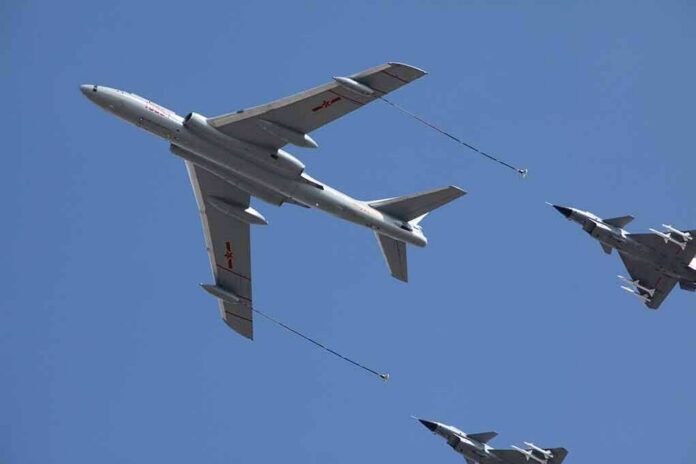
Japan’s Joint Staff reported five military flights near its airspace between October 20 and 23, prompting daily fighter scrambles. Reports identify three Chinese Y-9 missions and two Russian Il-20 missions. Two Chinese flights crossed the Okinawa–Miyakojima gap on October 20 and 21. Russian Il-20 aircraft flew toward waters off Shimane Prefecture on October 22 and 23 before turning back. Japan scrambled fighters each day to monitor the aircraft and document their movements.
Japanese aircraft also photographed at least one Chinese mission during the exercise’s opening period, according to reporting on a Ministry of Defense release. A Y-9 and a BZK-005 drone moved through the Okinawa–Miyakojima gap from the East China Sea, and Japan Air Self-Defense Force fighters intercepted for visual confirmation. Officials did not state that territorial airspace was violated. The missions occurred near international waters commonly used for reconnaissance routes.
Why the Okinawa–Miyakojima Gap and Shimane Approaches Matter
The Okinawa–Miyakojima gap forms a narrow passage between the East China Sea and the western Pacific. Chinese aircraft using that lane can watch allied ship and air traffic moving to and from the Philippine Sea. The reported Y-9 routes matched past patterns that seek to observe exercises, logistics, and radar responses. The Russian Il-20 flights near Shimane approached Japan’s Sea of Japan coastline, a separate vector that still presses Japan’s air defenses and sensor coverage.
Japan’s scramble response reflects standard practice when foreign military aircraft approach its air-defense identification zones. Scrambles are common while proven airspace incursions are rare. Japan recorded 669 scrambles in fiscal year 2023, but only 46 recognized airspace violations from 1967 through 2023. That contrast shows how often foreign aircraft test edges and watch drills without crossing into sovereign airspace. The recent four-day run fits that broader pattern of high-tempo monitoring.
Keen Sword 27 Set the Stage for Surveillance and Signaling
Keen Sword 27, the biennial Japan-United States drill, ran October 19–29 and involved about 45,000 Japanese personnel, 40 vessels, and 260 aircraft. Exercises of this size attract foreign reconnaissance as a matter of routine. China and Russia had clear reasons to sample radio traffic, radar behavior, and force flows during the event. Japan’s confirmation of five flights from October 20–23 aligns closely with the exercise’s most active opening week.
🚨 JAPAN SCRAMBLES FIGHTER JETS AS CHINA & RUSSIA STEP UP SPY FLIGHTS!
Japan intercepted five reconnaissance flights near its territory between October 20–23, involving three Chinese Y-9s and two Russian Il-20s.
The timing? Right in the middle of the massive US–Japan Keen Sword… pic.twitter.com/a2IQEd4YxW
— Xi Znping (@XiZnping) October 27, 2026
The Joint Staff did not state the Chinese and Russian missions were coordinated. The timing shows overlap, but overlap does not prove joint planning. The aircraft types identified, China’s Y-9 and Russia’s Il-20, are built for intelligence roles. Their presence during a major drill supports a surveillance purpose even without public details on sensors or collected data. Officials and outlets report no Japanese territorial airspace breach in this episode.
What This Means for Readers at Home
Foreign flights near Japan’s borders during big drills mirror what Americans see near Alaska and Guam. Major powers watch each other’s moves because military readiness, communications, and logistics matter more than slogans. Governments spend billions while middle-class families face rising costs and fewer clear answers. When great powers posture, the risk is that routine surveillance can spark missteps. Clear rules and calm intercepts help keep the peace while leaders argue elsewhere.
Sources:
stripes.com, mod.go.jp, aerotime.aero, straitstimes.com