
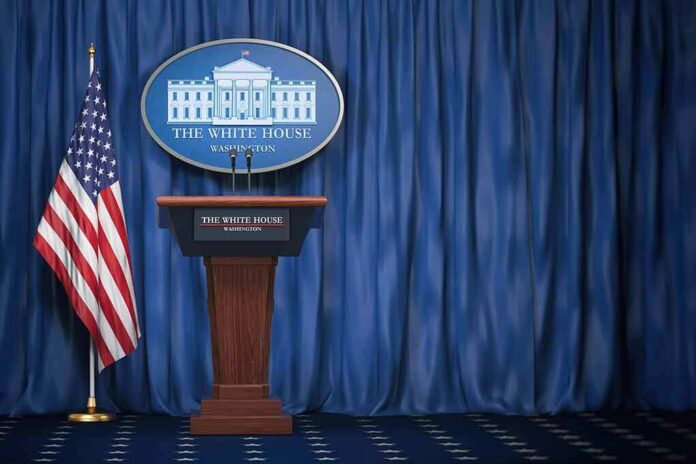
The White House is reviewing mass preemptive pardons for junior staffers, a sweeping step with few modern parallels that could shield aides tied to high-stakes policies.
Story Highlights
- Two sources said White House lawyers evaluated mass or policy-specific pardons for junior staffers.
- President Trump said preemptive staff pardons are legally possible and that he is open to the idea.
- Outside conservative groups reportedly urged pardons or legal-fee support for aides under scrutiny.
- The proposal remains under discussion with no draft order or named beneficiaries identified.
What the White House Is Reportedly Considering
Washington Sun reported that White House attorneys examined broad clemency for junior staffers, citing two people familiar with the talks. The report said a universal pardon for all junior personnel was viewed as unlikely. Instead, the team weighed blanket pardons tied to work on deportations, war, or trade policy. Those areas have drawn intense legal and political fights in recent years. The report did not list names, eligibility rules, or a time window for covered conduct, leaving the scope unclear.
Mediaite summarized the same core idea and described the policy-specific approach as a more realistic option than a universal sweep. Newsweek also framed the discussions as part of renewed talks about staff pardons, but did not present documentary proof, such as a draft proclamation. The reporting to date centers on internal evaluations and options. It does not show that the administration has chosen a path or scheduled an announcement. That distinction matters for staff and critics who want clarity on next steps.
What President Trump Said About Preemptive Pardons
President Trump told reporters in Florida that he had not thought about mass staff pardons but said he would be allowed to issue them. He argued that aides should not “go through hell” after serving during years of what he called corrupt weaponization against his administration. The Washington Examiner quoted him saying he is “allowed” to grant such preemptive pardons to junior staffers, which shows legal openness but not a final decision. His comments set the tone but stop short of confirming active drafting.
Those remarks fit a long-running debate over how presidents use clemency. Supporters see preemptive pardons as a shield against partisan probes. Opponents see them as a way to avoid accountability. That split has grown as federal politics has hardened. Both sides say the system favors elites and leaves regular people behind. This fight taps that shared concern: whether powerful officials protect their own while everyday citizens face strict rules and rising costs with little relief.
The Legal Frame: Preemptive Pardons Are Rare but Possible
Legal scholars point to Supreme Court precedent that allows a pardon after a federal offense is committed, even before charges are filed, which makes preemptive pardons legally plausible. National outlets have noted examples, including President Gerald Ford’s pardon of Richard Nixon, and broader amnesties for draft evaders, which show unusual but real precedents. Experts also stress that such pardons are rare and often come late in a term, when political risk and legal exposure both rise.
Those precedents do not answer every detail that matters here. Lawyers still debate how specific a preemptive pardon must be about conduct. They also debate how far a blanket pardon can reach across a group of people tied to general policy work. That legal gray area explains why counsel might prefer policy-linked categories over a universal sweep. It is easier to defend a pardon that names a clear set of acts and a defined time period, rather than an open-ended class.
Outside Pressure and the Politics of Protection
Washington Sun reported that the Heritage Foundation and American Moment urged the White House to prepare pardons or at least fund legal defenses for staff facing probes, lawsuits, or Hill inquiries. Raw Story echoed that outside pressure, saying the talks had “turned serious” as lawyers studied blanket options. Such advocacy can look like a defense of civil servants who followed orders. It can also look like a political shield built by allies to preempt courtroom tests.
👀White House Is Weighing Mass Pardons for Junior Staff https://t.co/85tItch5WJ
— Sally Sue 🕊️NO DMs (@SallySueIam) October 25, 2026
That framing lands in a country where many voters on the left and right feel the system protects insiders. Conservatives point to years of investigations they see as payback. Liberals point to powerful people skating past rules others must follow. If the White House grants policy-specific pardons, supporters will call it a guard against partisan revenge. Critics will call it proof that elites close ranks while families struggle with high prices, taxes, and uneven justice.
What We Know and What Comes Next
Today’s facts are clear and limited. Reporting, based on unnamed sources, says lawyers reviewed mass or targeted pardons for junior staffers. Mediaite and Newsweek matched that core picture and added that a universal pardon is unlikely. President Trump said the law allows preemptive pardons and that he is open to them, but he has not announced a policy or signed an order. No public draft, list of beneficiaries, or timeline has surfaced in these reports.
The next signals to watch are straightforward. First, any on-the-record White House statement naming covered conduct or personnel. Second, a formal proclamation that outlines dates and offenses. Third, congressional reactions that could shape legal and political risk. Until then, staffers, watchdogs, and voters are left with a live option on the table and an old question that cuts across party lines: does power serve justice, or does it mainly protect itself?
Sources:
mediaite.com, newsweek.com, washingtonexaminer.com, washingtonsun.com, rawstory.com