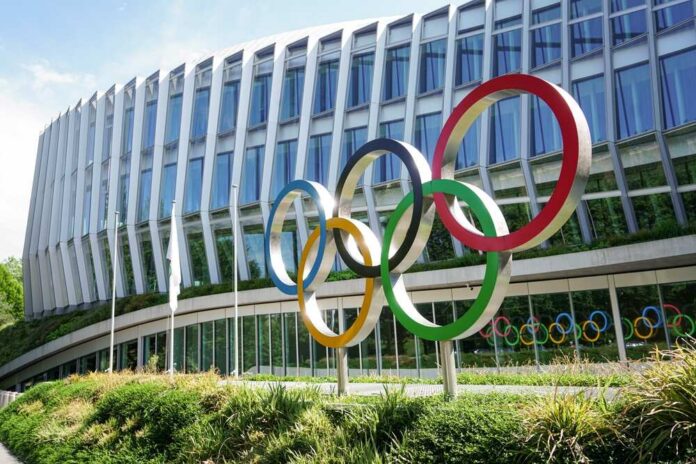
The International Olympic Committee has lifted its suspension of the Russian Olympic Committee — opening the door for Russian athletes to compete at the 2028 Los Angeles Games — even as Russia’s war in Ukraine continues.
Story Snapshot
- The International Olympic Committee (IOC) provisionally lifted its suspension of the Russian Olympic Committee (ROC), citing the ROC’s decision to stop claiming jurisdiction over four Ukrainian territories annexed by Russia.
- Russian athletes may compete at the 2028 Los Angeles Games, but the Russian flag and anthem remain banned — for now — with final decisions on national symbols left to individual sports federations.
- The IOC imposed the original suspension in October 2023 after Russia’s Olympic body claimed authority over sports organizations in Ukrainian territory, which violated the Olympic Charter.
- Critics, including Ukraine’s allies, call the move premature. Some sports bodies are already moving faster than the IOC, with World Aquatics allowing Russian athletes to compete under their national flag and anthem.
Why the IOC Suspended Russia in the First Place
The IOC suspended the ROC in October 2023 for a specific reason. After Russia’s full-scale invasion of Ukraine in 2022, the ROC claimed control over sports organizations in four Ukrainian regions — Donetsk, Luhansk, Kherson, and Zaporizhzhia. The IOC said this violated the Olympic Charter, which protects the territorial rights of each country’s National Olympic Committee (NOC). The Court of Arbitration for Sport upheld that suspension when Russia appealed.
The IOC’s original ban on Russia and Belarus came just days after the February 2022 invasion. Since then, Russian athletes have competed only as neutrals — no flag, no anthem, no team events. The IOC argued this approach protected athletes from being punished for their government’s actions while still holding the Russian state accountable.
IOC President Kirsty Coventry stated that “athletes should not be punished for their government’s actions” while also affirming that the IOC stands “shoulder-to-shoulder in solidarity with Ukraine.” The IOC says sanctions against Russian state officials remain in place. No events will be held in Russia, and Russian government officials will not be invited to IOC events.
What Changed — and What Hasn’t
The IOC says it lifted the suspension because the ROC formally stopped claiming jurisdiction over those four Ukrainian territories. That was the specific Charter violation that triggered the ban. With that condition met, the IOC says it had legal grounds to provisionally restore the ROC’s status. The IOC also proposed changes to its own charter in June 2026 to better protect sports from political interference.
Despite the lifted suspension, the ROC itself remains under a separate review by the IOC’s Legal Affairs Commission tied to Russia’s long history of state-sponsored doping. Russian athletes will still compete under restrictions. The ban on displaying the Russian flag and anthem has not been formally lifted by the IOC — though the final call on national symbols has been left to each individual sports federation.
The Complications Critics Are Pointing To
Not everyone is on board. World Athletics, the governing body for track and field, has rejected the IOC’s proposal to lift Belarus’s ban. Meanwhile, World Aquatics went the other direction — it already allows Russian swimmers to compete with their national flag and anthem, drawing sharp criticism from Ukraine. This patchwork of rules across different sports creates confusion about what the IOC’s standards actually mean in practice.
🚨 IOC PROVISIONALLY LIFTS SUSPENSION OF THE RUSSIAN OLYMPIC COMMITTEE
The International Olympic Committee (IOC) has provisionally lifted the suspension of the Russian Olympic Committee (ROC), which had been suspended since October 2023 for incorporating regional sports… pic.twitter.com/YNwTbsq59k
— Track & Field Gazette (@TrackGazette) July 7, 2026
There are also unresolved doping concerns. A whistleblower reportedly told the World Anti-Doping Agency (WADA) about a Russian athlete’s direct knowledge of the state-sponsored doping scandal from 2014, though WADA has not confirmed an active investigation. Around 40 athletes born in Russia competed under other nations’ flags at the Milan Olympics, raising questions about whether vetting rules — which require athletes to have no military ties and no support for the war — are being enforced consistently. The IOC has not released a public audit of how those checks are carried out. Until the rules are applied uniformly and transparently, the debate over Russia’s return to the Olympic stage is far from settled.
Sources:
insiderpaper.com, youtube.com, olympics.com, reddit.com, facebook.com, latimes.com, pbs.org