

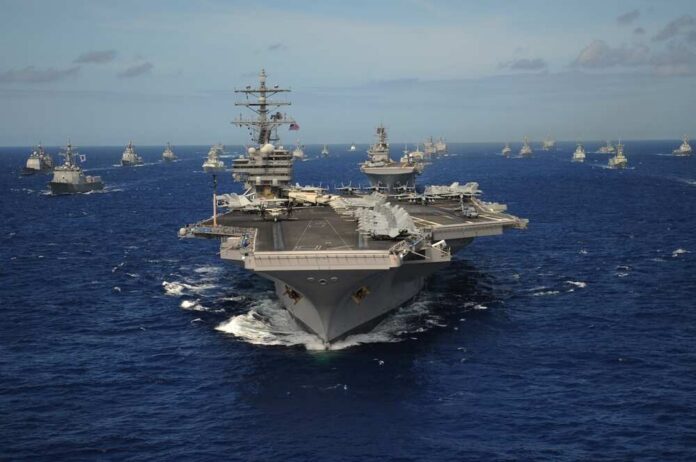
USS America, half the size of a Nimitz-class carrier, packs 13 F-35B stealth fighters on deck, revolutionizing U.S. naval power projection against growing threats like China—yet at what cost to traditional Marine amphibious roles?
Story Highlights
- USS America (LHA-6) sails with at least 13 F-35B Lightning IIs visible, potentially more below deck, turning an amphibious ship into a “Lightning Carrier.”
- America-class prioritizes massive hangar space over well decks, enabling 20+ F-35Bs on a 45,000-ton vessel versus 100,000-ton supercarriers.
- Boosts Indo-Pacific deterrence amid China tensions, doubling surge airpower for Marine Expeditionary Units without full carrier deployments.
- Trade-offs spark debate: enhanced aviation sacrifices ground assault capacity, fewer LCACs and Marines embarked.
America-Class Design Revolutionizes Naval Aviation
USS America, lead ship of the America-class, entered service in 2014 after keel-laying in 2007. Builders at Huntington Ingalls Shipbuilding in Pascagoula, Mississippi, optimized Flight 0 ships like America and Tripoli for aviation from the start. These vessels lack floodable well decks found in Wasp-class predecessors, dedicating space to an enlarged hangar up to 11,000 square feet larger. This shift supports F-35B short takeoff/vertical landing (STOVL) fighters, reinforced deck areas handle the jet’s exhaust. Post-delivery refits in 2017 ensured full compatibility. The 45,000-ton ship, homeported in San Diego, carries over 30 aircraft including MV-22 Ospreys and F-35Bs.
Lightning Carrier Concept Emerges in Pacific Operations
U.S. Navy’s 7th Fleet integrates F-35Bs aboard America for “Up-Gunned Expeditionary Strike Groups” amid Indo-Pacific tensions. Observations from 2016-2017 captured 13 F-35Bs on deck during eastern Pacific routine operations, approximating Lightning Carrier mode. Recent activities include VMFA-121 operations in the Philippine Sea on August 26, 2024, and VMFA-242 takeoffs on February 18, 2025. USS Tripoli validated the concept in exercises. Vice Adm. Karl Thomas emphasized flexibility: F-35Bs enable strikes and Expeditionary Advanced Base Operations one day, switching to MV-22s for troop lifts the next. This supports Marine Expeditionary Units like the 31st MEU.
Stakeholders Drive Integration Amid Trade-Offs
U.S. Navy Amphibious Force and USMC squadrons like VMFA-121 and VMFA-242 lead F-35B integration. Lockheed Martin supplies the versatile STOVL jets, promoting multi-service use. Commanders including Rear Adm. Brad Cooper and Col. Tye R. Wallace hail it as a warfighting leap, boosting lethality in contested seas. Power dynamics show Navy providing platforms while Marines own aircraft and doctrine. Tensions arise as aviation focus reduces amphibious capacity—fewer landing craft air cushion vehicles and embarked Marines. Allies like Japan benefit from forward F-35B presence in exercises such as Cobra Gold 2020.
Strategic Impacts Bolster deterrence, Reshape Doctrine
Short-term, Lightning Carriers double first-day airpower with 20+ F-35Bs per ship, piercing anti-access/area-denial threats from adversaries like China. Long-term, they reshape amphibious ships into distributed light carriers, enabling EABO across islands. Politically, under President Trump’s second term with GOP congressional control, this enhances America First deterrence without bloating federal spending on new supercarriers. Economically, the $100 billion F-35 program sustains shipyards and jobs. Critics note reduced ground punch for MEUs, but consensus favors versatility. Both conservatives frustrated by past globalist overreach and liberals wary of elite-driven wars see a leaner, more capable force serving national interests over endless commitments.
Expert Views Highlight Versatility and Value
Defense analysts at The War Zone declare America-class “changed everything,” trading wells for hangars to maximize F-35B density—the jet’s biggest advantage. CSIS and USNI proceedings underscore daily swaps between air strikes and Marine assaults. Col. Wallace calls F-35B the “most capable aircraft for the rifleman.” Proponents praise surge capacity effectively doubling carrier numbers; detractors lament amphibious trade-offs. In 2026, as federal frustrations mount over elite priorities, this innovation delivers efficient power projection, aligning with demands for government focused on core defense rather than reelection posturing or wasteful programs.
Sources:
Behold USS America Sailing With A Whopping 13 F-35Bs Embarked Aboard
Historic First: F-35B Lands on Wasp, Launching Era of Increased Navy-Marine Corps Integration
F-35B Flight Operations Aboard USS America (LHA 6)
How Capable Are ‘Lightning Carriers’ Armed with F-35Bs for Japan, Iran?