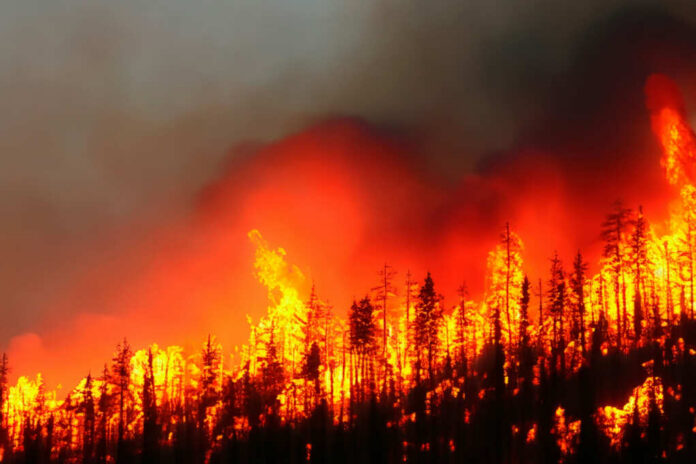
A California island wildfire is burning through rare habitat before investigators have fully pinned down how it started.
Quick Take
- Officials and reports describe the Santa Rosa Island fire as human-caused, but the exact ignition source remains under investigation [1][2].
- Reporting links the leading theory to a stranded sailor who may have used a flare after a boat grounding, but that account is not final [2][3].
- The fire has spread across a large share of the island, including territory important to rare species and Torrey pine habitat [2].
- Public coverage is focusing on the ecological damage, which can overshadow the need for careful fact-finding before blame hardens into certainty [1][2].
Fire Origin Still Unsettled
California fire officials say the Santa Rosa Island blaze is human-caused, and they have not released a final explanation for the ignition point . That distinction matters. A fire can be classified as human-caused without investigators yet knowing whether a flare, equipment failure, or another action started it. In a country where early narratives often outrun the evidence, that gap creates room for rumor and premature certainty, especially when the public sees a dramatic, fast-moving wildfire.
Inside Climate News reported that the leading theory points to a stranded sailor who may have fired a flare after grounding a boat, but the outlet also said the exact origin remained under investigation [2]. The Los Angeles Times similarly described the blaze as sparked by a flare from a shipwrecked mariner, showing how quickly an early explanation can take hold in coverage [3]. At this stage, those accounts remain reporting, not the final word from investigators.
Rare Species Face Immediate Risk
The ecological stakes are high because Santa Rosa Island contains fragile habitats and species that do not have easy alternatives if fire moves through their range [1][2]. Inside Climate News reported that the flames had passed through the island’s Torrey pine stronghold, one of the most sensitive natural features in the Channel Islands [2]. NASA Earth Observatory imagery also showed the blaze spreading across the southern side of the island, underscoring how remote ecosystems can be hit hard before help arrives .
This is the part of the story that should bother people across the political spectrum. Conservatives can see another case of human carelessness turning into a public-cost disaster, while liberals can see the vulnerability of protected habitat and species under stress. Both reactions point to a broader problem: government systems often seem slow, fragmented, and more reactive than preventive. When a rare island ecosystem is already in trouble, every hour of uncertainty carries real consequences for the land and the wildlife that depend on it.
Why the Investigation Matters
The evidence now available is still limited to secondary reporting and official statements, which means the public does not yet have a complete cause-and-origin file [1][2]. That limitation matters because early fire explanations are often simplified for headlines and social media. If investigators later confirm a flare-related ignition, the final record will need to match the scene evidence, not just the first wave of reporting. If they reach a different conclusion, the correction will need to be clear and public.
A large wildfire has burned nearly a third of Santa Rosa Island in California’s Channel Islands National Park — an area home to dozens of rare plants and animals, including some found nowhere else in the world. https://t.co/2dGemGUIjL pic.twitter.com/4QG8YvqmFh
— CNN (@CNN) May 21, 2026
For now, the safest reading is straightforward: a major wildfire has damaged a rare island environment, officials are calling it human-caused, and the exact ignition source remains unresolved [2]. That leaves room for patience, but not complacency. The fire highlights a familiar weakness in American public life, where institutions often communicate in fragments while citizens are left to sort out what is known, what is assumed, and what still needs proof. On a fire-prone coast, that is not a small problem.
Sources:
[1] Web – Fire threatens rare wildlife and fragile habitats on Santa Rosa Island
[2] Web – Fire in the ‘Galapagos of North America’ Risks Species Found …
[3] Web – Largest fire ever recorded on Santa Rosa Island endangers ‘gem of …