
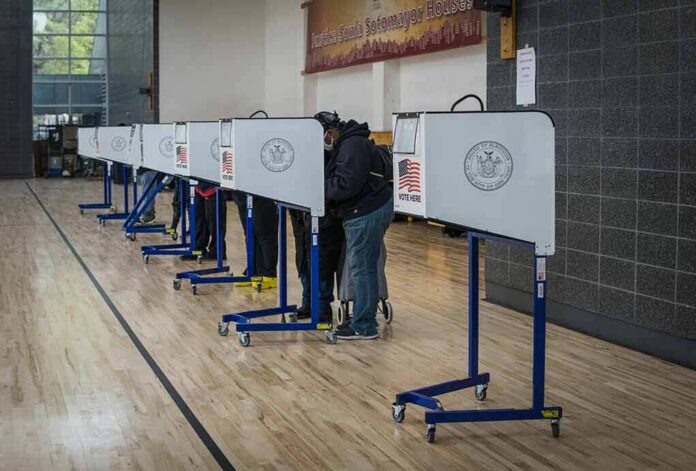
With days to go before voting ends, the Justice Department asked the Supreme Court to let California set aside ballots tied to about 20,000 flagged voters while citizenship is checked — a move courts have so far rejected and the state calls unlawful.
Story Snapshot
- The Justice Department said it identified about 20,000 likely noncitizens on California’s rolls and sought to segregate related ballots.
- Lower courts declined to order ballot segregation, warning of disruption and potential disenfranchisement.
- California officials and outside researchers said the federal list appears error-prone, with thousands of mismatches.
- The Supreme Court was asked to intervene with a temporary, verification-first remedy.
What The Federal Government Asked The Supreme Court To Do
The Justice Department filed an emergency application asking the Supreme Court to require California to set aside ballots linked to roughly 20,000 registered voters who the government says may be noncitizens. The request described the remedy as narrow and temporary. It asked the state not to count those ballots until citizenship could be verified. The department said it worked with the Department of Homeland Security to assemble the list and cited the federal prohibition on noncitizen voting.
Solicitor General D. John Sauer argued that once any disputed ballots are mixed with other ballots, they cannot be separated later. He said the point of segregation was to prevent an irreversible mistake. The filing framed the request as a “modest” step to protect the integrity of federal elections without canceling any votes that later prove lawful. The government emphasized it was not seeking to stop the election or throw out ballots without review.
Why California And Lower Courts Pushed Back
California officials said the federal government had not provided proof that the listed voters are noncitizens. State and local election officials warned that changing procedures so close to Election Day would be unlawful and unworkable, and could block legal voters from having their ballots counted. A federal judge rejected the request, writing that the government’s process description was vague and similar claims elsewhere had proved unreliable.
Los Angeles County’s registrar reviewed a small subset of names and said a substantial share appeared to be U.S. born. Independent researchers at the University of California, Los Angeles reported that 8,880 names, or about 42 percent of the federal list, did not match anyone in the current state voter file. The analysis also identified at least 22 U.S. citizens on the list and estimated that many naturalized citizens could be wrongly flagged if the same method were applied widely.
The Stakes: Protecting Elections Without Disenfranchising Voters
Federal law bars noncitizens from voting in federal elections. The dispute centers on how to enforce that law without sweeping in lawful voters due to data errors. The government argues that a short pause to verify citizenship is common sense and prevents an irreversible count of ineligible ballots. California counters that last-minute changes risk chaos, and that the list’s match quality does not justify holding back ballots from registered voters.
Courts often cite what is known as the Purcell principle, which warns against altering election rules close to an election because it can confuse voters and officials. That caution helps explain judicial reluctance to order sudden ballot segregation so late in the process. Broader research also finds that proven cases of noncitizen voting are rare, while data matches can misfire, especially when they lack unique identifiers or use old records.
What To Watch Next As The Supreme Court Weighs In
If the Supreme Court denies emergency relief, counties would continue processing ballots under current state rules while the underlying lawsuit continues. If the Court grants a narrow order, California would need a clear, uniform method to set aside the specific ballots without exposing voter identities or delaying lawful counts. Either way, public trust hinges on transparent methods, accurate records, and timely verification that protects both election integrity and eligible voters’ rights.
Sources:
youtube.com, nytimes.com, edition.cnn.com, argusleader.com, dw.com, wjla.com, apnews.com, npr.org, snopes.com, courtlistener.com