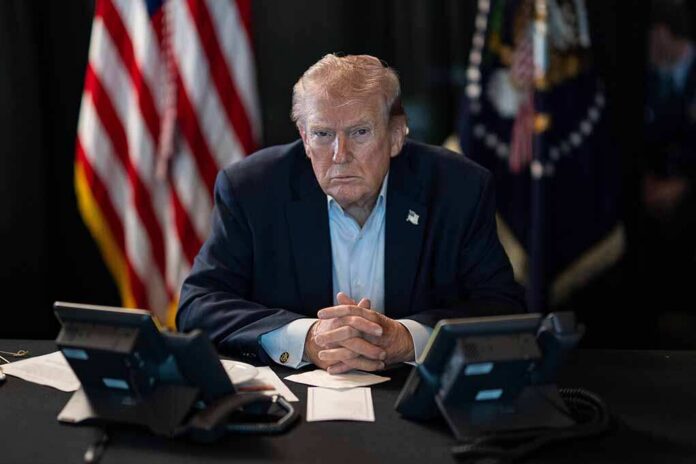
After Democrats swept the midterms, President Trump said he could “work with them” on key money issues while warning he still holds the veto pen.
Story Highlights
- Trump said he is open to working with Democrats after their midterm win.
- He pointed to financial policy and the debt ceiling as possible areas for deals.
- He ruled out cooperation on an open border and men competing in women’s sports.
- He stressed he has veto power and would be “very tough” if talks fail.
Trump Signals Conditional Bipartisan Talks After Midterm Losses
President Trump acknowledged Democrats’ sweeping midterm victory and said he could work with them on select issues. In a phone interview, he said, “We’ll probably work something out,” and added he was “absolutely willing” to accept the results after the “blue wave” became clear. He framed cooperation as practical and limited. He said he would listen if Democrats bring “good ideas” but made clear that certain issues remained off the table for any bargain.
Trump pointed to the economy and government finance as the likeliest space for agreement. He told a business outlet he could work with Democrats on “a lot of financial ideas that would be mutually good,” a signal to markets and voters that basic governing can continue despite partisan fights. He specifically cited the federal debt ceiling as an area where common ground might be possible, a key test that often demands cross-party votes to avoid economic harm.
Boundaries Set: Border Policy And Sports Remain Red Lines
Trump also set clear limits for any dealmaking. He said he would not work with Democrats on what he called an “open border,” and he rejected policies that allow men to compete in women’s sports, drawing a hard line on culture and immigration fights. He paired those limits with a warning. He said he retained “total veto power,” and that he would be “very tough” if Democrats pushed ideas he opposes, underscoring that cooperation would be selective, not sweeping.
Reports said Trump claimed Democrats had already reached out to discuss working together, and that talks could include high-stakes fiscal issues like the debt ceiling. He did not name the Democrats involved, and no joint proposal has been released. That means the public record shows an offer to talk, not a finished deal. The statements came within days of the vote, before either side could test a working relationship in Congress.
What Divided Government Usually Delivers On Big Money Fights
History shows divided government can still pass laws, though major bills are less common than under one-party control. Research finds most laws still win votes from both parties, especially on routine or must-pass items that keep the government and economy running. Debt ceiling deadlines often force talks. Past Congresses have paired debt limit increases with other budget or policy steps, which can create room for a targeted bargain if both sides see benefits.
For many Americans on the right and left, this moment hits core frustrations with Washington. People see leaders talk tough after an election, then trade blame as deadlines loom. Trump’s stated openness hints at movement on the economy, which touches jobs, prices, and retirement savings. His red lines remind voters that culture and border fights will not cool soon. The practical test arrives when the next fiscal cliff nears and both parties must choose between a deal and more brinkmanship.
Sources:
lifesitenews.com, people.com, abc11.com, local12.com, hbs.edu, cambridge.org