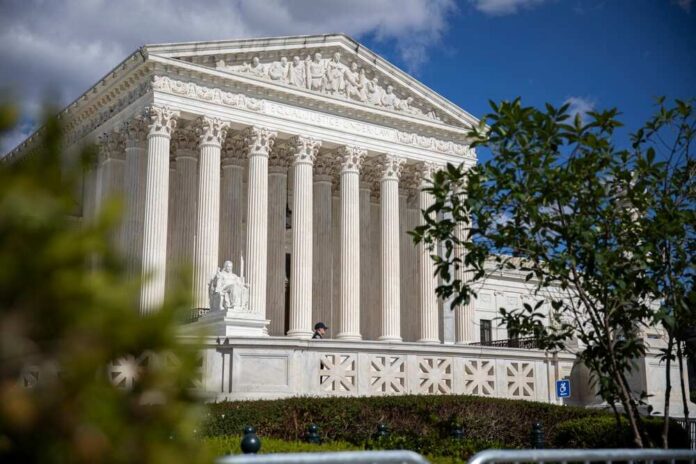
A federal case has already confirmed one attempted murder plot against a sitting Supreme Court justice, but the latest online framing risks blurring that record with unsupported claims about a separate incident.
Quick Take
- The Department of Justice said Nicholas Roske was sentenced for attempting to kill a sitting Supreme Court justice in Maryland after flying in armed with a gun and burglary tools.[1]
- The available research does not provide any police report, charging document, or investigator finding tying the Washington, D.C., gunfire claim to a justice.[1][2][3][5][6]
- The supplied Supreme Court materials mainly cover emergency entry law in an unrelated Montana case, not a targeted attack on a justice’s home.[1][2][5][6]
- The record supports caution: a high-profile headline can outrun the evidence when officials have not yet released basic facts.[1][2][5][6]
Roske Case Shows a Real Threat to Supreme Court Security
The Department of Justice said Nicholas John Roske received 97 months in federal prison after pleading guilty to attempting to kill a Supreme Court justice in Maryland.[1] Prosecutors said Roske flew from California to Washington, took a taxi to Montgomery County, and arrived near the justice’s residence with a firearm, ammunition, zip ties, and burglary tools.[1] Roske also admitted he came with the intent to kill a specific justice.[1]
That case matters because it shows the federal government has already confronted a genuine threat against a sitting justice, not just online speculation.[1] According to the Justice Department, Roske told a communications center he had homicidal and suicidal thoughts, a gun in his suitcase, and a plan to kill a particular justice.[1] Those admissions, along with the recovered weapons and tools, made the factual record unusually strong.[1]
Why the New Headline Does Not Yet Carry the Same Proof
The research package provided here does not include a contemporaneous police report, charging document, witness statement, or official investigative conclusion showing that the Washington, D.C., gunfire was aimed at a justice.[1][2][3][5][6] It also does not identify a suspect, a weapon, a motive, or a line of fire for that separate incident.[1][2][3][5][6] Without those basic facts, a targeted-assassination claim remains inference, not documented proof.
The closest Supreme Court-related material in the record involves Case v. Montana, which addresses emergency home entry by police after a separate shooting incident.[1][2][5][6] That case deals with whether officers could enter a home without a warrant to render aid; it does not say anything about a Washington, D.C., attack on a justice.[1][2][5][6] The overlap is legal, not factual, and the distinction matters.
Why Readers Should Be Careful With Premature Framing
High-profile violence stories often attract instant political spin, especially when the subject is a Supreme Court justice and the public already expects threats against conservative institutions.[1][2][5][6] In this case, the available record is thin on the event that inspired the headline and much stronger on unrelated Supreme Court gun-and-emergency doctrine.[1][2][5][6] That mismatch creates exactly the kind of evidentiary vacuum that can reward rumor over reporting.
Until investigators release scene details, the honest reading is limited: one case proves an actual assassination attempt against a justice, while the newer headline has not been backed by the same level of public evidence.[1] The burden now falls on law enforcement to release the incident report, call logs, and forensic findings if the Washington, D.C., event is to be described accurately.[1][2][3][5][6]
Sources:
[1] Web – Report: Police Rush to Supreme Court Justice’s Home After Gunfire …
[2] Web – CASE v. MONTANA | Supreme Court – Law.Cornell.Edu
[3] Web – Shooting prompts Supreme Court to tighten emergency warrantless …
[5] Web – Justices Reject “Moment of Threat” Rule in Police Shooting Case
[6] Web – Court hears arguments on when police may enter a home without a …