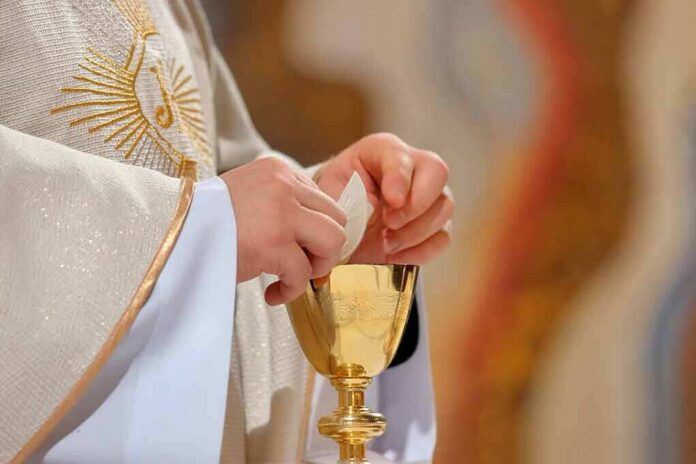
A viral clip from Pope Leo XIV’s Rimini Mass shows a woman distributing Holy Communion, igniting debate over when lay people may serve at the altar.
Story Highlights
- Video from the Rimini Mass shows a woman giving Communion during a papal liturgy.
- Church law says clergy are the ordinary ministers; lay ministers serve only when needed.
- Diocesan norms allow qualified lay women and men to assist at Mass as extraordinary ministers.
- The Vatican schedule confirms the Rimini Mass and large crowd context for the visit.
What The Video Shows And Why It Sparked Questions
Social media users shared footage from Pope Leo XIV’s Mass at the Port of Rimini on August 22, where a woman is seen distributing Holy Communion. The clip spread fast because papal Masses are tightly organized and watched worldwide. Many viewers asked if this was allowed under Church rules. The Vatican’s event listing and schedule confirm the Mass took place that evening as part of the Pope’s pastoral visit to San Marino and Rimini.
Church rules distinguish between ordinary and extraordinary ministers of Communion. The Holy See states that bishops, priests, and deacons are the ordinary ministers. Lay people may serve only as extraordinary ministers in cases of true necessity, according to norms issued by the Roman Curia’s Pontifical Council for the Laity. That means lay distribution is possible, but it is not the default, and it should respond to a concrete need at that Mass.
What Church Norms Permit At Large Liturgies
Large outdoor liturgies often face tight timing and long Communion lines. Many dioceses publish guidelines to meet that need in line with universal law. The Archdiocese of Newark’s norms state that the ministry is open to qualified lay women and men, and that they may distribute the Eucharist at Mass when deputed to assist the clergy. These local rules do not replace Vatican law; they apply it on the ground at big events or crowded parishes.
The Vatican’s own communications emphasized the pastoral nature of the Rimini visit. The schedule lists the Mass with local faithful, following other stops that day. The timing and setting suggest a large crowd, which often requires many Communion stations to serve people in a reasonable time. While the clip proves a lay woman assisted, it does not show how many clergy were present or who deputed her, details that matter for judging necessity.
The Line Between “Ordinary” And “Extraordinary”
The core tension is simple. The Church wants clergy to distribute Communion whenever possible. The same law also allows lay help when priests and deacons are too few, when the priest is impeded, or when the crowd is so large that the rite would be unreasonably delayed without help. The 1997 instruction from the Holy See summarizes this balance and anchors the limit: extraordinary means exceptional and needs-based.
Pope Leo's Mass in Rimini had a woman distributing Holy Communion.
Footage also showed many people receiving the Blessed Sacrament dressed immodestly.https://t.co/iknHURSdSJ pic.twitter.com/00bbk7lQ6s
— Sign of the Cross (@CatholicSOTC) August 26, 2026
Some catechetical resources and diocesan documents underline that women may serve as extraordinary ministers on the same basis as men, when properly deputed. They also note that this can occur during Mass if ordinary ministers are not enough to serve the faithful in a timely way. Those points align with the universal norms. The open question in any given case is factual: did that specific Mass meet the threshold of necessity?
Why This Moment Resonates Beyond Church Walls
Many Americans, left and right, see institutions bending rules for convenience. They worry elites decide first, explain later. This debate taps the same nerve. Viewers saw a short clip and read it as either routine, lawful help at Communion or as casual rule-stretching during a papal Mass. The Vatican schedule and Church law confirm both the event and the legal pathway for lay ministers. What the video cannot answer is whether necessity actually required it that night.
Sources:
lifesitenews.com, vatican.va, vaticannews.va, infovaticana.com, ewtnnews.com