The U.S. Army locked in a sole-bid deal worth up to $4.84 billion to shield helicopters from heat-seeking missiles through 2035.
Story Highlights
- The Army awarded Northrop Grumman a full-rate production contract for a laser-based countermeasure.
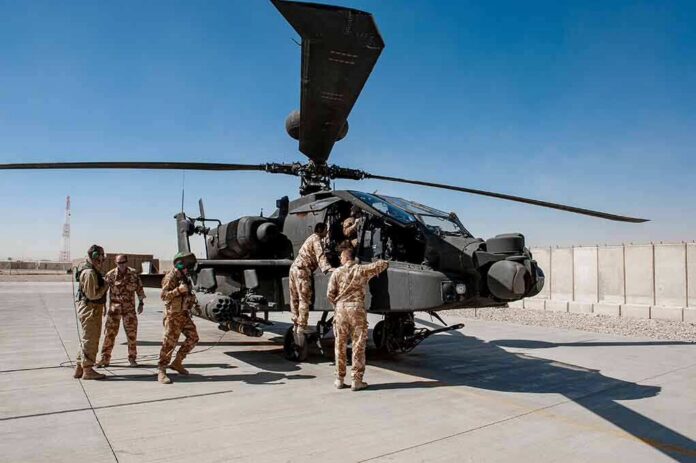
- The system aims to protect Apache, Black Hawk, and Chinook helicopters from infrared-guided missiles.
- The contract is a firm-fixed-price, indefinite-delivery/indefinite-quantity award running to September 2035.
- The Pentagon reported a single bid for the work, raising long-running questions about competition in defense buys.
What The Army Bought And Why It Matters
On September 8, 2026, the Army awarded Northrop Grumman a contract worth up to $4.84 billion to keep producing the Common Infrared Countermeasure, known as CIRCM. The deal moves the program into long-term, full-rate production. The system is designed to protect helicopters from heat-seeking missiles. It cues off missile-warning sensors and uses a pointer-tracker with laser energy to confuse the missile’s seeker, forcing a miss rather than blowing it up.
Reports describe the award as a firm-fixed-price, indefinite-delivery/indefinite-quantity contract managed by Army Contracting Command at Redstone Arsenal, Alabama, with work planned through September 2035. Outlets state the value as a ceiling, not an immediate spend of all funds. The Army first put CIRCM into production years earlier, after a 2021 contract and initial operational fielding. This award extends production so the service can finish equipping a large helicopter fleet.
What CIRCM Does On The Aircraft
CIRCM is a defensive jammer, not a weapon that burns targets. Army helicopters carry missile-warning sensors that look for a launch. When those sensors detect a threat, CIRCM points a laser at the missile’s infrared seeker and disrupts its aim. That breaks the missile’s lock and steers it off course. Reports say the system is already flying on Apache attack helicopters, Black Hawk utility helicopters, and Chinook heavy-lift helicopters, and has built up many flight hours.
Defense trade coverage says the Army reached initial operational capability and began accelerated fielding across more than a thousand aircraft in recent years. That history helps explain the size and length of the new deal. The Army wants a common solution across many helicopter types. A common kit can simplify training, parts, and sustainment. It also helps crews survive against shoulder-fired and vehicle-launched infrared missiles that remain common in modern conflicts.
Competition, Cost, And The Long Game
Several reports say the Pentagon listed the award as a single-bid purchase, with one offer solicited and one received. That is typical once a system reaches full-rate production and one contractor already builds the gear. The Department of Defense’s own guidance explains that sole-source or single-bid awards often occur when only one source can meet the need or when the government buys into an installed base. That structure can speed delivery but narrows price competition.
The U.S. Army awarded Northrop Grumman a contract worth up to $4.84 billion for full-rate production of its CIRCM laser-based helicopter missile defense system.
CIRCM protects aircraft including helicopters from heat-seeking missiles that have downed helicopters in Ukraine. https://t.co/VydHf4KdBx— Space potholes technology (@momofullplate) September 10, 2026
While outlets align on the contract’s ceiling and schedule, they do not specify unit counts or annual funding profiles. That means the ceiling sets an upper bound, not a firm spend plan. Still, the public facts point to a long-term push to harden the fleet against infrared threats through 2035. The bottom line for readers across the spectrum is clear: this is a big, decade-long bet on keeping Army aircrews alive, bought the usual Pentagon way, with the usual trade-offs between speed, scale, and competition.
Sources:
taskandpurpose.com, finance.yahoo.com, defensedaily.com, govconfeed.com, x.com, theaviationist.com