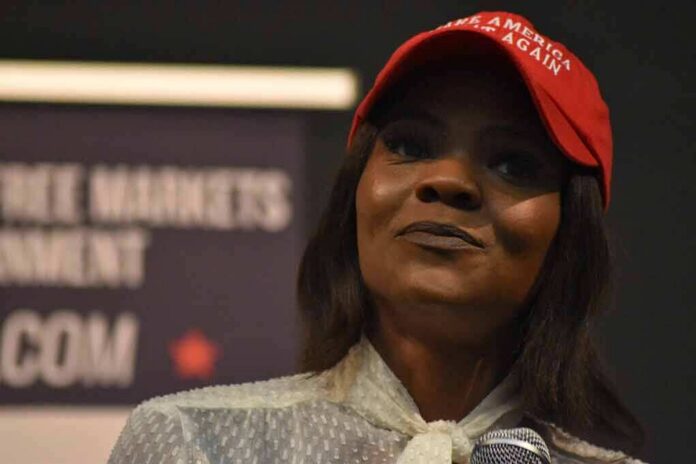
Andrew Wilson pressed Candace Owens to show proof for calling Erika Kirk “complicit,” sharpening a debate that now centers on evidence, not rumor.
Story Snapshot
- Wilson challenged Owens to define “complicit” and present concrete evidence.
- Owens cited perceived inconsistencies and doubts about the official story, not new proof.
- A prior Owens–Erika Kirk meeting cooled tensions but did not end Owens’s doubts.
- Free-speech and defamation standards give wide room for opinion, but facts still matter.
What Sparked The Clash On-Air
Andrew Wilson confronted Candace Owens during a recorded exchange about her claim that Erika Kirk was “complicit” in shaping a misleading narrative after Charlie Kirk’s killing. Wilson asked for specific proof and a clear definition of “complicit.” Owens argued her view came from what she called inconsistent public statements and open questions in the case. The segment shifted the focus from speculation to whether hard evidence supports serious public accusations.
Wilson also argued that Owens’s broader claims about alleged involvement by Erika Kirk, Turning Point USA insiders, or foreign actors lacked substantiation. He framed the charge as harmful and unfair to a widow under intense public pressure. He said Owens had not shown “a single shred of evidence” to back the allegation. That line has appeared in his other public comments and interviews, underscoring his demand for proof over innuendo.
Owens’s Position And The Limits She Faces
Owens told audiences that her view of Erika Kirk evolved after a long, private meeting, and that she still believes the official account leaves gaps. She has continued to question how information was managed after the murder, including what she calls mixed signals from public appearances. Despite the meeting’s “productive” tone, neither side issued evidence that resolves the core dispute. The conflict remains about interpretation, not new verified facts.
During the exchange Wilson repeatedly asked Owens to tie her “complicit” label to specific, checkable facts. Owens answered by referencing patterns she found troubling, not by producing documents, messages, or witness statements that confirm a role by Erika Kirk. The back-and-forth captured a wider problem in modern media: big claims often ride on vibe and inference, while proof lags behind, if it comes at all.
Why This Matters Beyond One Feud
Public fights like this thrive in a system many Americans see as failing them. People on the right and the left worry that powerful insiders shape stories while key facts stay hidden. That frustration is real. But the law draws a line between opinion and false factual claims. United States Supreme Court doctrine requires public figures who sue for defamation to prove falsity and “actual malice,” a high bar that protects heated political speech while still valuing truth.
🔥 CANDACE OWENS vs. ANDREW WILSON — WHO WON THE DEBATE? 🔥
The highly anticipated debate between Candace Owens and Andrew Wilson happened TODAY, with Patrick Bet-David moderating a showdown centered around the assassination of Charlie Kirk and the evidence surrounding Tyler… pic.twitter.com/EsK4Z9EhX2
— Jonathan Brister (@Saints_75) August 14, 2026
For citizens trying to make sense of it, two things can be true at once. Demanding transparency from institutions is healthy. Repeating claims without evidence can harm real people and make the public even more cynical. In this case, Wilson’s demand is simple: show proof or step back from the charge. Owens’s response leans on doubts and perceived inconsistencies. Until verified facts emerge, the fairest reading is that this is an argument over evidence, not a settled account.
Sources:
youtube.com, independent.co.uk, abcnews4.com