Archaeologists found nearly a thousand ancient cannabis seeds and cannabis chemicals in human hair inside a 2,800-year-old Siberian tomb, tying the plant to real people and a specific moment in time.
Story Highlights
- Excavation at the Tunnug 1 burial mound uncovered a large cache of cannabis seeds.
- Six seeds were directly radiocarbon-dated to the early eighth century BCE.
- Human hair from the central chamber showed cannabinol and weak tetrahydrocannabinol signals.
- The site belongs to the early Scythian period in southern Siberia.
What Excavators Found In The Siberian Tomb
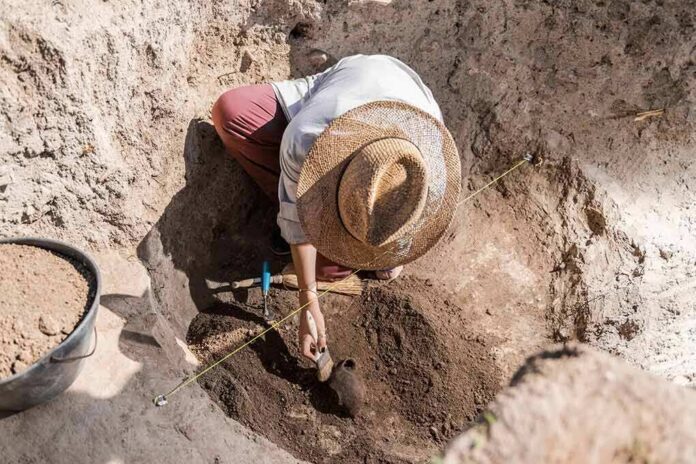
Researchers working at the Tunnug 1 burial mound in southern Siberia reported a striking find: hundreds of cannabis seeds inside the funerary complex, with accounts ranging from almost 1,000 whole seeds to more than 1,400 including fragments. The seeds were recovered in and around burial areas, including near a central chamber. The team also recovered preserved human hair. Together, these remains gave scientists both plant evidence and a biological record from the people tied to the tomb.
Scientists directly tested six cannabis seeds using radiocarbon dating. The results place their deposition around the early eighth century before the common era, roughly 800 to 760 BCE. That timing aligns with the earliest Scythian period known from the region. Directly dating the seeds matters. It reduces guesswork based on style or artifact comparison and links the plant remains to a specific phase of use at the mound.
Hair Chemistry Ties Cannabis To Real People
Laboratory analysis of hair from people in the central chamber detected cannabinol, a compound that forms in part when tetrahydrocannabinol ages and oxidizes. The tests also found weaker signals consistent with tetrahydrocannabinol, the psychoactive part of cannabis. Reports say cannabinol appeared in each tested hair sample, while the tetrahydrocannabinol match was less strong. This pattern supports past exposure to cannabis, rather than seeds only being placed as goods.
Hair offers a different type of proof than seeds. Seeds can be food, medicine, or fibers. Hair can record what went into a person’s body over time. Finding cannabinol and tetrahydrocannabinol-like signals in human hair from the same 2,800-year-old context strengthens the case for use, not just presence. The team and press materials interpret the chemistry as evidence of intoxication-level use, though the tetrahydrocannabinol signal was described as weak.
Culture, Rituals, And What This Evidence Does And Does Not Show
The mound belongs to the early Scythian world, a horse-centered culture known from texts and artifacts across the steppe. Reports link the tomb to early Scythian burial customs in the Uyuk Valley of southern Siberia. The seed cache and hair chemistry both sit within this ritual setting. That mix makes the site stand out. It connects a named culture, a dated burial phase, plant remains, and human biology in one place and time.
Archaeologists have uncovered the earliest direct evidence of cannabis being used for its intoxicating properties in a monumental 2,800-year-old royal tomb located in southern Siberia’s Uyuk Valley.
The Tunnug 1 burial mound, belonging to high-ranking members of the early… pic.twitter.com/O1RGXjOagK
— Trilok Chand (@trilokpchand) November 5, 2026
The evidence does not identify who in the tomb used cannabis, how they took it, or when use happened relative to death. It also does not prove that every Scythian used cannabis. The seed counts vary across outlets, which may reflect different counting methods or excavation stages. Still, the combined data push the record forward: direct dates on cannabis seeds and chemical traces in ancient hair in the same burial complex are rare in archaeology.
Why This Matters Now
This discovery shows how science can cut through myth and hype by tying claims to hard data. Many Americans on the left and right see a system that often ignores facts and history. Here, researchers matched a cultural story with physical proof: dated seeds and chemicals in hair from real people. That careful link is what good evidence looks like. It also reminds us that debates about drugs, health, and ritual go back far in time, beyond modern policy fights.
For readers trying to make sense of today’s drug and health debates, this find adds context. People in the past used powerful plants in social and sacred spaces. Today’s choices about science, safety, and freedom should start with facts, not slogans. This study cannot answer every question yet. But it shows a method that respects truth: measure, date, and test, then connect the dots. In a noisy era, that is a standard worth defending.
Sources:
newscientist.com, livescience.com, eurekalert.org