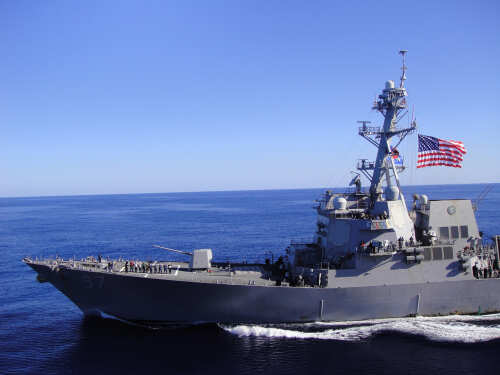
The U.S. Navy has opened fire on and disabled two Iranian-flagged vessels attempting to violate a blockade of the Strait of Hormuz, marking an escalation in the military standoff between Washington and Tehran.
Quick Take
- US forces disabled Iranian tanker M/T Hasna using F/A-18 cannon fire on May 6, targeting the vessel’s rudder after repeated warnings went unheeded.
- USS Spruance seized cargo ship MV Touska on April 19 after firing into its engine room; US Marines now hold custody of the vessel.
- Both incidents occurred under “Project Freedom,” a Trump administration operation to enforce a blockade preventing Iran-bound shipping through a critical global oil chokepoint.
- The Strait of Hormuz handles approximately 21 million barrels of oil daily; disruptions threaten global energy markets and international commerce.
Precision Enforcement in the Strait of Hormuz
On May 6, 2026, a U.S. Navy F/A-18 Super Hornet from USS Abraham Lincoln fired 20mm cannon rounds at the Iranian-flagged tanker M/T Hasna in the Gulf of Oman. The aircraft targeted the vessel’s rudder after the ship ignored multiple warnings to cease its approach toward an Iranian port. The strike disabled the tanker’s steering capability, forcing it to drift. CENTCOM confirmed the incident, emphasizing that warnings preceded the military action and that precision targeting minimized potential casualties while demonstrating resolve.
The Hasna incident represents the second major enforcement action under the blockade. On April 19, USS Spruance intercepted the cargo ship MV Touska, which was headed toward sanctioned Iranian ports at Bandar Abbas and Qeshm Island. After the vessel ignored directives, the destroyer fired into the ship’s engine room, disabling propulsion. U.S. Marines from the 31st Marine Expeditionary Unit subsequently boarded and seized the vessel, placing it under American military custody for inspection and sanctions enforcement.
Context: The Blockade and “Project Freedom”
President Trump announced the Strait of Hormuz blockade on April 12, 2026, directing the U.S. Navy to intercept vessels attempting to enter or exit Iranian ports in violation of American sanctions. The blockade followed Iranian actions that effectively closed the strait to most commercial traffic, with Tehran citing a U.S. “breach of trust” as justification. The Strait of Hormuz, through which roughly 21 million barrels of oil transit daily, represents a critical chokepoint for global energy supplies and international commerce. Disruptions threaten economic stability worldwide.
“Project Freedom,” the broader operation encompassing these actions, aims to defend commercial shipping lanes and enforce sanctions compliance. Between April 17 and early May, Iranian Revolutionary Guard Corps (IRGC) forces launched attacks on U.S.-escorted vessels, prompting retaliatory strikes by American forces. The U.S. military has destroyed Iranian fast-attack boats and anti-ship missiles during these exchanges, according to CENTCOM statements. The operation represents a significant escalation from previous naval tensions in the region.
Economic and Strategic Implications
The blockade and vessel seizures carry substantial economic consequences. Approximately $100 billion in annual trade flows through the Strait of Hormuz. Disruptions elevate insurance costs for commercial shipping, delay cargo deliveries, and create uncertainty in global oil markets. Energy prices have already risen in response to the escalating tensions, with projections suggesting further volatility if hostilities intensify. Shipping firms operating in the region face mounting operational costs and reduced predictability in transit schedules.
For Iran, the blockade restricts access to vital oil export revenues and prevents the delivery of sanctioned cargo. The seizure of MV Touska enables U.S. authorities to inspect the vessel’s cargo and operations, yielding intelligence on Iranian sanctions evasion networks. The disabling of M/T Hasna similarly disrupts Iranian shipping capabilities and signals that the Trump administration intends to enforce its stated policy through military action. These actions reinforce existing sanctions regimes and demonstrate American willingness to use force to maintain maritime control.
Precision Over Escalation: The Military Calculus
Both incidents employed precision targeting to disable vessels without inflicting mass casualties. The F/A-18 strike on the Hasna’s rudder and the destroyer gunfire on the Touska’s engine room represent calibrated applications of force designed to achieve policy objectives—stopping sanctions violations—while minimizing unnecessary harm. CENTCOM emphasized that repeated warnings preceded each action, establishing a clear record of compliance demands before military intervention. This approach distinguishes these incidents from uncontrolled escalation, though the risk of miscalculation or Iranian retaliation remains elevated.
The use of military assets to enforce blockades reflects a broader assertion of American naval power in contested waters. The operations involve carrier strike groups, destroyer escorts, fighter aircraft, and Marine boarding teams—a comprehensive display of capability. However, the IRGC possesses asymmetric weapons including fast-attack boats, anti-ship missiles, and unmanned systems. The potential for unintended escalation persists, particularly if either side miscalculates opponent intentions or if civilian vessels become caught in crossfire.
US says opened fire to disable two Iran-flagged ships violating port blockadehttps://t.co/BnHlGGpjYa
— Insider Paper (@TheInsiderPaper) May 8, 2026
Broader Context: Ceasefire Fragility and Regional Tensions
These incidents occur against a backdrop of broader U.S.-Iran tensions dating to the 1979 Iranian Revolution and decades of friction over the Strait of Hormuz. Previous “tanker wars” in the 1980s and 2019-2020 saw similar patterns of escalation and de-escalation. The current blockade follows alleged Iranian ceasefire violations in an earlier regional conflict, suggesting that underlying hostilities remain unresolved. Iran’s state media has characterized U.S. actions as unprovoked aggression, while American officials frame them as necessary enforcement of lawful sanctions.
The Trump administration’s willingness to use military force reflects confidence in American naval superiority and a determination to maintain sanctions pressure on Iran. However, the blockade also risks drawing in other actors. China and Russia, both backing Iran economically and diplomatically, may increase support for Tehran or attempt to mediate. Commercial shipping firms from neutral nations face pressure to choose sides or risk delays and losses. The situation underscores a fundamental challenge: enforcing policy through military means in contested waters invites reciprocal escalation and miscalculation.
Sources:
US forces fire at, disable Iran-flagged tanker trying to evade blockade
Trump announced US Navy fired on and seized ship with Iran flag in blockade standoff