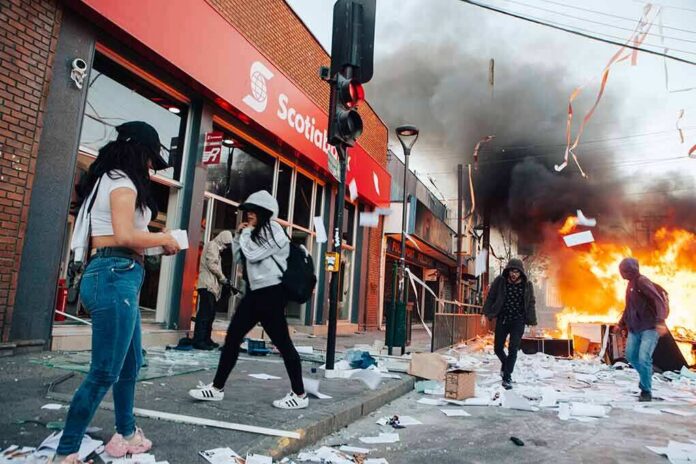
Paris saw cars burning, shops ransacked, and police firing tear gas as cost-of-living protests turned violent.
Story Snapshot
- Cars burned and shops were looted amid clashes in Paris, with police using tear gas and water cannons.
- France’s Interior Ministry reported hundreds of arrests during nationwide unrest tied to prices and public services.
- Livestreams and on-the-ground video showed fires, projectiles, and fast police dispersals in central Paris.
- The scenes echo past French protest flashpoints, raising questions about order, rights, and trust in institutions.
What Happened on the Streets of Paris
Reporters in Paris described violent clashes as demonstrators broke off from larger marches and fought police. Cars burned on several blocks. Masked groups smashed windows and looted shops. Police fired tear gas and used water cannons to push crowds back from key squares and boulevards. Associated Press reporting said officers faced fireworks and paving stones near Place de la République as they tried to clear streets of barricades and debris. BBC live coverage captured looting claims and fast-moving dispersals.
France’s Interior Ministry said police faced “targeted acts of violence” and confirmed arrests across major cities. Reuters reported some of the worst unrest in years as crowds rallied over high prices and declining public services. Officials tallied hundreds of arrests nationwide during the day, while calling in reinforcements to hotspots in Paris and Marseille. Authorities said officers removed ad hoc barricades, extinguished street fires, and guarded public buildings against break-ins as the night wore on.
Why the Protests Boiled Over
Marchers rallied against soaring living costs, strained public services, and social inequality. Many families say rent, food, and energy bills keep rising faster than wages. Small business owners complain about taxes and rules that cut margins. Students joined, citing crowded classrooms and poor resources. These economic grievances drew broad crowds, but a smaller set turned to street fighting and vandalism. EFE and Deutsche Welle both described fires, scuffles, and smashed storefronts alongside peaceful marches in other areas.
On-the-ground video and livestreams shaped public views in real time. Viewers saw projectiles launched at police and police pushing lines with tear gas. That instant feed gave people a raw lens into the chaos but not always the full context of how each clash began. BBC’s live page described arrests and alleged looting while official updates rolled in. The spread of clips can amplify the worst minutes of a long march, making the most violent images define the night for many viewers.
The Security Response and the Trust Gap
French riot police moved to restore order using crowd-control tactics common in recent years. Teams advanced, fired gas canisters, and used water cannons on dense groups at choke points. Officials framed the actions as necessary to protect life and property. Critics point to France’s hard edge on protest control and past injuries tied to heavy police tactics. Foreign Policy has documented watchdog concerns about excessive force during earlier French protest waves, fueling a lasting trust gap.
The cycle is now familiar: a large protest with mixed motives, a small violent core, swift police action, and a country arguing over where the line should be. Many citizens on the left and right see the same pattern at home and abroad: rising prices, fraying services, and leaders who seem distant from daily life. When anger spills into the streets, ordinary people pay twice—first in higher costs and second when neighborhoods and shops are damaged during the unrest.
What Matters Next for France—and Beyond
City leaders must stabilize streets, help shop owners recover losses, and keep commuters safe. National leaders face a harder task. They need to show a clear plan on inflation, energy, and services that families can feel quickly. Communication also matters. Clear facts on arrests, injuries, and damages can calm rumors. Fair reviews of police actions can build trust. If those steps lag, more people will decide the system serves insiders first and leaves everyone else to clean up the mess.
Sources:
youtube.com, rmb.reuters.com, efe.com, bbc.co.uk, kuwaittimes.com