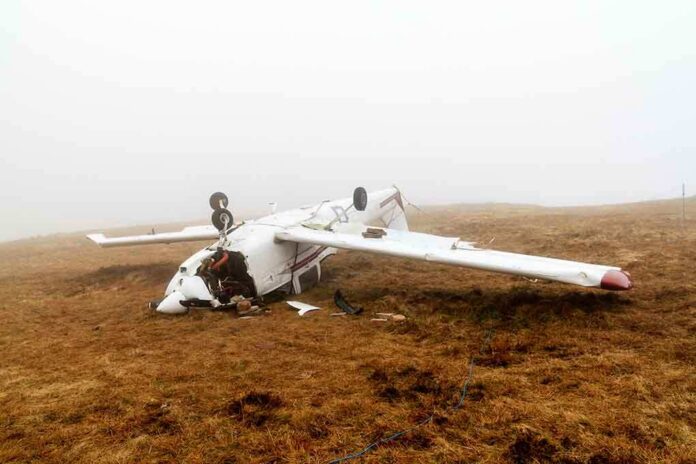
A North Carolina pilot, his wife, and their two dogs walked away after a night engine failure ended in a treetop landing that stopped the plane inches from the ground.
Story Snapshot
- A husband, wife, and two dogs survived a nighttime forced landing in trees.
- The pilot reported a sudden loss of engine power around 6,000 feet.
- Federal officials said the aircraft had mechanical trouble before striking trees.
- The couple reported only minor injuries; the dogs were unharmed.
What Happened During The Night Flight
On October 7 in Columbus County, North Carolina, a single-engine Piper PA-32 lost engine power during a night flight, according to the pilot, Dustin Davis. He and his wife, Autumn, were flying with their two dogs when the engine “wasn’t producing power.” The couple said they ran troubleshooting steps and spoke with air traffic control while descending in the dark. Local outlets reported the pair later exited the aircraft with minor injuries, and both dogs survived.
The Federal Aviation Administration said the aircraft experienced mechanical trouble before it hit trees. The plane struck trees and came to rest above the ground, consistent with a treetop or tree-supported landing rather than a direct ground impact. Photos described by reporters showed the aircraft’s nose close to the ground, with the fuselage supported by trees. The couple credited a last-second pull-up for reducing the impact, a move Davis said he made after spotting the tree line.
How A Treetop Landing Can Save Lives
General aviation safety material explains that survival in a forced landing often depends on staying in control, slowing down, and letting the airframe soak up energy. Pilot guides stress aiming for a controlled touchdown and using terrain to reduce force on the people inside. Federal Aviation Administration handbooks also warn that many fatal crashes after power loss come from losing control, not only from the engine problem itself. Davis’s description matches these core ideas about energy management.
Tree landings are not gentle, but they can be survivable when the pilot controls speed and angle. Past analyses and training sources describe trees as a last-ditch “crash absorber” that can spread the hit over time and distance, which lowers the forces on passengers. In this case, reports said flexible trees slowed the aircraft and left it resting several feet off the ground. That outcome aligned with the couple’s minor injuries and their dogs’ survival.
Inside The Cockpit: Seconds That Mattered
Davis told reporters he saw the tree line and pulled up at the last moment to protect the cabin. He and Autumn had already worked through checklists and called for help after power fell off at altitude, reported in various accounts at about 6,000 to 6,500 feet. That sequence—troubleshoot, aviate, navigate, communicate—tracks common emergency training steps that pilots practice to preserve control and buy time to pick a landing spot.
Local coverage reported the aircraft’s belly took much of the hit as it slid into the trees. One outlet said a smaller, more flexible tree helped slow and support the plane, leaving it roughly six feet above the ground. Another described a larger tree that stopped the forward motion near ground level. Such small differences are common in early reporting, but both versions point to the same key factor: the trees spread the impact and kept the cabin intact.
What Officials Still Need To Determine
Officials from the Federal Aviation Administration and the National Transportation Safety Board are investigating the cause of the engine power loss. Reports so far do not identify a failed part, a fuel problem, or a maintenance issue. That is routine in the days after a crash, when teams collect parts, review logs, and examine the engine. A later preliminary report usually lists early findings, with a final report to follow months after the lab work and analysis.
Training and safety records show why these questions matter. Federal guidance warns that engine issues often become deadly when pilots lose control at low altitude, especially at night. Aviation groups teach that pilots who keep flying the airplane—managing speed, pitch, and touchdown area—can turn a worst-case event into a survivable landing. The Columbus County case fits that pattern. A sudden power loss forced a hard choice, and control plus a treetop “cushion” likely made the difference between life and death.
Sources:
nypost.com, wsoctv.com, wwaytv3.com, aopa.org