A Russian ballistic-missile submarine fired a nuclear-capable Bulava missile across Russia from beneath the Sea of Okhotsk during combat training, signaling steady readiness in Moscow’s sea-based nuclear force.
Story Snapshot
- Russia says the Generalissimus Suvorov launched a Bulava missile while submerged in the Sea of Okhotsk.
- The missile flew toward the Chizha test range in Arkhangelsk Region, a known impact area near Cape Kanin.
- The Defense Ministry released launch footage alongside its announcement.
- Media reports differ on the exact range, reflecting inconsistent distance figures across outlets.
Submerged Launch From Pacific Waters To Arctic Test Range
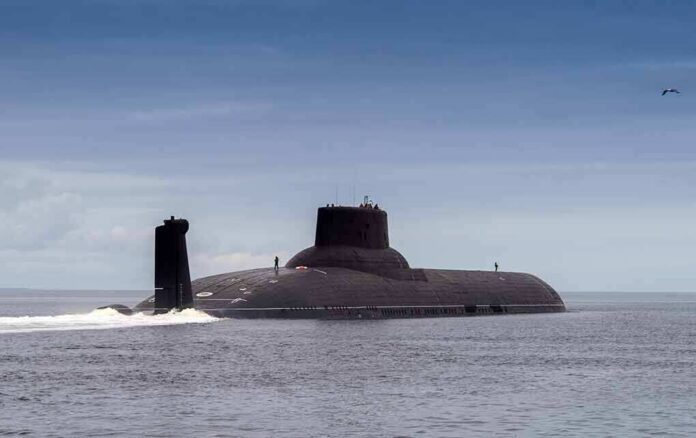
Russia’s Defense Ministry said the Project 955A Borei-A submarine Generalissimus Suvorov launched a Bulava submarine-launched ballistic missile from a submerged position in the Sea of Okhotsk during planned combat training. The report placed the target area at the Chizha test range in Arkhangelsk Region, a long-standing impact site for strategic missile tests. The submarine is part of Russia’s Pacific Fleet, which often trains in Far East waters before long-range shots toward northern ranges inside Russia.
The Ministry’s announcement came with video of the launch, which outlets described as showing the missile breaking the surface and climbing into flight. While the clip confirms a launch event tied to a submarine operation, public sources did not include flight telemetry or impact coordinates. The Ministry framed the event as planned training with expected results, consistent with past practice when Russia pairs technical checks with signals of strategic readiness.
Destination And Geography: Chizha’s Role In Missile Testing
Reports identified the Chizha test range in Arkhangelsk Region as the target area, a site near Cape Kanin on the Kanin Peninsula that hosts instrumented zones for reentry testing. Chizha’s remote location supports safe impact monitoring and debris recovery. Launches from the Sea of Okhotsk to Chizha require a long, internal Russia flight path. That path allows Russia to prove procedures and maintain crews without crossing foreign territory or airspace.
Outlets emphasized the submarine’s class and mission profile. Project 955A Borei-A boats carry multiple Bulava missiles, forming a core of Russia’s sea-based nuclear deterrent. Exercises like this check several systems at once: the submarine’s launch hardware, crew readiness, and the missile’s flight sequence. Such events also serve as public reminders of second-strike capability, which is central to nuclear deterrence theory.
Conflicting Range Figures And What They Mean
Media accounts described different range numbers for the flight, from about 4,000 kilometers to 5,160 miles, and even 5,500–6,000 kilometers, creating confusion for readers. The spread may reflect whether sources cited the missile’s potential maximum range, the great-circle distance for this specific route, or rough conversions between miles and kilometers. The key point is that the route spans the breadth of Russia, which fits an intercontinental profile even if reports list different figures.
🚨🇷🇺 Russia fired a nuclear-capable Bulava Intercontinental Ballistic Missile (ICBM) from a submerged Borei-A sub in the Sea of Okhotsk, sending it thousands of km across the country to the Arctic.
📷Tass Press service pic.twitter.com/svwAPRqDJj
— C14 News | EN (@c14english) October 29, 2026
The Russian Ministry of Defense acted as the primary source for the event, and many outlets repeated the Ministry’s account. This pattern is common with strategic launches, where official statements and curated footage often lead coverage. Independent tracking or foreign government assessments were not highlighted in the cited reports, but the shared details about platform, launch area, and target site were consistent across multiple publications.
Why This Matters For Americans Watching A Fractured World
This test shows why many Americans see a world growing less stable and more dangerous. A hidden submarine, a long-range nuclear-capable missile, and a cross-country shot inside Russia all point to hard power and constant readiness. Voters on the right worry about America’s defenses and energy costs. Voters on the left worry about global tension and social strain at home. Both sides see elites and bureaucracies that talk big but fail to deliver real security or prosperity.
Events like this heighten pressure on Washington to focus on basics: deterrence that works, borders that function, energy that is affordable, and spending that matches results. Russia’s test does not mean war is near. It does mean that major powers are drilling for serious scenarios. When trust in government is low, even routine tests feel like fresh warnings. Clear policy, honest priorities, and competent execution can move fear to resolve—something the public wants but rarely sees.
Bulava’s Track Record And Today’s Signal
The Bulava program faced setbacks during its early years, including multiple failed tests reported through 2009. Analysts tied many problems to component quality and production issues, which raised doubts at the time about reliability under stress. The record improved in later years, and the system entered fleet service, but observers still treat each new exercise as part of proving a complex chain. That context frames this launch as one more data point, not a decisive leap.
Russia’s pairing of a Pacific Fleet submarine and an Arctic impact range underscores a core message: the sea-based leg of its nuclear forces can operate far from homeport and still reach assigned targets. That is standard for nuclear deterrence, but it remains sobering. For Americans of all views, the lesson is simple. Great-power rivalry is back in daily life. The question is whether our leaders match that reality with steady, practical action at home and abroad.
Sources:
19fortyfive.com, aerotime.aero, indiastrategic.in, militarnyi.com, aol.co.uk, zona-militar.com, spectrum.ieee.org