
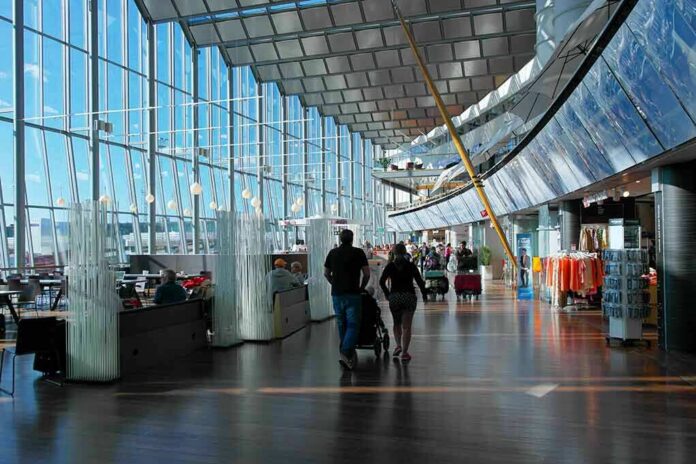
Holiday travelers arriving for Thanksgiving in Salt Lake City walked into “Abolish ICE” chants as activists targeted government detainee flights operating through the airport’s baggage claim area.
Story Highlights
- Advocates protested Immigration and Customs Enforcement detainee flights in a designated free-speech zone at Salt Lake City’s airport.
- The action followed a high-profile Seattle jet bridge arrest that delayed a flight and drew airline and port criticism.
- Port of Seattle officials labeled airport immigration enforcement “disruptive” and called for it to stop at airports.
- The events revive a wider fight over speech limits in airports and how enforcement tactics affect travelers and crews.
What Happened in Salt Lake City’s Baggage Claim
Organizers gathered inside Salt Lake City International Airport on November 25 as part of a national week of action opposing Immigration and Customs Enforcement flights that move detainees through commercial hubs. Reporters on scene said the group sang and held signs near baggage claim, drawing looks and some reactions from passengers. Airport officials placed the protest in a designated free-speech area, which kept the event within set rules for speech in the terminal.
Advocates said their target was not travelers but a system that transports detainees, often far from families and lawyers. They argued that the visibility of a holiday crowd made the message harder to ignore. The protest did not report arrests or major disruptions at the Salt Lake City site. The scene was notable because it brought a heated national debate directly into a high-traffic space as families arrived for Thanksgiving.
Seattle Arrests Spark Wider Backlash
Days before the Salt Lake City event, U.S. Immigration and Customs Enforcement officers detained a father and daughter on a crowded jet bridge in Seattle as passengers boarded an Alaska Airlines flight. The takedown delayed the Los Angeles-bound flight and left passengers and crew shaken, according to the airline. Witness video and airline statements helped fuel public anger and union concern about safety and workplace stress inside the narrow boarding area.
Port of Seattle leaders condemned immigration arrests at airport gates, calling the practice “new” and “disruptive” and urging that it stop in airport settings. Officials said the jet bridge operation distracted from core security duties and placed added strain on workers. Alaska Airlines said it was engaging with government and port authorities to reduce the impact of law enforcement activity on guests, employees, and operations going forward.
Why Airports Keep Becoming the Battleground
Airports mix strict security rules with huge public visibility. Courts treat most terminals as nonpublic forums, which allows government to set reasonable, content-neutral limits on speech. That means airport managers can channel protests to time, place, and manner zones, like the baggage-claim free-speech area used in Salt Lake City. Supporters say these rules keep people moving. Critics say tightly bounded zones blunt dissent where it is most visible.
Protesters select airports because they sit close to the actions they oppose, such as detainee transfers and last-minute arrests before flights. Industry groups warn that protests, if they spill into restricted or operational zones, can threaten safety and on-time performance. The line that matters most is conduct and impact: speech in permitted areas versus actions that block gates, delay crews, or disrupt boarding and security processes.
The Bigger Trust Problem Cutting Across Politics
Americans across the spectrum see airports as another place where powerful systems run with little transparency. Immigration and Customs Enforcement uses complex transport and data pipelines that are hard for the public to track. Critics argue that limited data on detention and transfers makes oversight weak. Defenders argue that enforcement at travel hubs is legal and sometimes necessary to locate and detain people with removal orders.
👀 WATCH:
Anti-ICE protesters STAGE singing demonstration inside Salt Lake City airportFootage shared by Turning Point USA's Frontlines shows demonstrators singing, "Don't stop fighting, till ICE is gone," inside Salt Lake City International Airport to protest deportation… https://t.co/NP5nv7dtQA
— Bobby (@bobbymorris280) November 24, 2026
Salt Lake City shows the tension most people feel: keep travel smooth and safe, but also protect the right to speak out on government power. The Seattle jet bridge arrest shows the cost when enforcement and travel collide in tight spaces. Clear rules, narrow enforcement near passengers, and honest public reporting could reduce conflict. Until then, holiday crowds will keep seeing national fights over immigration play out where families pick up their bags.
Sources:
thegatewaypundit.com, ksl.com, apnews.com, us.headtopics.com, seattletimes.com, kuow.org, abc6onyourside.com